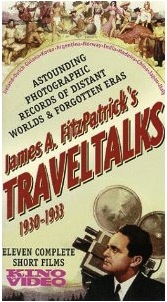
James A. FitzPatrick’s India

By Namit Arora

Traveltalks James A. FitzPatrick (1894-1980), American movie-maker, is best known for his 200+ short documentary films from around the world. They appeared in two series, Traveltalks and The Voice of the Globe, which he wrote, produced, and directed from 1929-55. Commissioned by MGM, the shorts played before its feature films and were no doubt a mind-expanding experience for many. Some of them are now online at the Travel Film Archive. Nearly eighty years later, what should we make of FitzPatrick and his travel films?

FitzPatrick's shorts on India—including Jaipur, Benares, Bombay, The Temple of Love (Delhi & Agra, no audio), and others not yet online—are a rare and unique window into Indian public life in the 1930s. We can see what many of these cities' prominent streets and traffic looked like before motor vehicles and billboards, what familiar urbanscapes and skylines looked like, and how uncrowded these cities were before the big rural migrations, not to mention 70% fewer Indians. It is interesting to hear an American public figure from the 1930s pronounce on the castes of India, the religiosity of the Indians, and how they shared their public spaces with animals. They have the charm of quaint narrative conventions we find in period pieces. His films are valuable records of history also because they are a unique encounter of two very different cultures—illuminating the world behind the lens through the one in front.

But having said that, I also think their present value owes more to the paucity of video records of everyday life from that era, than to the quality of FitzPatrick's mind. FitzPatrick seems to me very much a man of his time. In his directorial choices and opinions, he may well qualify as a textbook orientalist. This is not to say that his films are devoid of truth, empathy or humor. It is to say that he brought along with him a marked sense of cultural and racial superiority, as he trained his viewfinder on what he found amusing, outlandish or admirable.

§
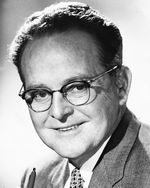
James_fitzpatrick FitzPatrick saw Bombay as “the first constructive imprint of western civilization upon this much talked of and generally misunderstood country.” He was impressed by the cosmopolitan life and energy of Bombay, whose population was “over one million people, representing practically every race and creed in the world.” But even in Bombay, he notes, “the 15th century is constantly rubbing shoulders with the 20th” and “the ancient procession goes on in strange defiance.” In his day, Jaipur was apparently “off the beaten track of tourist travel” despite being “unquestionably the most colorful of all the cities in India [and] one of the cleanest and most prosperous.” He doubts if there is another “place in the world where birds and beasts live in closer proximity with mankind.” The people of Jaipur, he finds, have “a contented and peaceful nature, living in a sort of bovine resignation to life”. While in Benares, “the Hindu Heaven”, he suspects that “in the whole world there is no stranger manifestation of human faith in the supernatural than what is witnessed here on the banks of the sacred Ganges.” It confounds him that millions of “dumb animals”, “made and kept worthless by the Hindu religious code, roam the land devouring annually millions of dollars worth of food for which they produce nothing.”

Read more »

Yet Another Monday Poem

Learning by Heart

He recited a short poem to me
Which he had learned by heart
Not to impress or intimidate
Me, or anyone else,

But just in case one year
Spring might be late in coming
And he need cheer his friends
Saddened by the dearth of birdsong.

Or perhaps for that moment in love
When he would be struck speechless,
When he knew that he would need
To borrow another man’s tongue.

Or maybe just so that if he wanted
He could tie a brightly colored cravat
On the neck of an autumn crepuscule
Too-soberly dressed in a charcoal suit.

For Robin Varghese, April 8, 2010—S. Abbas Raza

Monday Poem

Bread on the Water – mp3

Bread Upon the Water

Oh, the young don't keep
and the old just go
and the keeper of the sheep
casts a long, long shadow
but your song won't come
where your life won't go

so throw your bread on the water
and beat your feet to the chimes
and if you have a daughter
and you count your change to the dime
and if you open up the borders
it'll all fall in behind

Well, every book just speaks
and every light just shines
and every touch just feels
and every look just finds
and everywhere just is
and every road's a line

so throw your bread on the water
and beat your feet to the chimes
and if you have a daughter
and you count your change to the dime
and if you open up the borders
it'll all fall in behind

When every deed is done
and the morale is so low
and the dream is over
just like it didn't grow
well, the soil is still good
and with what we know

throw your bread on the water
and beat your feet to the chimes
and if you have a daughter
and you count your change to the dime
and if you open up the borders
it'll all fall in behind

song by Jim Culleny, 1970
© 1972, Jim Culleny and Starship Productions

Attached mp3 recorded 1972,
Intermedia Studios, Newberry St., Boston, MA

To Spend or Not To Spend: The Austerity vs. Stimulus Debate

Greek unions protest

Public sector austerity has come back to the West in a big way. Governments throughout the European Union are wrestling against striking civil servants, a stagnant private sector, and an entrenched public welfare system to drastically reduce spending. The budget cuts are broad, and they run deep. Under pressure from global financial markets and the European Central Bank to reduce public deficits, Spain, Italy, Portugal, and Greece have issued “austere” budgets for the coming year that simultaneously raise taxes and slash government spending. David Cameron’s new Conservative government has violated its campaign pledge to spare Britain’s generous middle class subsidies in an attempt to close a budget gap that is among the world’s largest, at 11 percent of GDP. Supposedly confirming the wisdom of austerity, the financial press has trumpeted the re-election of Latvia’s center-right government, which passed an IMF-endorsed budget with austerity reductions equal to 6.2 percent of GDP. Prime Minister Valdis Dombrovskis won his “increased mandate” – “an inspiration for his colleagues in the EU” – against a backdrop of 20 percent unemployment and a cumulative economic contraction of 25 percent in 2008 and 2009, the most severe collapse in the world.

Latvian electoral politics notwithstanding, austerity has been a tough sell worldwide. Both the protests that broke out across Europe at the end of September and the general strikes mounted against Socialist governments in Portugal, Spain, and Greece attest to the resistance all governments face in cutting public spending. And opposition has not been confined to the streets. At a G20 summit in Washington DC on April 23, the finance ministers and central bank governors of the world’s 20 largest economies agreed that extraordinary levels of public spending should be maintained until “the recovery is firmly driven by the private sector and becomes more entrenched.” Indeed, Larry Summers, the departing Director of the White House National Economic Council, still argues that the United States must continue its policy of economic stimulus in the form of deficit spending on infrastructure rather than pull back public resources, lest it cede the small gains of the nascent recovery.

Read more »

0

To be able

Just to be

Present

With

Without

Want

Of

Possession.

Is it possible?

This nothing?

Is that the space

Of not

That space?

That refuge?

Is it possible?

This nothing?

Where nothing, is.

After journeys of

Need,

Want,

Loss.

This addition

Of shedding is

Nothing.

The place arrived.

Ethiopia1 041

Build me a space where the walls hold up the sky.

Where the ceiling allows in

The moon and his daughters:

The star at dusk and dawn’s star.

Where there is room for thought to settle in and scatter on

The citrus and jasmine scented breeze

From the courtyard.

There, in the shade of the trees, a water pool

Harvests the rain, and reflects the promise of fruits in blossom above

And sounds of sparrows mingle

With the rustling of the leaves.

By Maniza Naqvi

The Owls | The Sorrow Gondola by Tomas Transtromer

A Page from the Nightbook

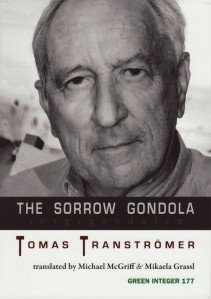
Sorrow-gondola-cover By Tomas Tranströmer

One night in May I stepped ashore
through a cool moonlight
where the grass and flowers were gray
but smelled green.

I drifted the slope
in the colorblind night
while white stones
signaled to the moon.

In a period
a few minutes long
and fifty-eight years wide.

And behind me
beyond the lead-shimmering water
lay the other shore
and those who ruled.

People with a future
instead of faces.

*

Translator's Note:

In the days leading up to the announcement of this year’s Nobel Prize in Literature, the literary world was abuzz after British odds-makers, Ladbrokes, published their Nobel predictions in The Guardian (UK). They originally placed the Swedish poet Tomas Tranströmer in pole position. For devotees of Tranströmer’s poetry (and there are many, as he’s the 20th century’s most translated poet behind Pablo Neruda), this was far from surprising news. I first encountered Tranströmer's work through Samuel Charters’ translation of the book-length poem Baltics (Oyez, 1975). For me, Tomas Tranströmer’s poetry is uncontainable, organic, apparitional, and wrought with simultaneities. His work is stripped down to an acute, essential lyricism that he finds in the natural world and the wilderness of the imagination. He has always been outside of academic circles and has never belonged to an aesthetic movement. His background is in psychology, the piano, and entomology. He writes with spiritual overtones yet avoids the trappings of religious poetry. He alludes to political peril and the great human failings of our recent history yet he does so without pandering to didacticism. His allegiances are to liminal spaces, hinterlands, intersections, border crossings, and the images that take us there.

–Michael McGriff

*

“A Page from The Nightbook,” by Tomas Tranströmer, translated by Michael McGriff and Mikaela Grassl, from The Sorrow Gondola, Green Integer Books, 2010. Click here for Green Integer's ordering information on this title. The Owls site is for digital writing and art projects. New projects on the site include Micrograffiti, edited by Stacey Swann, and Pima Road Notebook, by Keith Ekiss. Cross-posts appear here thanks to 3DQ. Updates from The Owls are available via email subscription on the main page. To add The Owls to your Facebook news stream, Like the site here.

Monday, October 25, 2010

Love a Man in Uniform? Think Twice in Congo

In today’s world, rarely do raping and pillaging so routinely coincide as in Eastern Congo's conflict. Increased scrutiny from the US Congress and concerned activist networks are highlighting the systematic rape and abuse of Congolese women and girls by marauding security forces, particularly Congo’s National Army. Equally appalling is Congo’s 'conflict minerals' problem—mineral ores extracted from mines controlled by various military factions, fueling the lucrative anarchy that is crippling the East and supporting the communications technology central to our way of life. Greater scrutiny should bring practical solutions, but our policy makers are missing the elephant in the room.

So is it greed, governance or grievance driving this crisis? Eastern Congo is a vast ungoverned space; some of its many armed groups are foreign, others domestic. Yet none treat the civilian population as brutally as President Kabila’s own National Army. A recent Human Rights Watch survey indicates that Congolese soldiers are the primary rapists in the East.

Since President Kabila took office in 2006, all three national security services—police, army, and intelligence—have operated as a winner-take-all bonanza where pedestrian pocket change, rare timber, protected fauna, and high-value minerals are equally expropriated by the services. As under Mobutu, a deliberate lack of oversight and no threat of sanction encourage economic opportunism among security officers, made easier with guns and uniforms with which to intimidate and extort. Would be public service providers but instead instruments of a nimble kleptocracy, state security services have become ‘Public Enemy Number One’, say Congolese here, raping and stealing instead of protecting and serving.

Commissariats pilotes Bas Congo 058 Police are generally circumscribed to towns; soldiers roam the country’s wild spaces, hence their freedom to occupy remote mining areas in the mineral-rich eastern provinces. Together they comprise a legion of footmen driving an extensive parallel economy whose profits rival those skimmed from government coffers by politicians in the capital. Low-level shakedowns of average citizens, taxi drivers and small-time traders generate large sums to be paid back up the chain and pocketed by the top brass. Urban traffic cops, for instance, must meet a daily quota of 50$ to 100$ a day. Failure means they lose their uniform and weapon, the sole means of improving their lot in life.

Outside observers, and many Congolese, believe that chronically unpaid soldiers and police must be destitute and thus obliged to extort, steal and beg in order to survive. The reality is that without a convincing deterrent to extraction and extortion—and their fantastic spoils—the security sector will continue to ransom the population into perpetuity. Lucrative extortion rackets and resource extraction are far more attractive than the promise of regular salaries, public accountability and civilian oversight. The current array of foreign-funded security sector reform programs, totaling hundreds of thousands of foreign tax dollars annually, contain only carrots, no sticks.

Read more »

Can Jon Stewart Restore Our Sanity?

TDS_RallyPoster by Olivia Scheck

I can’t decide what to wear to next weekend’s “Rally to Restore Sanity,” the Jon Stewart march on Washington to take place the Saturday of Halloween weekend. I spent $30 plus shipping and handling on the foam I’ll use to make my life-size Olivia Scheck silly band costume, and I want to get as much use out of it as possible. On the other hand, I’m still holding out hope that the rally will be more than an opportunity for people to actively abstain from throwing feces at Tila Tequila, as promised on the event’s website – that it might instead serve as a powerful symbol of the public’s opposition to the state of American political discourse.

Since Stewart announced the rally (and Stephen Colbert announced his competing “March to Keep Fear Alive”) last month (the two have since joined forces, renaming the event the “Rally to Restore Sanity and/or Fear ”), Arianna Huffington and Oprah Winfrey have both leant their support. Even President Obama seemed to endorse the rally, or at least allude to it, even if he couldn’t remember the actual name, while he nearly bored the teenager sitting in front of him to sleep.

Others have been less supportive. Bill O’Reilly refused to attend for obvious reasons but also because he felt it was “a Halloween thing and [he didn’t] have a costume.” Slate’s Timothy Noah said Stewart should cancel the march, fearing what effect “the spectacle of affluent 18-to-34-year-olds blanketing the Mall to snicker at jokes about wingnut ignoramuses and Bible thumpers” might have on the election, to be held just three days later, as did Carlos Lozada of the Washington Post, who argued that the rally seemed too “earnest” and might undermine Stewart’s role as “media critic in chief.”

Either of these predictions could turn out to have been accurate. (Colbert’s in-character appearance before congress last month did, after all, spark an unexpected backlash from Republicans and Democrats.) Or the rally might have no significant ramifications for the election or for its hosts.

Still, it seems to me, there is a chance, however slight, that the rally might be a memorable, awesome and even historically important event.

Read more »

What Obama Can Learn From Lady Gaga (And Progressives From The Tea Party)

by Evert Cilliers aka Adam Ash

Lady_Gaga My name is Obama. But call me Icarus.

I soared on the wings of an angel. I was the biggest star the planet had ever seen, without having to go near a guitar. I was dancing on the moon, when suddenly, the moon gathered its bowels and dropped me like a turd back on earth.

Plop!

And here I sit, in my redecorated Oval Office, surrounded by all these clever Ph.D people, and by my pointillist-picture-perfect family, and I'm gobsmacked and paddywhacked and privately pissed and publicly petulant.

People scorn me. Left and right. They treat me like a dog.

After all I've done. What a record of legislation! How did I legislate? Let me count the bills.

On my 24th day in office, I whelped a $787 billion Recovery Act that included $78.61 billion of green energy stimulus, and cut the taxes of 95% of our taxpayers.

But I didn't rest.

I squeezed out Healthcare Reform. That took a little longer. It was an almost stillborn breech baby, but today it is incubating and will start kicking about four years from now if the Republicans don't starve it to death before then. Wonder of wonders, in its placenta can be found the detritus of the “pre-existing condition” scam. Unfortunately the baby is missing its genitals — the public option — but some industry deal snipped that one out of its genetic code.

Still, I didn't rest.

Soon I begat Financial Reform that included a Consumer Financial Protection Agency birthed by Elizabeth Warren and now being midwifed by her.

And then, lest you forget, as most Americans have, I saved Detroit. Plus I shook down BP for $20 billion.

Those were my five biggies. Stimulus, health, finance, Detroit, BP shakedown. There's a lot of little stuff too numerous to mention: my ban on torture, the student loan overhaul, our foreign rep restored, two okay Supreme Court ladies, etc.

But what happened? Where have all the voters gone? I feel like Sartre locked out of De Beauvoir's bedroom because she's banging the husband of the wife I banged, or their daughter, all because of some combination of nausea and misplaced ressentiment because our final philosophy agregation exam jury quibbled about whether they should give first place to me or to her, and then naturally confirmed her second-sex status.

Read more »

Monday Poem

Under & Over

Under a full moon

Under a luminous night sky under
a full moon

Under stark black trees in the cold under
a luminous sky at night under a full moon

under stars unseen in the light of a full moon
hung over a second sphere with an iron core

under a magma sea beneath twelve billion dancing human feet
upon a crust brittle and hard of granite and gneiss

under a humus bed black as oil
under fathoms of sea and sand and stone

Cenozoic remains pooled under
the smoke of burning pearls of wisdom
curling through skulls clouding

over the march of mammals and millipedes
under a luminous sky at night under a full moon
radiating silver

Under these stark black trees
in the midnight cold I walk with you

by Jim Culleny
Oct 24, 2010

Historical Achievements and Contemporary Failures: The American Lawn

by Diana Balmori

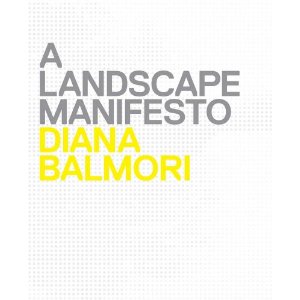
51OePl1in0L__SL500_AA300_ As a first example of this redesigning based on a new interpretation of nature and history, and on seeking a better model of the coexistence of humans with nature, let us take the American Lawn.

Your backyard, that third of an acre where you’ve lounged, played Frisbee, and let your small children crawl, is your private property and nobody else’s business. The American Lawn, all thirty-one million acres of it, is the nation’s largest single crop, sixty percent of it made up of home lawns like yours, the rest in public landscapes. Between your lawn and those thirty-one million acres lies the new story.

The American Lawn has a notable trait that makes it the perfect landscape to examine. It tells a tale at the very small front-yard-of-your-house scale. And it also tells a tale at the million-acre scale. What emerges from the examination of the relation of each of these scales is that scale itself is what prompts the need for a transformation of the lawn.

The lawn’s rise to preeminence as the American landscape first brings us back to the Picturesque and then to the history of its entry into North America.

Though the French had also used lawn (the “flowery Meade” of tapestry)—in walled medieval gardens as a place for music and pleasure, the American Lawn is a direct descendant of the eighteenth-century English lawn. More than anyone else, the landscape artist Capability Brown was its creator; in the words of the contemporary landscape artist Ian Hamilton Finlay: “Brown made water appear as Water, and lawn as Lawn.” The great inventions that made it Lawn were its scale, sweeping over topography and uniting distant landscapes with its blanket of green, and the contemporary invention of the ha-ha (a dry ditch with a raised retaining wall used to conceal the boundaries of a landscape), which hid hedges or property fences from view and kept vistas open. Thomas Jefferson’s notation on visiting one of these English eighteenth-century estates summed it up: “the lawn about thirty acres.”

Read more »

Luck of the draw

AppleWe all remember our favorite teacher; the one who inspired us, excited us, saw something in us that perhaps we didn't even see in ourselves and helped us nurture that spark into a flame. For me, that teacher was Mrs. Rocco and I was 8 years old. Before I entered Mrs. Rocco's class, I had heard “the stories” about her: she was crazy and stood on desks and stamping feet. In fact, there was some truth to some of these stories; Mrs. Rocco would usually wear a long, flowing, fringed shawl and she did like to sometimes, just for the fun of it, stand on a desk and pretend to be a flamenco dancer. And she was just a little eccentric, let's say, flamboyant. But she was one of the best teachers I have ever had. She made learning fun and exciting as she approached every subject with a contagious enthusiasm. When I was asked recently to draw a picture illustrating the story of my life journey, including people who had inspired and motivated me along the way, a stick figure drawing of Mrs. Rocco was there front and center. Through my life, Mrs. Rocco has been followed by many other inspirational teachers and mentors, in high school, in university and throughout my career. These teachers have guided me, expanded my horizons, awakened my curiosity and dared me to follow my dreams.

Just as I have been lucky enough to have some great teachers, I've had a few pretty terrible ones as well; teachers who were clearly just going through the motions after too many years of teaching the same subject; teachers for whom a teaching career was a consolation prize when they failed to achieve their true career aspirations; and sometimes, teachers who just didn't seem to like children very much at all. Teachers who brought no energy or enthusiasm to teaching, making us squirm in our seats with boredom as we watched the hands of the clock on the wall move forward, time, seemingly, slowed down to a snail's pace.

I was fortunate, bad teachers were the exceptions in my life and my exposure to them was minimal, normally outweighed by the rest of my educators. I realize that teaching is often a poorly paid, demanding, exhausting job, and that intimating that any teachers might be less than stellar is a statement that is probably going to get me get me some unpleasant responses to this piece. But of course, when we all reflect back on our educational experiences, we know this is actually true. My question is: what happens when this kind of teacher is all a child knows?

Read more »

Statistics – Destroyer of Superstitious Pretension

Statistics-education-research-day1 In Philip Ball’s Critical Mass: How One Thing Leads to Another, he articulates something rather profound: statistics destroys superstition. The idea, once expressed, is simple but does not stem its profundity. Incidents in small numbers sometimes become ‘miraculous’ only because they appear unique, within a context that fuels such thinking. Ball’s own example is Uri Geller: in the 1970’s, the self-proclaimed psychic stated he would stop the watches of several viewers. He, perhaps, twisted his face and furrowed his brow and all over America watches stopped. America, no doubt, turned into an exclamation mark of incredulity. What takes the incident out of the sphere of the miraculous, however, is the consideration of statistics: With so many millions of people watching, what was the likelihood of at least some people’s watches stopping anyway? What about all those watches that did not stop?

Our psychological make-up seeks a chain in disparate events. Our mind is a bridge-builder across chasms of unrelated incidents; a credulity stone-hopper, crouching at each juncture awaiting the next link in a chain of causality. To paraphrase David Hume, we tend to see armies in the clouds, faces in trees, ghosts in shadows, and god in pizza-slices.

Many incidents that people refer to as miraculous, supernatural, and so on, become trivial when placed within their proper context. Consider the implications of this: Nicholas Leblanc, a French chemist, committed suicide in 1806; Ludwig Boltzmann, the physicist who explained the ‘arrow of time’ and gave us the Boltzmann Constant, committed suicide in 1906; his successor, Paul Ehrenfest, also committed suicide, in 1933; the American chemist Wallace Hume Carothers, credited with inventing Nylon, killed himself in 1937. This seems to ‘imply’ a strong link between suicide and science. Of course, as Ball indicates himself, we must look at the contexts: We must ask what the suicide-rating of these different demographics was in general: of Americans, Europeans, males, and any other demographic.

Read more »

For adventurous film, whether making or watching: Colin Marshall talks to film critic David Sterritt

David Sterritt is the chairman of the National Society of Film Critics and former longtime critic at the Christian Science Monitor. Sterritt’s books, from titles on Jean-Luc Godard and Alfred Hitchcock to more recent ones on B-movies and even the television sitcom The Honeymooners, reveal cinematic interests that stretch from the avant-garde to the long and widely beloved to the ostensibly (but perhaps not actually) disposable. Colin Marshall originally conducted this interview on the public radio program and podcast The Marketplace of Ideas [iTunes link].

I'm interested in talking to you as a film critic, but also as a fellow interviewer. You've interviewed two filmmakers that are my absolute luminaries for filmmaking: Werner Herzog and Abbas Kiarostami. What does those guys' work mean to you?

An interesting pair. In some ways, they're really different from each other. I guess the way in which they're most similar is that each one seems to have carved out a distinctive — one might even say unique — niche in the world of the movies. The one who's been practicing the longest is Werner Herzog. I've interviewed him many times over the years, or just talked with him casually. Just a few years ago, I interviewed him — and this was kind of an interesting experience — during the San Francisco film festival in the Castro Theatre. Sold out house. Enormous number of people just jammed the Castro to hear Werner. I sat on the stage with Werner and they had us on a big TV screen. We did this interview for something like an hour, and it went really well. He was very witty, very scrappy, as he usually is. Just a real pleasure to talk to him.

The interesting thing was that the movie he had chosen, a brand new movie he had just finished, to have shown right after our interview as the other part of the evening. It was a very, very experimental work. It consisted largely of long takes of a diver swimming underneath ice floes in the Antarctic. These went on and on and on. There wasn't a whole lot other than that. I didn't stay for the screening; I had seen the film already. I was not really sure how the audience was going to respond to this. But later on, I was hearing that a lot of people were really dismayed. It was not only what they did not expect from Werner Herzog; it was what they didn't expect from the movies at all, ever.

It was just an interesting moment. He has, since, made a movie called Encounters at the End of the World, which is about the Antarctic and which is a very coherent and interesting documentary. I think that footage I'm talking about got incorporated into that film. But what was shown that night was so strange and so bizarre. The fact that he was perfectly happy to show this and see what people make of it — if they don't like it, okay, I'm going to be making another movie real soon. That sums him up, in certain ways.

Read more »

Monday, October 18, 2010

A Letter from Karavali

By Aditya Dev Sood

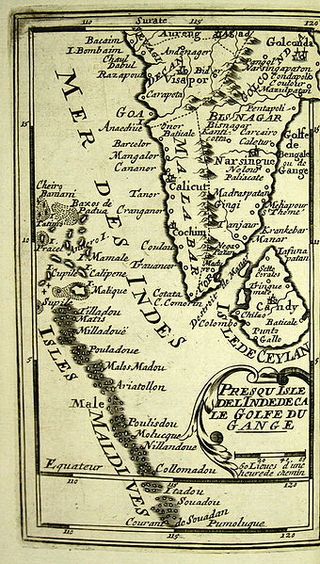
Mer des Indes Not many people know where or what Karavali is, I find. Many in the north refer to it vaguely as Mangalore, on account of the large port city located there. With friends from overseas I'm best off describing it as the strip of India south of Goa and north of Kerala. European traders from the 16th Century called it the Canarese coast, from Canara, or Kanada, the language of the inland powers that loosely controlled it. It is also sometimes called the Konkan coast, for the Konkani speaking merchants, originally from Goa, who did so much of the commerce with European and Arab vessels. So many different languages, cultures, and religions are folded into these undulating hills, which rise up from the Deccan Plateau, before plunging down, just a few kilometers from the Arabian Sea.

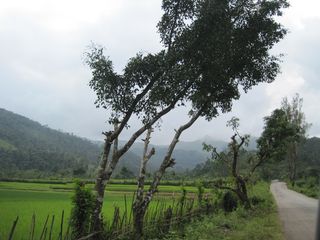
Country road I first came here by accident, in the late summer of 1991. I had actually gone to Goa to visit Ravi, an old school friend of mine, but hadn't counted on the dynamics of his rather conservative joint family, which frowned on us sipping beers in shacks by the seaside, and prevented us from going out at night, or from bringing friends over. He had a cousin graduating from the Regional Engineering College of Mangalore, several hours south by road, so we volunteered to drive down and pick him and his stuff up. We took the family jeep, a fiendishly powerful indigenous vehicle called a TRAX, which as I recall, looked to be built out of folded steel sheets and what was reputed to be a reverse-engineered Benz engine. The TRAX ate up the road, while its muscular window wipers swept away the rain furiously. From the right window you could glimpse the sea from time to time, and on occasion you would spot the trains of the Konkan railway, which run generally parallel and then sometimes criss-cross over or under National Highway 17. The drive down from Goa was among the most beautiful I had ever been on. And coming from the North, I was pleasantly surprised to find the scenic beauty coupled with a kind of rural prosperity I'd never seen before in India. Just about everyone seemed to have their own motorcycle and laterite-stone house with Mangalore tiled roofs and a clutch of coconut trees to tend. When I tried to explain what I'd seen to my friends and family back in Delhi, I struggled with the words. It's like India, I gushed, but perfect!

Read more »

Gauguin: Maker of Myth

Tate Modern, London: 30th September 2010-16th January 2011
National Gallery of Art, Washington: 27th February – 5th June 2011

Sue Hubbard

Gauguin_Tehamana_has_many_E34711 There can be few artists who have been as lionised and lambasted as Gauguin. Condemned by many as a colonial pederast who bought the syphilitic worm into a South Seas heaven, an arrogant self-promoter who abandoned his wife and children for the life of a lotus eater, he represents for others the archetypal painter who gave up everything for his art, breaking away from the bourgeois strictures of a career as a stockbroker and the dab-dab of Impressionism to create paintings full of flat vibrant colour that pre-figured German Expressionists such as Nolde and Kirchner. For his champions he has long been held up as the hero of modernism, a painter who released art from the confines of the naturalistic world and liberated colour to create works of universal symbolism and mystery.

[Photo: Paul Gauguin
Merahi metua no Tehamana (Les Aїeux de Tehamana / The Ancestors of Tehamana or Tehamana has many Parents) 1893
Oil on canvas 76.3 x 54.3 cm
The Art Institute of Chicago. Gift of Mr and Mrs Charles Deering McCormick.]

So much of the narrative that surrounds Gauguin is myth, often of his own making. He has been the subject of countless representations from Somerset Maugham’s The Moon and Sixpence to Mario Vargas Llosa’s historical novel The Way to Paradise. One of the first artists to have the media savvy to exploit the narrative of his own life, the Faustian pact he made with posterity finally came back to taunt him when, in 1902, isolated and ill, he dreamt of settling in the Pyrenees. “You are,” his friend Daniel de Monfreid wrote, “ at the moment that extraordinary, legendary artist who sends from the depths of Oceania his disconcerting, inimitable works, the definitive works of a great man who has disappeared, as it were, off the face of the earth…. In short, you enjoy the immunity of the great dead; you belong now to the history of art.”

That he had an extraordinary life is not in question. His father was a political journalist and his mother Aline the daughter of the writer and political activist, Flora Tristan, a pioneer of modern feminism. After the 1848 revolution his family left France for Peru and political exile, where his father died of a heart attack leaving Aline to bring up her two young sons in Lima at the residence of an elderly uncle. It was here that Gauguin spent the first five years of his life, which would later allow him to claim Peruvian heritage and caste himself in the role of a ‘savage’. “The Inca according to legend,” he wrote in a letter to his friend Emile Schuffenecker in 1888, “came straight from the sun and that’s where I will return.” Yet his mythic, archetypal images of Polynesian women and his ‘essentialist’ stereotypes of Breton peasants have often proved problematic for contemporary audiences in these more politically correct times.

Read more »

Free Will and Responsibility

Chimp Recently, my mother came to visit for a week. She bought some butter while she was here, since I didn’t have any. I don’t normally eat butter, but I do now. In fact, I’ve been eating it at every meal and putting it on everything I eat. I’d forgotten just how delicious it is. I now see other foods as mere vehicles for the greasy indulgence. After multiple failed attempts at self-restraint, I've reached this conclusion: as long as there is butter in my kitchen, I will consume it in a shamefully gluttonous fashion.

We like to think that we have free will, that we make decisions for ourselves–even if they’re trivial, like what to have for breakfast. But because I have a weakness for butter, whether or not I ate it over the past few days was largely determined by my mother, when she left a half pound of the decadent gold lard on my counter top.

Our breakfast choices, in general, seem to be largely determined by factors that are beyond our immediate control. Maybe you’d like to have toast and peanut butter for breakfast, but you won’t if someone else polished off the last of the bread. Or perhaps you’ve overslept and don’t have time for breakfast, or maybe you’ll be meeting with a friend who has a severe peanut allergy. The very fact that you desire toast and peanut butter may also be beyond your control. You could have awakened not feeling hungry at all. Sure, the choice is yours, but what you choose depends on a myriad of factors that are not within your control.

Debates about free will have been waged for millenia. They’ll probably continue far into the future as the issue is complex, but we should be able to agree on this: our actions, at least to a large extent, are determined by factors that are beyond our immediate control. These factors can be internal or external, or more often a combination of the two.

For example, the rituals of obsessive-compulsive disorder are largely determined by neurobiology. Many of us have minor compulsive habits, but at more extreme levels, obsessive compulsive behaviors, like repetitive hand washing and compulsive hair pulling, can get manifestly weird. People don’t choose to act this way and they generally can’t will themselves to stop. These behaviors are determined by internal factors, but they are nonetheless beyond the individual’s immediate control.

Read more »

Monday Poem

Flash Fires

If these thoughts became fossils
they might be found by some
neuro-paleontologist in time to come
buried among those of others
pressed in the strata of notions
like carcasses of trilobites in stone
or the bony ghost of a pointing finger
caught in basalt —but they will not be

These thoughts are here and gone
like the flickerings of fireflies
after being incarnated momentarily
in wind blown through a larynx
and taken by a breeze to ears
into a mind or two and recalled
a few times like echoes
articulated by dancing tongues
and lips of others
until they run out of steam
after perhaps a generation
and vanish
like the smoke of flash fires in a
wilderness

by Jim Culleny
Oct 12, 2010

Was it really necessary to remake “Let The Right One In” in English?

by Kevin Taylor Anderson and Salman Hameed

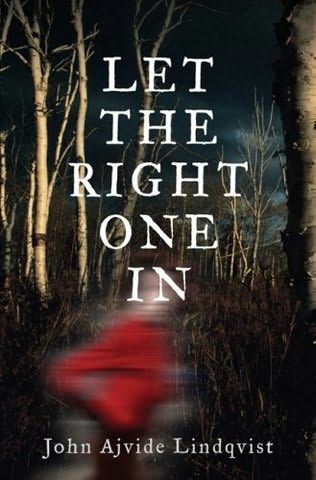
Let-the-right-one-in-book With the recent release of Let Me In – an English-language remake of the Swedish film, Let the Right One In – we essentially have a carbon-copy of the Scandinavian film. On the one hand we were relieved – surprised even – that the American incarnation remained true to both the style and content of the original film. On the other hand, as the lights came up, we were compelled to ask, “So why’d they redo it”?

If the remake was done simply to make more money, then one could have imagined the American filmmakers possibly selling out and sacrificing the bleak, contemplative tone of the Swedish version for either the teen romance of the Twilight films or the gorefest of remade foreign horror films. But admirably, the filmmakers resisted the temptation.

There are indeed some minor structural and other changes between the original and the remake. The bleak, snowy landscape and the featureless and unimaginative architecture of “somewheresville” Sweden is relocated to the equally nondescript outskirts of Los Alamos, New Mexico, circa the cold war era of the early 1980s. However, the rhythm and pacing of both the editing and dialogue match the original so exactly that you half expect the actors to deliver their lines in Swedish while ankle deep in snowdrifts. Yes, there is more explicit mention of religion (and evil) in the American remake, but ultimately, these changes are quite minor for the plot of the film. What we end up with is a vampire romance for an American audience (without the Twilight simplicity), but one with a European sensibility for time, place, character development and dramatic conflict.

Read more »

Southern California’s radio pointillist: Colin Marshall talks to Off-Ramp host John Rabe

John Rabe is longtime public radio report and host of KPCC’s Off-Ramp, a weekly examination of Southern California and especially Los Angeles. The show’s interviews and field pieces provide a radio portrait of the city and its surrounding half-state, highlighting some of the most interesting people, places, and things there without attempting the futile task of precisely representing the massive amount and constantly changing composition of Southern California culture. Colin Marshall originally conducted this interview on the public radio program and podcast The Marketplace of Ideas [iTunes link].

I just used the phrase “radio portrait” of Los Angeles to describe your show. Is that accurate, or is that just me being public radio-y about it?

No, I think that's absolutely fine. Off-Ramp is about anything interesting happening in Southern California. It's like an accumulation of snapshots, or a buckshot approach to covering something as huge as Southern California. If you put all of the shows together we've done since August of 2006, you'd have a pointillist portrait on the radio. If you're talking digital, because everything's broken up into tiny little pieces, you've got your radio portrait.

I like that pointillist image. There's a lot of analogies I've tried to describe the show. When I reviewed it on Podthoughts for The Sound of Young America's web site, which I believe is how you encountered me originally, I was just trying to describe what it's doing. Certainly, the idea that it covers not just L.A. but Southern California in general I didn't quite frame when when we started. How far are the boundaries of the show? How far are you willing to go in the name of what's interesting in L.A. and beyond?

Our signal reaches up slightly into Ventura County and all the way down to northern San Diego County. It reaches a little bit past Palm Springs, and then somewhere out into the water of the Pacific Ocean. We try to pick things for the show that are somewhere in that area, which gives us a huge amount of leeway. But there are times when we do stuff I think is simply interesting for Southern Californians to hear that may have no actual connection to Southern California.

I had Alan Furst on the show, the historical spy novelist. There's no connection, but I love Alan Furst. I knew he'd be a great talker. One of out commentators, Mark Hafley, recently realized that everybody was talking about the mosque, the cultural center they want to build on Ground Zero. He said, “Look, this used to be an Arab neighborhood before they leveled the area to build the World Trade Center.” Does that have something to do with Los Angeles? Angelenos and Southern Californians care about that issue. I stretch the boundaries when I want to.

The boundaries are already pretty wide. I'm thinking about the mandate of a show that covers interesting things in Southern California. Southern California is very large. “Interesting things” is an infinitely wide mandate. That seems like it introduces its own set of difficulties. Are there actually as few constraints as I'm describing?

Yes, there are very few constraints. I was simply given the gift by management to do an arts and news show that ran on the weekends. I didn't want to put any constraints on it. I didn't want to have themes. I didn't want to have holes we had to fill. You do a show; if you start doing a thing that's a specific thing every week, you've got to fill it and you've got to do that. I didn't want to have any of that. I wanted to just be able to go out and cover Southern California in whatever way I wanted, and either management agreed or didn't notice that that's how I described it. That's what I've been doing for four years.

Read more »