by Misha Lepetic
There wasn't a damn thing I could do or say
Up in the skyway
~The Replacements
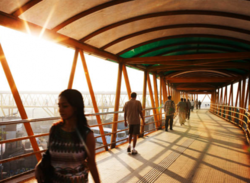
The history of walking in American cities is one of the steady erosion of an activity that was so natural that its importance was almost entirely tacit. It is always amazing to realize how malleable our norms are: during the automobile’s first few decades, pedestrian fatalities were commonly greeted with criminal charges such as ‘technical manslaughter’. Drivers were viewed with mistrust, considered reckless and even represented class division. However, pedestrians became increasingly regarded as impediments to the velocity of modern life, and economic progress became increasingly associated with the automobile and the infrastructure that made its hegemony possible.
How did this change come about? As Sarah Goodyear writes in the Atlantic Cities blog,
One key turning point…came in 1923 in Cincinnati. Citizens’ anger over pedestrian deaths gave rise to a referendum drive. It gathered some 7,000 signatures in support of a rule that would have required all vehicles in the city to be fitted with speed governors limiting them to 25 miles per hour.
Local auto clubs and dealers recognized that cars would be a lot harder to sell if there was a cap on their speed. So they went into overdrive in their campaign against the initiative. They sent letters to every individual with a car in the city, saying that the rule would condemn the U.S. to the fate of China, which they painted as the world’s most backward nation. They even hired pretty women to invite men to head to the polls and vote against the rule. And the measure failed…The industry lobbied [for] the adoption of traffic statutes to supplant common law. The statutes were designed to restrict pedestrian use of the street and give primacy to cars. The idea of “jaywalking” – a concept that had not really existed prior to 1920 – was enshrined in law.
This was the beginning of a long and effective campaign that saw walking legislated and planned almost out of existence. Even now, designers and planners are often hobbled by a perspective which continues to favour the automobile over pedestrian – most ironically, in the name of safety.