by Paul Braterman
Glen Roy is a valley in the Western Scottish Highlands, just south of the Great Glen (home to Loch Ness), and draining through Glen Spean to Loch Linnhe, an inlet of the Atlantic. It is remarkable for the presence of the Roads, a series of parallel, almost horizontal, grooves in the hills on the sides of the glen. Clearly shorelines; but of what body of water? And why are there more than one of them?
Darwin thought the Roads represented vanished marine shorelines, one above the other as the result of vertical movement. Agassiz explained them, rather, as successive shorelines of a glacial lake, now vanished because the retaining glacier has melted away. If so, and if global warming is real, we might expect to see vanishing lakes today, as the glaciers retreat. We can, and we do, as my friend Peter Hess explains.
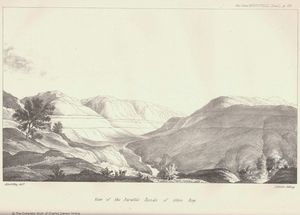
Charles Darwin visited the Glenroy area in 1838, two years after his return from his round the world voyage on the Beagle. During that voyage, he had examined the geology as well as the plants and animals of the places he visited, and among them was the coastal area of Chile. This is marked by raised beaches inland where once had been shoreline, and Darwin correctly described these as the effects of uplift, which we now know to be driven by plate tectonics. So it was natural that Darwin should have applied a similar explanation to the Roads, suggesting that the Cairngorms, like the Andes, were a zone of uplift, and that the Roads were ancient beaches of the Atlantic, now some ten miles away. The alternative theory, that they represented shorelines of an ancient lake, ran up against a seemingly conclusive objection; such a lake could only have formed if there had been a barrier across the valley, but there was no trace of this.