by Paul Braterman
Few topics are less exciting than the mechanics of local government. Nor would I expect the world to pay much attention to the details of these mechanics in a small, only partly independent, country of no particular economic or strategic importance. Nonetheless, the case exhibits some interesting general features regarding the legacy of religion in an incompletely secularised Europe, and the realities of effecting change in a diverse and pluralist society.
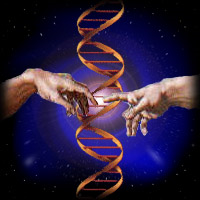
The petition has attracted international attention, most notably from Michael Zimmerman, as director of the Clergy Letter Project, who in a Huffington Post article has eloquently described the current structure as “bad for science education as well as for religion”. The Clergy Letter Project itself is an impressive assemblage of over 15,000 ordained clergy, from various denominations and creeds, who argue that the correct response of religion to scientific discovery is acceptance and celebration. The image above symbolises this view, by combining the memes of DNA and Divine Creation. Accommodationism, in the best and truest sense of this much misused word.
Michael Zimmerman expresses his reasons for concern as follows:
There are many reasons why a law of this sort is inappropriate and undemocratic, and you can read most of them in the petition, but rather than focusing on those aspects of the situation, I want to address the potential for serious problems associated with science education. As we have seen in far too many instances, some with deeply held fundamentalist beliefs, beliefs that are well out of both the religious and secular mainstream of society, feel compelled to promote their narrow perspective rather than the consensus of the scientific community. These extreme views are almost always at odds with the religious beliefs that are held just as deeply by the vast majority of the religious community.
And events have shown this concern to be well justified.