
by Niall Chithelen
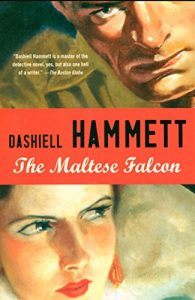 Our first act of communication is to look in each other’s eyes, or not to. Many descriptors center subtly on the gaze: I might be shifty if I’m looking away from you too often and too purposefully, diffident if I cast downward when I ought to be looking you in the eyes, or unsettling if I never stop looking at you.
And in observing others’ interactions, it seems body movements have to catch your attention; you were not looking at a person’s hand until they put it on another’s shoulder. But what were you watching before?
The Maltese Falcon is a classic noir centered on private detective Samuel Spade. It is not a verbose novel, but it is a novel of details. Despite featuring morally grey characters who share a deep wariness of one another, it reads as intimate, taking place mostly in closed rooms as these people become embroiled in a plot that isolates them—and us—from the world around them. The author, Dashiell Hammett, does not explain his cast, he has them interact until we start to understand them. Character introductions are mostly physical; the novel opens with the protagonist’s jaw, chin, and mouth, and then makes its way around his face such that we learn he “looked rather pleasantly like a blond Satan.”
Within his physical sketches, Hammett permits the eyes a special depth. The next character, Spade’s secretary Effie Perrine, has eyes that are “brown and playful,” and the novel’s femme fatale, Miss Wonderly, appears in the doorway with “cobalt-blue eyes that were both shy and probing.” These descriptions are coy, as we have not quite been told that Effie herself is playful or that Miss Wonderly is shy and probing. We simply know what their eyes suggest, and with such guarded or duplicitous speech from the characters, we cannot trust that the eyes tell us a more honest story. Read more »


 In the science fiction short story “
 The major “National-Socialist Underground” trial
  The ill-defined term ‘populism’ is used in different senses not just by common people or the media, but even among social scientists. Economists usually interpret it as short-termism at the expense of the long-term health of the economy. They usually refer to it in describing macro-economic profligacy, leading to galloping budget deficits in pandering to all kinds of pressure groups for larger government spending and to the consequent inflation—examples abound in the recent history of Latin America (currently in virulent display in Venezuela). Political scientists, on the other hand, refer to the term in the context of a certain widespread distrust in the institutions of representative democracy, when people look for a strong leader who can directly embody the ‘popular will’ and cut through the tardy processes of the rule of law and encumbrances like basic human rights or minority rights. Even though I am an economist, in this article I shall mainly confine myself to the latter use of the term.
 When Mrs. William Shakespeare died on this August day in 1623, her family and friends believed they would lay her to eternal rest beside her renowned husband. They did not. They did inter an ordinary wife and mother, but the memory of her went out to become a Frankenstein monster, cut up and reassembled down the centuries. Few of the many makeovers done to Anne Hathaway Shakespeare since her passing have been flattering.
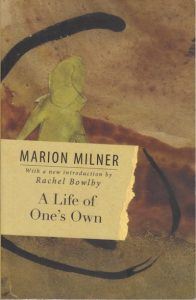 I’m tempted to describe Marion Milner’s book A Life of One’s Own as the missing manual for owners of a human mind. However, it’s not didactic or prescriptive. In fact, it’s useful mainly because it’s nothing like a manual or a self-help book. The book is more like an insightful travelogue by an articulate and honest observer with a gift for using vivid physical imagery and metaphors to describe her inner world.
 The 2020s will have a name. In the nursing homes of the future, Millennials’ grandchildren will hear all about the coming decade. Gran will remove her headset, loaded out with VR-entertainment and the latest in biometric tech, and she’ll tell the kids about the world as it was in the third decade of the 21st Century. For now, we look ahead to the Twenties, a decade certain to be charged with meaning, roaring in one way or another.
 One of my favorite quotes about artificial intelligence is often attributed to pioneering computer scientists Hans Moravec and Marvin Minsky. To paraphrase: “The most important thing we have learned from three decades of AI research is that the hard things are easy and the easy things are hard”. In other words, we have been hoodwinked for a long time. We thought that vision and locomotion and housework would be easy and language recognition and chess and driving would be hard. And yet it has turned out that we have made significant strides in tackling the latter while hardly making a dent in the former. The lower-level skills seem to require significantly more understanding and computational power than seemingly more sophisticated, higher-level skills.