
by Gary Borjesson
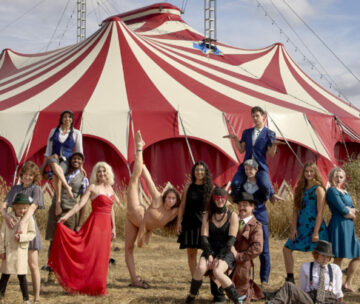
Last year my wife and I went to the circus when it came to town. I expected I’d enjoy it, but I was shocked by how much I enjoyed it. I was thrilled and inspired by the whole intimate spectacle, under a tent with a high top, facing the central ring and our fellow spectators across the way. It was moving in some of the same ways a great musical or theatrical performance is. But the circus had something extra.
I left the tent looking forward to next year, when The Flynn Creek Circus would be back in town. This year we went again, and loved it. At the risk of breaking the spell, of disenchanting the marvel by speaking of it, I want to say a few words about what makes a circus great. The kind folks at the Flynn Creek Circus have given me permission to publish photos from their show. (Visit their website if you want to see more, or find out where you can see them perform.)
1. History
Years ago my wife and I visited Knossos on the island of Crete. This was the center of the ancient Minoan civilization. (Settlement there began as early as 7000 BCE.) Among the ruins were frescos that once adorned the walls of the palace. One depicted a circus-like scene, in which two youths surrounded a bull while a third launched themselves over it. At the time it struck me as extraordinary that this image should have endured so long in so prominent a place. Looking back, I imagine it endured because it is humanly compelling and instantly relatable, depicting as it does a kind of glorious play, as daring as it was virtuosic.
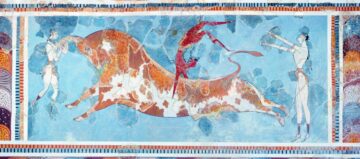
In Egypt at Beni Hasan, 4000-year-old tomb paintings show women juggling. In the middle ages, jugglers, minstrels, tightrope walkers, and animal handlers traveled to different fairs and market towns. They were widely admired, but lived on the often seamy margins—an association that has followed circuses ever since. The sometimes grotesque and transgressive spectacles made the shows that much more riveting. I’m reminded of Robertson Davies’ absorbing novel, World of Wonders, where a young boy runs away to join the “World of Wonders,” a traveling carnival that is at once seedy, grotesque, and wondrous.
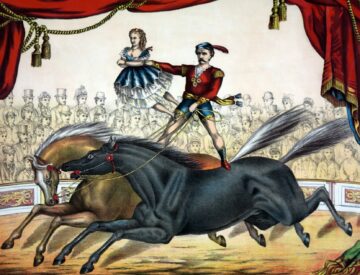
The modern circus began in London in 1768, when former cavalry sergeant-major Philip Astley opened a riding school. Astley found that if horses galloped in a circle about 13 meters in diameter, a rider could use the resulting centripetal force to balance while standing on horseback. Curiously, this became the standard of measure for other circus rings. Astley added acrobats, tightrope walkers, and clowns to the performances, which became the template for the modern circus. (Circus is the Latin word for ring or circle.)
The Flynn Creek Circus delivered it all, including the racier carnival vibe in their adults-only show. Their website says, “Adults Only shows do feature crude and sexual language and semi-nudity. You’re welcome.”
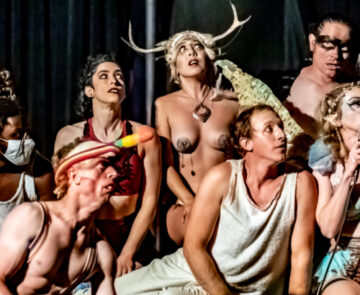
Penises were in plain view, brandished proudly and, as we’ll see, spun into the plot. Butts and breasts and crude sexual humor ran jauntily through the show. Inside this relatively small circus tent, the performers might come within a foot or two of you on their way to and from the ring. You felt you were part of the action, and sometimes the audience was invited to be. Some were eager, while the rest of us clapped and cheered enthusiastically, joining in the spirit of carnival.
2. Virtuosity
Circuses offer spectacles, from the grotesque and erotic to the spellbinding and virtuosic. What most thrilled and moved me was the physical virtuosity and daring of the performers—and their off-stage supporters. I loved watching how performers who were off-stage managed the rope and rigging for the aerial acts. Two pairs of hands on the same rope, all eyes on the performer high above them, hoisting and releasing the rope precisely as she moved. One slip in grip or timing could end in catastrophe. Meanwhile the performers up high are entrusting their lives to each other, depending on each other to be focused and exact in every movement, catching and releasing each other in perfect rhythm. For all of them, the stakes are real, and yet, like the youth leaping over the bull, it’s all in the spirit of virtuosic play.
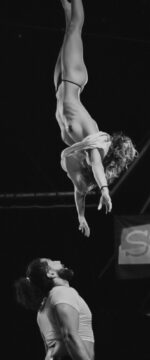
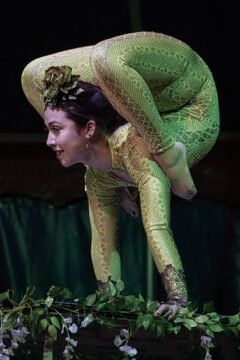
Nearly naked, beautifully fit bodies are sexy, of course, but the real thrill of the nakedness is getting to see their bodies doing astonishing things. We watched as head, shoulder, back, and chest move with formal grace, doing what most of us can’t imagine doing, whether tumbling from a great height or arching into a backbend so complete as to make one’s body into a circle, feet resting on shoulders. To watch each vertebra of the spine and each rib stretch and bend into position was to watch something impossibly beautiful, stripped down to its essence. (Here’s the General Audiences version of that image. You can’t see what you’re missing.)
3. Significance
All this reminds me of the Greek word kalón, by which Plato and Aristotle referred to a notion that can be translated as ‘beautifully noble.’ It names a blend of virtuosity and beauty that we might see in a statue, hear in music, or witness in the character of Socrates. Likewise, a mathematician’s proof that is elegantly virtuosic might be called kalón. (A human proof, anyway, where the excellence is earned and failure means something.)
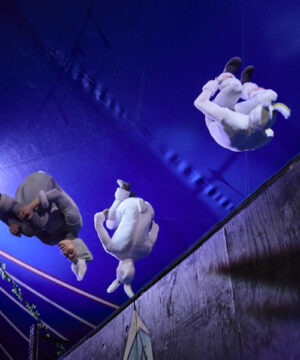
For most of us, being in the presence of something nobly beautiful is a moving and inspiring experience. I’m moved by the displays of extraordinary skill, cooperation, daring, courage, and grace. The performances gain depth for being so exquisitely vulnerable. Imagine how you’d feel performing naked in front of an audience that includes your fellow performers (who are counting on you!) when you fall out of the ring you’re spinning in, or crash into the other tumbling rabbits. Misses happen now and then, and when they did I felt even more keenly how spectacular it was, for being so hard and living so near to failure, or disaster.
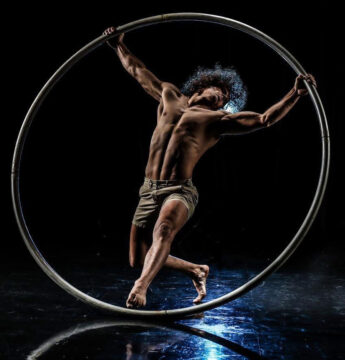
We might say much of this about theatrical performances; yet, as I mentioned at the beginning, the circus seems to me to offer “something extra,” an element that made it surprising and enchanting. I’ll call it transgression: performers daring to cross physical and social lines, risking injury and even death to push beyond what seems humanly possible. The trapezist may fall to the ground and break their neck, the bull-leapers may be gored or stomped under foot any moment. In the adult-only shows, there’s also the public nakedness: transgression and vulnerability made visible.
And all for what? The Flynn Creek Circus performers are surely not doing it for the money, nor are they playing to win, as athletes in professional sports are. Like the bull-leapers, they seem free from these motives. Instead they embrace the exhilarating spirit of play: playing with limits and boundaries, playing with conventional pieties, playing with a life outside the norm, playing with each other—and playing with the audience, inviting us briefly into that circle of play, where we can feel, through a kind of emotional contagion, the thrill of being part of something kalón.
Saying that sounds a little high falutin, as if I’m taking the noble aspect a little too seriously. But here again the performers playfully come to my rescue. I’ll leave you with an image from the first adults-only show I saw, of a naked man on wheels being spun around the ring by a woman holding a rope attached (somehow) to his penis. You could hear the audience—especially the male members—gasping in fascinated horror.