
by Eli Rarey
Lately I have been drawn to trees. I moved across the country from Detroit to Los Angeles, and while I’ve been looking for a new apartment I have been noticing the trees nearby. If I can’t find a big tree in the neighborhood that I can hang out with, then the apartment isn’t for me.
Many trees, especially fruit trees, have lifespans comparable to a person. I’m almost 50 years old, and many of the trees planted as landscaping on city sidewalks are actually younger than I am. But when I find a tree that looks like it might be older than me, trees that might be a hundred years old or more, that’s when I get excited. I go up to the tree and press against the bark with the palm of my hand or even press my cheek up against it. I feel an intimacy here, as if the tree and I are communing in some shared language humming at the level of our skin.
I have been feeling rootless lately. I spent most of 2026 without a fixed address or a job, and now that I started a new job and I’m moving into a new place, I have the sense that I need a kind of sanctuary. Trees provide that for me—they provide comfort to someone who has felt uprooted in the world. At one point I thought maybe I had some wisdom to learn from trees about being fixed in place or even about photosynthesis—but this isn’t what I really want trees to teach me. The tree is not a role model or a science experiment. The tree is a being, like me, but a being with a radically different experience of its time on this planet. That’s what I’m reaching for, I want the tree to offer me a different sense of time. Tree time.
On September 29, a group of interfaith leaders and community activists began a eight-day pilgrimage. Their walk began at the Adelanto ICE Processing Center, and continued for 96.5 miles, ending in Downtown LA at the Metropolitan Detention Center. This group explicitly uses the word “pilgrimage” to describe this action. They are coming together as spiritual communities and social activists; they do not separate those spheres. On the contrary, these feed each other. Justice is a constant topic of religious texts—both divine justice and the justice or injustice among humans. Demanding justice is a moral requirement. Rabbis, pastors, and ministers all walked together. All of their faiths are deeply concerned with justice and all include long-practiced, ancient traditions of pilgrimage.
This pilgrimage to Los Angeles began as an idea from Rabbi Susan Goldberg, founder of the Nefesh congregation on the east side of LA, but as she tells the story, she wasn’t sure it was possible. She wanted to do it, but she thought they might have to scale it down, walk just a segment of the full 96 miles. It’s a long way to walk. She brought the idea to a group of interfaith leaders, and Reverend Canon Jaime Edwards-Acton, Rector of St. Stephen’s Episcopal Church in Hollywood, said, “I will walk with you.” That was enough to make it possible. The planning began.
The pilgrimage is in memory of those who have died in federal custody or died fleeing ICE raids, and it is in honor of those who are still in federal custody, kept captive under conditions that are both immoral and illegal. “It is on purpose that Adelanto is so far from Los Angeles,” Rabbi Goldberg says. “It is to keep the public’s focus away from the horrible conditions and deaths of those detained, and to hurt the families of the disappeared by keeping their loved ones so far out of reach.” The pilgrimage brings light to the act of hiding people away. These pilgrims want us to see the place and see the distance. Everyone who walks is choosing to walk for their own reasons. Some are associated with a religious congregation or a social activist group or both. Those who walk are supported by people with cars who bring them food, water, and supplies. A small group will walk all nine days. And every day others join. Some join for a day or two, when they can get off work. One man followed with his car for a day and waited at the end of each block with snacks for those walking. Some people might join for a few hours. This is a collective ritual action, a counter-ritual to the violence committed by the state. Someone is abducted by masked men and taken first to the detention center downtown, then transported 96 miles to the ICE detention center in Adelanto. The pilgrimage reverses the journey, both literally and figuratively. These pilgrims are cared for. They are not isolated. No one is here against their will.
This kind of direct action is not only a call to change the lives of others in the future, it is a practice of changing our own lives in the present. When we make a pilgrimage, we say that another world is possible—right now. It takes nine days to walk 96 miles, especially during the extreme heat wave that started on Friday. As Rabbi Susan Goldberg said, “It will require us to draw on deep spiritual, emotional, and physical resources.” Those who walk hold in their awareness those in federal custody held without air conditioning, offered foul water and rotten food. Those held captive are also drawing on their deepest resources. Some of them have died there. More will die there if they are not released.
The outdoors operate on a different time scale than the indoor life we humans have made for ourselves. This is the time scale observed by trees. Also rivers and rocks, sand and mountains, clouds and oceans. This time, tree time, doesn’t have a calendar, though we use our calendar to track it as best we can. Our calendar in some ways is a translation of outdoor time into indoor time, where we count with numbers and divide the day up into equal portions, and then divide those portions up into ever smaller portions so we can know exactly how long things take. So we know when to go or stop or wait until the rest of the party arrives. So we can predict the weather. Indoor time is a matter of planning and division. Outdoor time is a space for transformation.
The author and poet Wendell Berry says of the Bible that it is “an outdoor book.” Because of this there are particular benefits to reading it outdoors. A pilgrimage is a kind of prayer, and this particular pilgrimage falls during the Jewish holiday of Sukkot, a harvest festival that includes a tradition of holding up three branches and a fruit, shaking them while saying a blessing. During Sukkot some Jews sleep outside in ritually prepared dwellings open to the outdoors. (We call this temporary dwelling a sukkah, and the plural is sukkot.) These pilgrims pray on a schedule. They pray according to their calendars. They arrange to meet up with others during scheduled breaks. At the end of each day, they gather in predetermined locations. All these events are posted on a website so that others can join. What could be further from outdoor time than a website!
And yet, while they walk, pilgrims leave indoor time behind. They enter ritual time. They walk under freeway overpasses, through parks, past industrial lots, through residential neighborhoods. It is not a bucolic walk, but it is transformed by a change of perspective. This sense of transcendence of ordinary time is central to the ritual of the pilgrimage—and central to ritual itself. Outdoor time and ritual time are linked, even for our rituals kept indoors. A ritual is fundamentally non-linear, intrinsically linked with all other rituals like it. The lighting of the candles for Shabbat becomes one with all the other moments when these candles have been lit, not only by me and my family but by millions of other families throughout history. It is the same for the tree, for whom each day is not a day in a sequence—because a tree has no use for counting in sequence—each day is day, pure and indivisible. Every rainfall is a ritual of rainfall, connected to all other rains throughout the life of the planet. This is tree time, and we enter it through our human rituals that take us outside the ordinary time we use for appointments and bus schedules. We open up time and take it outdoors. Suddenly we see things that we had become blind to: the trees, the mountain, the sky, our breath, each other.
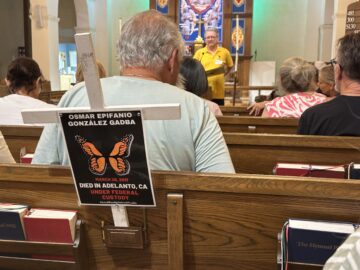
When I joined the group for dinner at St. Luke’s Episcopal church in Monrovia on Sunday evening, there was lots of food and lots of talk. I sat down at one of the large round tables with my paper plate next to a rabbi wearing a tie-dye t-shirt with a yellow happy face on the front. He had walked four of the previous six days and described it as a life-changing experience. These were prayers he had been saying for over thirty years—they now had all new meaning for him, just because he took them outside. People showed me their t-shirts and buttons from the various social activist groups that had brought them there. Most people wore nametags. I saw people in socks or barefoot, dirt and grime from the road on their toes. Some walked gingerly, almost limping. It had been a particularly grueling day—14 miles in 103 degree heat.
At one point Rabbi Goldberg gathered the attention of the group. She thanked those who fed us, and she announced that the evening programming would be happening “over there.” She waved her arms vaguely, not entirely sure where we were headed. They had stopped at a different place each night, sometimes a church, sometimes a hotel lobby, sometimes a campground. “We’re meeting in the sanctuary. Does anyone know where it is?”
Humans are, anatomically, rootless. We can only feel rooted through our will, our chosen connection to a place. “Putting down roots” is, for a person, a way of talking about our desire, our longing for connection to something we know as fixed. This connection, this rootedness, is what allows one to make a pilgrimage. A pilgrimage, despite it being marked by movement, is given meaning by connection to place. When a group of people choose to make this ritual, this spiritual commitment that is indistinguishable from activism, it brings our political lives, our lives as historical figures undergoing social upheaval, and connects it with the time of trees. It allows the trees to be a sanctuary for us when we need them most.
Enjoying the content on 3QD? Help keep us going by donating now.