by Rafaël Newman
My paternal grandfather—my Zaideh—was born in 1912 in Biała, north of Łódź in what was then Congress Poland, the Russian third of the partitioned Polish territory. At the time of his birth, Biała was a “private” town, a shtetl on lands ceded by a local nobleman within the Czar’s Pale of Settlement. My grandfather’s family ran a kosher dairy there, producing, he recalled with pleasure, something called gomolka, a Polish cottage cheese.
Zaideh emigrated with his father, not long after World War I, by way of Gdańsk and Portsmouth to Canada. He spent the rest of his life, until his death in 1997, in Montreal, where he and my Bubbi raised their three children and where he founded and directed a factory supplying the local garment trade with sequins and appliqués for ladies’ apparel. As far as I know, Zaideh never visited any country outside of Canada—except for the United States, to which I know he traveled on at least two signal occasions, to New York on both of them. One of these trips was for business in the early days, to stay at a discount hotel near Times Square and dine, seated on the edge of his bed, on rye bread with corned beef, a meal he remembered as one of the best he’d ever eaten. The other was in the winter of 1968, when he and Bubbi accompanied my parents and a four-year-old me on a sight-seeing trip that included the Rockefeller Center, dinner at a Beni Hana, and the purchase of a pair of child-sized cowboy boots.
Zaideh was an avid but critical follower of American politics, especially during Watergate, while his Canadian patriotism was crystalized in solemn reverence for Pierre Trudeau, the epochal leader of the federal Liberal Party in the sixties, seventies, and eighties. Zaideh saw Trudeau and the Liberals as a bulwark against the crypto-ethno-nationalism of francophone Quebec, his adopted home province, whose superiority to neighboring Ontario was tainted for him otherwise solely by its stupid prohibition against making a right turn on a red light.
The only other country to which Zaideh remained attached throughout his life was Israel.
Zaideh’s Zionism was iron-clad, identity-constitutive—and violent: my single experience of corporal punishment was at his hands, when he slapped me for my criticism of Menachem Begin. (My nascent anti-Zionism must have been exacerbated in his eyes by a suspicion of covert antisemitism, given my academic interest in German and Greek literature.) His Zionist faith was also entirely hypothetical, since despite giving regularly to the United Jewish Appeal and contributing money every year for the Jewish National Fund (JNF) to “Plant a Tree in Israel,” neither he nor my Bubbi ever visited the young country. They supported my father’s sojourn there in 1956, on a kibbutz, when he briefly considered enlisting to fight during the Suez crisis, and they maintained contact with members of the extended family who had settled in Israel; but they made no attempt to spend so much as a brief vacation in Ha’aretz, let alone make Aliyah.
As for Poland, his once and future birthplace, Zaideh was as violent in his hatred for the Old Country as he was in his loyalty to Israel. When I visited him in Montreal in the summer of 1991, freshly returned from a year abroad in Berlin, I presented him with an album of snapshots I had taken in Biała during my trip to a Poland newly emerged from behind the Iron Curtain. I hoped the photos would awaken some valuable memories. Sitting in his recliner in the corner of the humble apartment he shared with my Bubbi in the Snowdon district, Zaideh placed the album on his bony knees and paged through it, in complete silence, picture by picture: the muddy central square; the wooden buildings; the schoolhouse; the statue of Marshall Piłsudski. When he had finished, he looked up and fixed me with his greyish gaze. “Poland,” he said. “They should have turned that place over with a shovel.”
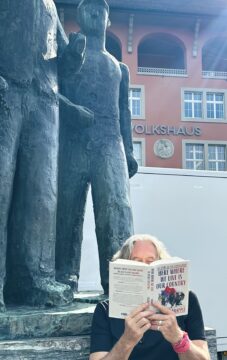
I thought about Zaideh a lot as I was reading Here Where We Live Is Our Country, Molly Crabapple’s new, widely acclaimed, variously criticized account of the Bund, a Jewish socialist labor organization formed in Czarist Russia in 1897, the same year in which the World Zionist Congress was first constituted. The Bund later moved its operations to Poland, where it organized resistance to both Bolshevik terror and Nazi exterminationist antisemitism, as well as to the more workaday perils of imperialist capitalism. Unlike my Zaideh’s family of Polish Jews, Bundists wanted to remain in the country where they lived, rather than settling either Palestine or Birobidzhan. Ultimately, however, its leaders scattered or murdered and its forces depleted, the Bund was obliged to admit defeat. It exists today essentially as a memorial, as a rallying cry, and as a set of archives.
And it is out of such archives, in New York and elsewhere, that Crabapple, an artist and activist, summons her enormous cast of larger-than-life characters. Naomi Klein admiringly calls her “a necromancer,” an apt title for a practitioner of meticulous historical research combined with dramatic invention. In imaginatively reconstructed encounters among historical actors illuminated by her own romantic-realist illustrations, Crabapple tells The Story of the Jewish Bund (the book’s subtitle carefully avoids the word “history”). Her technique, pioneered by Saidiya Hartman as “critical fabulation,” is a synthesis of quantitative and qualitative historiography that seeks to reclaim and revive stories otherwise lost to the official record: because they are the stories of history’s official losers. In Hartman’s case, these latter are of course the millions of African people enslaved, sold into bondage, tortured and, often, murdered in the New World; for Molly Crabapple, they are the Jewish revolutionaries who made common cause with neither the Zionist settlers of Palestine nor the Soviet imperialists—both of whom are (or were for a time) history’s winners, and thus the authors of its master narrative. The Bundists were instead determined to fight for their right to live in dignity in the various Central and Eastern European countries of their birth. Where they lived was their country, they maintained, in the formulation of Crabapple’s title that recurs throughout the narrative as a refrain.
Crabapple’s style, in conveying the mass of archival data accumulated from sources often in Yiddish, a language she was obliged to learn in order to perform her research, is marked by a vivid, personal tone: unsurprising, given that her inspiration for the work was her own great-grandfather, Samuel Rothbort, who encountered the Bund in his birthplace of Volkovysk, in what is today Belarus. But she is not content merely to intersperse her own memories, both personal and inherited, among documented historical events—recollections of her involvement in the Occupy movement of the 2010s, references to the ongoing war in Gaza, and family legends of Sam Rothbort’s youth in the Pale are inserted alongside vivid portraits of Pati and Arkady Kremer, the Bund’s founders in Vilna, and a variety of their allies and opponents. She also peppers her account of events in the first half of the 20th century with slang borrowed from the current American moment. Members of Tsukunft, for example, the Bund’s youth movement, are depicted at a summer camp in the mid-1920s sneaking away from discussions of socialism to “hook up on the meadow grass,” while young women attending events sponsored by Morgenstern, the Bund’s sports club, are seen in a 1926 magazine spread wearing “booty shorts.” Photos of the Bund’s 30th anniversary celebration in 1927 feature “sleek babes of the jazz age,” and in 1930s Warsaw, Bernard Goldstein, head of the Bund’s self-defense militia, prefers Gertner’s restaurant to Fat Yosl’s tavern, “where all gangsters liked to hang.”
“Archives are a way for the past to speak directly to the present,” writes Crabapple, as she marvels at her ability to hold in her hands the papers Franz Kursky, the Bund’s archivist, had smuggled out of Berlin to Paris following Hitler’s appointment as Chancellor. In her use of jarring linguistic anachronisms as well as in her suturing of our own age’s struggles into the older historical pageant, Crabapple turns her archival ventriloquism into a dialogue, speaks back to the past from her position in the present. And in this intermingling of bygone and ongoing she is practicing the principle of do’ikayt—
Hereness, a doctrine created by the godless Jews of the diaspora, written with mongrel words in Hebrew letters, then spread by itinerant troublemakers carrying forged passports, whose fundamental demand was the right to stay. What does Hereness mean in our age of blood-soaked mass displacement? An attempt, I believe, to find the self in exile, to square homeland with the freedom to leave.
The Bund did not fail, Crabapple insists, in a testy exchange with a friend recounted towards the end of the book: it lost. The Bund was failed—by the Western world, which “hypocritically paid lip service to freedom and humanity while hewing to the crude doctrines of might.” With her first-person intrusion of early-21st-century events into the early-20th-century story of the Bund, Crabapple draws a parallel between the two epochs and makes clear the continuation of the West’s hypocrisy. And as an American socialist with both Jewish and Puerto Rican heritage, she affirms her own active commitment to do’ikayt, and to the ongoing struggle for justice in the country where she lives—as well as in the world we all share.
What that justice might look like in particular depends, of course, on our own specific social and geographical circumstances, and may involve a variety of contradictions. I am reminded of a Jewish joke from the Russian Imperialist era, which could work just as well in the Soviet period, as well as, with some crucial adjustments, in Israel/Palestine today:
The Czar has decreed a census throughout the farthest reaches of his empire, and commissars are accordingly dispatched far and wide. In a tiny mud-infested village in the Pale of Settlement, one such functionary knocks on the door of a hovel. When its ancient inhabitant appears, the commissar consults his list and inquires:
“Does Chaim Rabinovich live here?”
“No,” answers the old man.
“And what is your name,” asks the commissar.
“Chaim Rabinovich.”
“But I thought you said he doesn’t live here!”
“You call this living?”
As the third anniversary of October 7, 2023, is marked this week, a similar doubt arises in me. Not about Gaza and the Occupied Territories, where there can be little question of living at all; where the civilian inhabitants of bombed-out towns and villages threatened with attack and destruction hardly even enjoy what Giorgio Agamben calls bare life, “a conception of life in which the sheer biological fact of life is given priority over the way a life is lived.” My doubt is about Israel, whose citizens, whether ardent supporters of Netanyahu or pro-Palestinian protesters, are all effectively complicit in a crime of enormous and increasing proportions.
How can that be called living? How can that be called one’s country?
Contrary to my Zaideh’s suspicions, my critique of Israel—my “anti-Zionism”—cannot be antisemitic: not so much because I am, at least in part, a species of Semite myself, as because I believe that the current Israeli regime is not behaving in accordance with Jewish principles; that the forces governing Israel are no longer Jewish (since I subscribe to Shlomo Sand’s belief that Judaism should be considered a religion, or a set of ethics, rather than an ethnicity). My anti-Zionism does not deny Israel’s “right to exist”—it cannot, since, as Francesca Albanese has rightly said, countries do not have a “right to exist”: only people do. My anti-Zionism constitutes my opposition to the very same ethno-nationalism my Zaideh had opposed in Quebec.
Where he lived. In his country.