
by Dwight Furrow
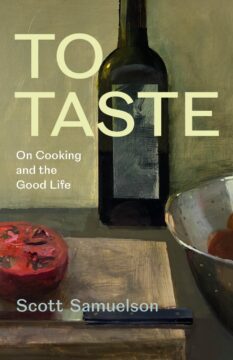 It’s not intimate, it’s philosophy. That sounds like something ChatGPT would say but there is truth in it. Philosophical writing is seldom intimate. When philosophical writing styles are discussed, Nietzsche is usually trotted out as the example that avoids the calculated, dispassionate, heavily qualified tone of philosophy. But intimate? No. Nietzsche was too busy shouting at the reader to achieve intimacy.
One achievement of Scott Samuelson’s To Taste: On Cooking and the Good Life is a level of intimacy rarely attained in philosophy. To say the book is well written is an understatement. He squeezes philosophical insight from engaging accounts of relationships fostered through cooking and eating. The tragic irony of his daughter’s struggle with bulimia is genuinely moving. And his facility with anecdote is considerable. Near the end of the book he summarizes his moral ideal which he borrows from Anne Lamott: “Don’t be an asshole and make sure everybody eats.” That captures about 90% of ethics doesn’t it? (I know. That other 10% is a real bear.)
The argument the book makes is straightforward: “…Cooking and sharing a meal is the paradigm for caring for the soul.” Notice the definite article. “The” paradigm, not “a” paradigm, or “one” paradigm. Apparently, cooking and sharing a meal give us unique insights regarding how to live. In philosophy, this is a controversial claim to say the least. Socrates was the first philosopher, as far as we know, to exhort human beings to care for the soul, but that care had little to do with cooking or eating. One’s soul was to be nurtured by seeking wisdom and virtue through relentless philosophical disputation. Cooking, for Plato’s mouthpiece Socrates, was mere flattery and eating a necessity that too often created desires that overwhelmed reason and fostered moral decay. Much of the history of philosophy has agreed with Plato at some level.
Samuelson is having none of that. He recognizes that a good human life is built out of relationships, and most of those relationships are cultivated and nurtured through food, not as a mere pleasant accompaniment but as something constitutive of those relationships and essential to them.
Over the past 30 years, philosophers have become much more open to the idea that food is worthy of contemplation. And the insight that the meaning and significance of food lie primarily in how it fosters relationships, organizes social life, and celebrates life’s singular moments is almost always central to that discussion. In pointing out the centrality of food to human relationships, Samuelson is not breaking new ground. However, he does bring a new perspective to the topic which produces genuine insight. Prior to his career in philosophy, Samuelson was a professional chef. And as chefs are wont to do, he brings flavor and texture to the table in a way that distinguishes his view from others in this genre.
There is a peculiar absence that haunts most contemporary discussions of food and philosophy. Although we take great pleasure in how food tastes, sensory pleasure is not the primary source of meaning that food generates, according to most philosophers who have an allergic reaction to even limited forms of hedonism. The satisfactions we enjoy from the social bonds that are reinforced when we eat together are the main source of meaning. The appreciation of flavors and textures are too fleeting, subjective, and superficial to anchor a discourse about meaning,
Samuelson treats this contrast between sensory pleasure and meaning as a false dilemma. As a chef he knows how flavor is created and how the pleasure we get from food cannot be disentangled from its social function. After all, no chef could unreservedly praise a congenial dinner party with conversation punctuated by desiccated chicken and soggy rice. And so the book is packed with anecdotes of friendships anchored by the joy of sharing good food and drink and what can be gleaned from them about the nature of a well-lived life. It is, in part, a memoir but one with real philosophical substance.
But as charming and interesting as these stories are, alas I cannot help myself. I want to know how the argument works. The flesh of the argument is quite clear; the bones are often removed for ease of consumption. So what precisely is this paradigm of a good life we discover through cooking and eating?
I want to pull on three threads that, to my mind, form the heart of his argument. One thread concerns the parallels between the judgments we make when cooking and good judgment more generally. He writes “The standard last instruction in a recipe— that the cook should season the dish “to taste”— contains the entire mystery of being human.” He supports this bit of hyperbole with an illuminating discussion of famed Italian cookbook writer Marcella Hazan’s exploration of the concept of insaporire—strict attention to how the flavors of ingredients are disclosed in a dish. It begins with attention to one’s own enjoyment; then becomes an exploration of a food tradition where we go beyond our initial preferences and learn how others taste and create flavor; and finally requires the weaving of that knowledge into a personal style.
Flavor and the pleasure we take in it is essential to judgment in the kitchen—without it there is nothing to explore, no standard that the cook must meet. However, he leaves it to the reader to draw conclusions about good judgment in general from learning to recognize the distinctive goodness of a dish. I think of it this way: Coaxing out flavor is much like coaxing out the basis for cooperation and the alignment of incentives in any situation. It takes knowledge of the elements that create the situation, patience to allow the proper motivations to take root, an ability to imagine how others view the world from their perspective, and the good taste to determine when trajectories are headed in the right direction. The broad outline of good judgment is the same whether cooking a stew or negotiating with a child.
A second thread is the argument that ethics at its core is an extension of hospitality, which again flourishes most readily at the table. He writes: “Our desire for home, love, travel, conversation and transcendence are hooked into our central nagging pain….We’re needy at our core. We’re dependent on nature. We’re dependent on one another.” Hunger reveals those needs. The fundamental work of ethics, he then argues, is “setting the table”—making sure people have what is sufficient to flourish. The successful host must discover those needs and supply them, within the limited constraints of the situation that demands hospitality.
His argument appears to be that this differs in scale but not in kind from a more general ethical stance toward any human relationship. Here the argument thins. It is one thing to supply the conditions for flourishing to people we invite into our homes or festival spaces; quite another to have that aspiration for other people more generally. Of course, the discourse about hospitality has always been in part about the treatment of strangers. But an ethical framework must address the social world in which the vast majority of persons are neither friend nor stranger but an anonymous, unmet crowd whose needs are no less significant for being less known or salient. My inclination in viewing ethics as an extension of hospitality is to note that trust is essential to both. Hospitality cannot exist without trust both on the part of the giver and receiver of hospitality; the same is true of ethical relations more generally. Few will flourish in a low-trust society, as is becoming all too apparent, and so genuine hospitality is a model for how trust is fostered..
Lastly, the significance of food in our lives can perhaps be most clearly seen in festival cooking. Food expresses the existential richness of life, especially in festival celebrations where excess is required.
Though we now call any get-together with loads of food a “feast,” I think a real feast must be an occasion of festivity. The question— especially for the cook— isn’t “What is a feast?” but “What is festivity?” Festivity is musical. Not only do music and dancing often accompany a festival, all are expressions of the same phenomenon of joy overflowing from the depths. It’s not simply a matter of having a nice time. It’s about giving good form to the inevitable surplus of energy and meaning overflowing from our lives.
This idea of giving form to a surplus of energy and meaning, something that exceeds the satisfaction of needs, is crucial for understanding the desires that circulate around food. Part of loving life is enjoying its excess and being pushed toward an immoderation that enables us to enjoy it without incurring excessive risk. In fact, he argues, food and sex “are iterations of the same instinctive craving.” Both exceed their biological purpose. In sex we are thrilled by the hunt yet hunger for intimacy. Food “puts into play the solace of care and the wildness of killing.” In both we seek to explore “the vastness of our wants.” Samuelson’s ethical world is not the sanitized domain of rational choice theory, but a world in which we learn to cope with dirt, violence, and searing pain.
Caring for the soul then is not only about feeding the body, but neither is it about shedding desires that do not conform to narrow prescriptions about what is rational. Caring for the soul is about affirming life, this life, but unlike Nietzsche, who similarly argued for the affirmation of life as the foundation of value, Samuelson’s affirmation is routed through intimacy, care, and therefore flavor.
Flavor is both a symbol and the substance of care and excess. Flavor begins as just chemicals interacting with chemicals. Molecules that protect plants, spread seeds, and sustain muscle, through the magic of cooking, become the focal point of daily hunger—the fruit of life. Flavor is especially important because it makes this excess perceptible. The body needs calories and nutrients; it does not need the char on a pepper or the slow transformation of onions in a pan. Yet these are precisely the things around which attention gathers when we eat.
We flourish when what is necessary becomes the occasion for something more—for pleasure, generosity, intimacy, or play. Festivity takes desires that outrun necessity and turns them toward music, conviviality, and a heaping plateful. Care does not suppress immoderation so much as it makes it inhabitable.
Cooking and sharing food is a paradigm of a good life because life is exorbitant, beyond function or productivity. The work of care and hospitality is to give that surplus forms in which it can flourish.
For those who eat or know someone who does, this book is highly recommended.