
by Dwight Furrow
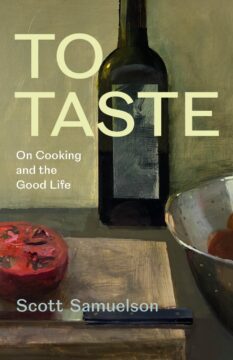 It’s not intimate, it’s philosophy. That sounds like something ChatGPT would say but there is truth in it. Philosophical writing is seldom intimate. When philosophical writing styles are discussed, Nietzsche is usually trotted out as the example that avoids the calculated, dispassionate, heavily qualified tone of philosophy. But intimate? No. Nietzsche was too busy shouting at the reader to achieve intimacy.
One achievement of Scott Samuelson’s To Taste: On Cooking and the Good Life is a level of intimacy rarely attained in philosophy. To say the book is well written is an understatement. He squeezes philosophical insight from engaging accounts of relationships fostered through cooking and eating. The tragic irony of his daughter’s struggle with bulimia is genuinely moving. And his facility with anecdote is considerable. Near the end of the book he summarizes his moral ideal which he borrows from Anne Lamott: “Don’t be an asshole and make sure everybody eats.” That captures about 90% of ethics doesn’t it? (I know. That other 10% is a real bear.)
The argument the book makes is straightforward: “…Cooking and sharing a meal is the paradigm for caring for the soul.” Notice the definite article. “The” paradigm, not “a” paradigm, or “one” paradigm. Apparently, cooking and sharing a meal give us unique insights regarding how to live. In philosophy, this is a controversial claim to say the least. Socrates was the first philosopher, as far as we know, to exhort human beings to care for the soul, but that care had little to do with cooking or eating. One’s soul was to be nurtured by seeking wisdom and virtue through relentless philosophical disputation. Cooking, for Plato’s mouthpiece Socrates, was mere flattery and eating a necessity that too often created desires that overwhelmed reason and fostered moral decay. Much of the history of philosophy has agreed with Plato at some level.
Samuelson is having none of that. Read more »