
by John Allen Paulos
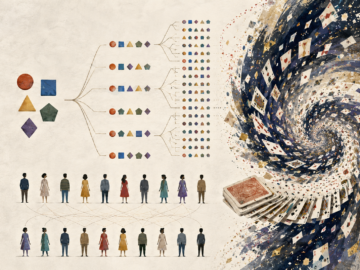 Here is a very simple notion that is astonishingly powerful. It’s called the multiplication principle and states that if some action can be accomplished in M ways and another action can be accomplished in N ways, then these two actions can be performed in succession in MxN ways. Hence the word “multiplication.” This can obviously be extended to three or more actions or choices. An example: In how many ways can one choose and order 3 letters from among the letters a,b,c,d,e? There are 5 possibilities for the first choice, 4 for the second and 3 for the third, so the answer is 5 x 4 x 3, which equals 60. Similarly the number of ways of ordering all 5 letters is 5 x 4 x 3 x 2 x1, which equals 120.
For a slightly more interesting example, assume that 10 world leaders at an international conference line up to get the commemorative group picture taken. In how many ways can the leaders be lined up? There are 10 choices for the left-most person in the photo, 9 choices for the next person in line, 8 for the next person in line, 7 for the next, and so on. So the number of possible orderings for the 10 leaders is 10x9x8x7x6x5x4x3x2x1, which equals 3,628,800. A surprisingly large number! (Of course, we assume that all of the orderings are possible, and that there is no narcissistic blowhard who can commandeer the center of the ordering.) A bit of useful notation for the product 10x9x8x7x6x5x4x3x2x1 is 10 factorial, written as 10!
Now rather than 10 world leaders, consider a deck of 52 cards (no jokers). In how many possible ways are there to order the cards in the deck. Note that there 52 possibilities for the first card in the ordering. After that choice, there remain 51 possible cards for the second card in the ordering, 50 possible choices for the third card in the ordering, 49 possible choices for fourth card, and so on for 48 possible choices, 47 choices, 46 choices until there is only one possible choice for the last card in the ordering.
Invoking the multiplication principle and factorial notation gives us 52x51x50x49x48 4x3x2x1 or 52! ways to order the 52 cards in a deck. So what does 52! equal? In this case the exclamation point might be taken to have two functions – to express the product succinctly and perhaps to express amazement at how big the number is.
The number of ways to order the 52 cards in a deck is, as noted, 52!, which is about 8.06×1067 or 8 followed by 67 zeroes or, in words, infinitesimally infinitesimal. There are many ways to induce an appreciation for the size of this number. One is that the probability that any two humans shuffling the cards in a deck would get the same ordering of the cards is 1/8×1067, which is essentially zero. In fact, any ordering of a thoroughly shuffled deck of cards that you might pick will almost certainly be unique.
Taking this further, let’s assume there have been 100 billion human beings so far and, quite oddly enough, each of them has found the time to shuffle 1,000 decks of cards. The probability oft two of these human-generated orderings resulting in the same ordering is the fraction of the total number of possible orderings constituted by the orderings produced by humans’ shuffles. That is, (100 billion x 1,000)/8 x 1067, which equals 102 x 109 x 103/ 8 x 1067 which, using the basic laws of exponents, equals 1014/8 x 1067or approximately 1/1054 (a decimal point followed by 53 zeroes and a 1). Again the probability of two of these 1014 humans’ shuffles resulting in the same ordering is essentially zero. Needless to reiterate but factorials get very large very fast. After a while they grow even faster than exponentials.
Some comparisons of 52! to other big numbers: the number of stars estimated to be in our Milky Way Galaxy is 400 billion or only 4×10¹¹; the estimated number of stars in the observable universe is only 1024; and the number of nanoseconds (a nanosecond is a billionth of a second) in 14 billion years (the age of the universe) is about 4.4x 1026. This means that 4.4x 1026/8.06×1067, is the minusculely minuscule fraction (once again essentially zero, about 5 x 10 -42) of all possible orderings of a deck of cards that were the result of shuffling a deck every nanosecond since the Big Bang! (Here the ! means Wow, not Bang factorial.) Just a simple physical action, shuffling a deck of cards, leads you to a number that exceeds almost every physical quantity we can think of. What other simple actions will lead us to comparably huge permutations? Cards or something more or less equivalent to them seem to be a canonical example.
The multiplication principle leads directly not only to these humongous numbers and permutations but also to combinations to combinatorics generally as well as to a crucial role in probability* and cryptography. A step in that direction might replace a deck of cards with the 26 lower case letters and the 26 upper case letters – aAbBcCdDeE…xXyYzZ. A 52 letter code involving these 52 letters, one of 8 x 1067 such codes, should be unbreakable, although with the development of quantum computers, who knows? Maybe goodbye bitcoin? In any case the multiplication principle should be an arrow in every person’s cognitive quiver.
*Finally. An exercise. Probability also satisfies a multiplication principle for independent events. Specifically the probability of a number of independent events all occurring is the product of their individual probabilities. So what is more likely – rolling a die 4 times and getting all 6’s or flipping a coin 10 times and getting all heads?
***
John Allen Paulos is an emeritus Professor of Mathematics at Temple University and the author of Innumeracy, A Mathematician Reads the Newspaper, and Irreligion. These and his other books are available here: (https://johnallenpaulos.com/booksandreviews.html).
Enjoying the content on 3QD? Help keep us going by donating now.