
by Steve Szilagyi
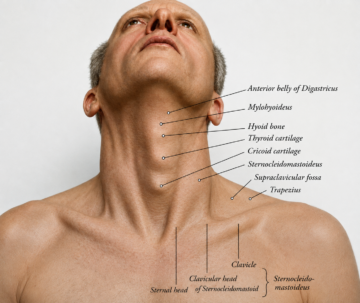
I was cleaning my office the other day and came across some notes for a book I’d been commissioned to write many years ago. The topic was remarkable surgical cases. The book never got finished; the publisher went out of business. But there were a lot of notes for one chapter in particular, and I thought I might try and work them up. So here we go:
The story begins with a young head and neck surgeon named Marshall Strome removing a man’s voice box. It’s a common treatment for some advanced cancers of the larynx that removes the cancer along with the voice box. The downside is loss of the natural voice.
It was only Strome’s second total laryngectomy. He felt pretty good about it. Before the operation, the patient had been facing certain death from cancer. Now the man could look forward to years of life.
Three weeks later, the patient—who had no previous history of mental problems—jumped to his death from a bridge.
The surgeon was shaken.
“I realized then that people were willing to die because they could not speak,” Strome told me when I interviewed him 22 years ago.
The deeper Strome looked into the problem, the more troubling it became. Depression is a well-recognized consequence of total laryngectomy, and suicidal thinking has long been a concern among patients struggling with the loss of their natural voice. Strome believed women were particularly vulnerable. In his experience, some women even refused the operation, preferring the risk of death from cancer to life without a natural voice.
As a head and neck surgeon, Strome knew he would be facing this issue for the rest of his career. Was it possible to find a treatment for advanced larynx cancer that allowed patients to retain the power of speech?
It hadn’t been long since Christiaan Barnard had become a surgical superstar by performing the first heart transplant. Caught up in the excitement, Strome began contemplating something equally momentous.
A human larynx transplant.
In the back of his mind, Strome began constructing the ideal patient for this untried procedure: someone young and strong who had lost his voice box through accident or trauma, not cancer. Someone psychologically stable and otherwise healthy. Someone who loved life but was reckless enough with his luck to risk death in an experimental operation for the chance to speak again.
Did such a person even exist?
Shortcut to Disaster
On the morning of June 11, 1978, 22-year-old Tim Heidler climbed onto his motorcycle and headed for volunteer firefighter training in central Pennsylvania.
“My friends called me ‘Mr. Edge,’” he told me. “Because that’s where I like to live.”
Heidler decided to take a shortcut down a dirt road that crossed private property. Motorcyclists had used the road often enough to anger someone involved with the property, who had strung a strong steel cable across it.
Heidler raced toward it at 40 miles per hour. At the last moment he saw the cable and tried to lay the bike down. Too late.
“It caught me right across the throat and head,” he said. “If I’d have been wearing a helmet with a face mask, it would have torn my whole head off.”
The cable crushed his larynx and hurled him backward.
Lying on his back, Heidler stared up into a clear blue sky.
“I tried to scream. Nothing came out. It was getting hard to breathe. I thought I was going to die.”
His body was battered. It was agony for him to move any part of it. But he was all alone in the woods. There was no choice but to get up and walk.
His firefighter friends were practicing at the local elementary school when one of them noticed a figure making its way across the ball field, wearing a motorcycle helmet and walking with the stiff gait of a corpse from Dawn of the Dead.
“When they saw me coming,” Heidler said, “they fell off the building and came running.”
He spent eight hours in emergency surgery that day. Whatever food he had eaten that morning was the last food to cross his lips for the next year. Whatever casual remarks he had made to his wife and six-month-old son were the last sensible sounds they would hear from a larynx that was now a mash of tissue and cartilage.
Heidler left the operating room breathing through a hole in his neck.
Then things got worse.
He developed pneumonia, staph infections and pancreatitis. Infection spread to his brain, and he fell into a coma that lasted two and a half months. He lost more than 100 pounds.
Then he woke up.
Three months after the accident he was transferred to Pittsburgh, where he underwent 29 more operations. Surgeons repeatedly tried to make surgical sense of his larynx. Nothing worked.
A year after the accident, the robust, rambunctious young man who loved the sound of his own voice was wan, silent and scrawny. Rehabilitation specialists had to reteach him the elementary activities of life.
Eventually he returned home. He tried to resume volunteer firefighting by driving a truck, but a driver who couldn’t shout warnings or directions was a liability.
His firefighting days were over.
“Spend a day with a piece of duct tape over your mouth,” he said. “See what it’s like.”
Heidler learned to use an electronic larynx, which created a buzz that he could sculpt into words with his lips, tongue and teeth. The resulting speech was understandable but robotic.
“My own son was afraid of me,” he said.
Years passed.
Waiting for Medicine to Catch up with Him
Then, in the mid-1990s, Heidler began dating an emergency-room nurse. The nurse knew transplant medicine was advancing rapidly.
Something, she thought, had to be going on somewhere that could help this man.”
Something was.
Marshall Strome had spent years experimenting with larynx transplantation. Dogs hadn’t worked the way he wanted. Sheep were too big. Finally he settled on rats.
Under a microscope, using needles as small and curving as an eyelash, he removed their larynxes and replaced them with those of other rats.
In 1992, Strome and his colleagues published a paper describing a successful rat model for vascularized laryngeal transplantation.
But rats can’t talk. Strome needed something larger.
Something that could tell him how the experiment was going.
“A big rat,” joked Timothy Heidler. “That’s what I am. The big experimental rat.”
By then Strome had left Harvard, where he felt his transplant ambitions were not taken seriously. “They thought I was crazy,” he said.
In Cleveland he found someone who didn’t: Floyd Loop, the heart surgeon who was then chairman and CEO of the Cleveland Clinic.
In 1993, Loop recruited Strome to head the Clinic’s Department of Otolaryngology.
“He gave me everything I needed to make it happen,” said Strome.
Strome began rehearsing transplant surgery in earnest. But the technical problems were only part of the challenge. There was an enormous ethical question.
A heart transplant patient risks death because the alternative is death. But the larynx is not a vital organ. You can live without one. A transplant recipient would undergo major surgery and then face the lifelong hazards of immunosuppressive drugs: infection, malignancy and other potentially fatal complications.
Was it ethical to risk someone’s life merely to give him a voice?
Strome believed it was.
“Speech is who we are,” he said.
He had never forgotten the patient who jumped from the bridge.
After repeated appearances before the Cleveland Clinic’s institutional review board, Strome received approval. LifeBanc, northeastern Ohio’s organ procurement organization, put out the word: the Cleveland Clinic wanted a larynx.
The call reached Nason Hospital in Roaring Spring, Pennsylvania.
Heidler’s emergency nurse girlfriend heard it.
“I wanted to do it for Tim as a Christmas present,” she said.
She called Cleveland.
At first, the Clinic thought she was offering a donor organ. Then she explained: “I have someone here who might make a good recipient.”
The Clinic invited them to Cleveland.
Most importantly, Heidler had never had cancer. A cancer patient receiving immunosuppressive drugs risked recurrence. A trauma victim avoided that danger.
A team of specialists subjected Heidler to a gauntlet of physical and psychological testing. Then came the final interview.
“We essentially did everything in our power to talk him out of it,” said one of the physicians involved. “We were brutal.”
Strome told Heidler to go home and think about it.
“I remember turning to a colleague and saying, ‘That’s it. We’ll never see him again.’”
Heidler returned to Pennsylvania.
Then he called.
“I’ll do it.”
Now all they had to do was wait for someone to die.
The donor was a healthy 40-year-old man from southern Ohio who suffered a catastrophic cerebral hemorrhage just after New Year’s.
At seven one evening, Strome’s telephone rang.
“We have a match,” they said. “The perfect donor.”
Strome turned to his wife.
“This is it,” he said. “If this fails, they’ll call me a lunatic. It will impact you. It will impact our son.”
He asked what she wanted him to do.
“Get on that plane,” she said. “If something goes wrong, we’ll find an island to live on.”
Strome and surgeon Raymond Esclamado flew south through a violent storm to harvest the organ. Eventually they removed the larynx, most of the pharynx, six tracheal rings, thyroid and parathyroid glands and placed the assemblage in a cooler.
Strome looked at it.
It seemed awfully big.
Meanwhile Heidler’s pager went off in Pennsylvania. They found a donor! His bag was already packed. A chartered plane waited at the Altoona-Blair airport.
By 5:30 the next morning, the surgical team had assembled at the Cleveland Clinic.
Before removing Heidler’s ruined larynx, Strome did something he himself called “crazy.” He laid the donor organ next to Heidler’s neck and temporarily hooked it to his blood vessels.
He removed the clamps.
The donor larynx fairly feasted on Heidler’s blood, the first it had tasted in almost ten hours.
“I had to see if it would perfuse,” Strome said. “If I’d taken the old one out and discovered that the new one didn’t work, we would have seriously jeopardized the patient.”
It worked.
Now came the size problem.
The donor larynx was much bigger than Heidler’s. It simply wouldn’t fit.
The surgeons divided into two camps: tight-fitters and loose-fitters. Most wanted to trim away enough muscle to make the new organ fit tightly. Strome worried that a tight fit might make the suture line leak, inviting catastrophic infection in an immunosuppressed patient.
He overruled the majority and left more muscle.
The operation lasted about 12 hours.
“As I finished sewing the larynx in, I thought, ‘Oh God, the thing is alive. It’s working.’”
Technically, the transplant had succeeded.
Now Heidler had to survive it.
He was given powerful immunosuppressive drugs to prevent his body from rejecting the foreign organ. Strome hardly slept during the first month.
“Thinking about the patient all the time, I lost close to ten pounds.”
Biopsy after biopsy showed no rejection.
But two questions remained.
Could Heidler speak?
Could he swallow?
The doctors expected it might take five months before he could produce his first syllable.
Three days after surgery, Strome walked into Heidler’s hospital room.
The patient was grinning.
Strome suggested he try to say something.
“Hello,” Heidler said.
Now Strome was grinning.
Heidler tried again.
“Hi Mom!” He grinned.
A dead set of vocal cords now buzzed with new life.
Heidler’s new voice was lower than his old one. It was not the donor’s voice. He retained the same central Pennsylvania accent and personal vocal inflections he’d had before his accident. The transplanted larynx supplied the sound; the architecture of his mouth and head, and the habits of a lifetime, made the voice his own.
He could even sing, though not particularly well.
There was still the question of swallowing. The doctors thought this might be harder than speaking. Swallowing requires numerous structures to work in precise coordination, and much of Heidler’s throat had been transplanted.
The doctors intended to proceed cautiously.
Heidler did not.
Three months after surgery, he decided his throat was working pretty well. He sat down and ate a meal of pot roast, salad and a dinner roll.
“It could have killed him,” Strome said. “He could have aspirated.”
But it didn’t. The transplanted mechanism worked.
Heidler could eat.
He could talk.
He had his voice back.
Strome waited three years before publishing the results in the New England Journal of Medicine. He wanted to make sure the transplant had truly taken. When the results appeared, network news programs, CNN, Time and newspapers around the world descended on the story.
Heidler spoke to them all.
“Any voice is better than no voice,” he told me.
And there, more or less, my old notes ended.
They ended at exactly the place such stories usually end: with the breakthrough accomplished, the patient restored, the doctors celebrated, and everybody looking expectantly toward the future.
What Happened After the Miracle. Looking at my notes 22 years later, I found myself wondering what that future had actually brought.
I recall that first flush of excitement when everyone thought that larynx transplant was going to be a “next big thing.” It didn’t turn out that way. There’s no international registry for the procedure, but by my count barely more than a dozen have been attempted since Strome’s, and only about half of those with known outcomes could be called successful.
Strome had always imagined the operation’s real beneficiaries would be cancer patients – not accident victims like Heidler. But there was a built-in problem: the last thing patients with circulating cancer cells need is the kind of immunosuppression that you need for a successful transplant. (In 2024, a team in Arizona successfully transplanted a donor organ into a patient with active cancer – but that patient was already immunosuppressed from an unrelated kidney transplant.)
So despite Strome’s hopes, larynx transplant sputtered. But it produced a priceless body of knowledge – quietly improving the art of transplant, microsurgery, patient selection and more. And it’s now on that list of elective procedures – face transplant, hand transplant, bariatric surgery, sex-change, etc. – that are a growing challenge for medical ethicists weighing real risk against no survival benefit.
As for Heidler, he had no doubts about the value of his long ordeal. In 2011, he told CNN the operation had changed his life “dramatically,” and that he’d do it again despite a lifetime on immunosuppressants.
But his destiny took another dramatic turn only one year later. Slow, chronic rejection had taken a toll on Heidler’s now not-so-new larynx. Doctors recommended that it be removed for the patient’s own good. Heidler agreed, and for a second time, his voice was taken away from him. This time, there was no replacement waiting by the table.
Since then, I can find nothing about him online and in the media.
A kind of silence has fallen. I wish him the best.
Enjoying the content on 3QD? Help keep us going by donating now.