
by Dilip D’Souza
August 15 is India’s Independence Day – this year, it was our 80th (1947, our first). This year, we were reminded by various government channels that the previous day, August 14, is Vibhajan Vibhishika Smriti Diwas (“Partition Horrors Remembrance Day”).
This particular “Remembrance Day” is an annual memorial. Which may make you think this year was also the 80th such Day that we’ve observed. But no, it’s only the sixth. For it was first announced only in 2021, by Prime Minister Modi.
To be clear: Of course we should remember the horrors of August 1947. Partition was a bloodbath, a horrific blot on the birth of two countries. But you’ll forgive me if I am just a little sceptical of the motives of the regime we have in India, in announcing such a memorial. Hostility and hatred killed over a million in 1947. Today, there is great political capital in keeping that hostility alive.
Stuff like this, it gets me down. But then I remember how I once travelled across a large island, a country by itself, to meet a favourite and famous author. About how he wrote about murderous hostility. About how he made me feel.
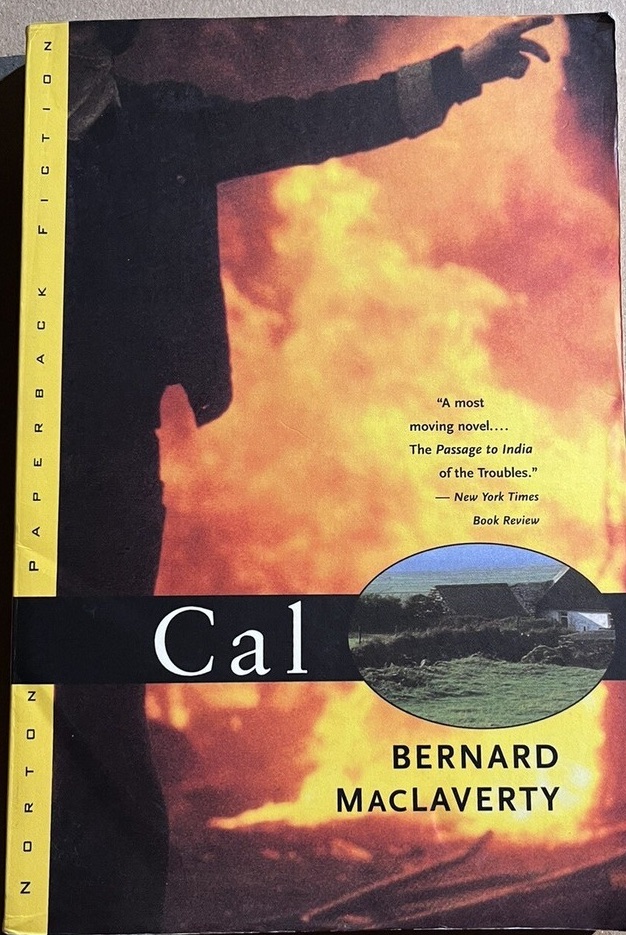
Someone once asked for a list of my favourite books. It was a charm to compile. Just looking at the names brings memories floating in. The finely-detailed, beautifully-told slice of Roman history, the searching examination of pro basketball in the USA … and an exquisite novel set in Northern Ireland’s Troubles.
Bernard MacLaverty’s Cal is about Marcella, a young widow, and Cal, the awkward post-teen who falls in love with her. Simple? But there are complications. For this is Northern Ireland, which is nearly explanation enough. Marcella and Cal come from opposite sides of the bloody chasm there, so reminiscent of chasms in our parts. Cal helps in a murder, and that, without revealing more, draws him to Marcella, wrapping him in grieving, remorseful love. Eventually, a measure of redemption destroys him.
Their story is so tender, so tragic, and MacLaverty writes with such shimmering beauty, that I was thoroughly drained when I finished Cal – but still, inspired by his craft. This, I knew, is how I want to write. This is a story like I want to tell, about themes in my own country I want to explore. I may never write like him, but MacLaverty set the bar high enough for me that there remains plenty of satisfying terrain below.
In England for some weeks some years ago, I knew I had to meet him. I wrote to his publisher asking how to get in touch with him. A few days later, a note arrived from MacLaverty himself, inviting me to visit him in Glasgow. (Though he was born in Belfast, MacLaverty is part of a large Irish emigré community in Glasgow.)
Quickly, I planned a trip there, even managing to call it work. Then again, at the time “work” actually consisted of learning all I could about Northern Ireland, its religious wrangles and the parallels to India and Pakistan. (All the way to this odd parallel: In Belfast, there’s a Kashmir Road.)
MacLaverty fit right in.
Reading Cal, I had imagined MacLaverty as a thoughtful man with a feel for both the tragedies and the absurdities of life; a twinkle-eyed soul who somehow would make it seem entirely natural to combine great sadness with quiet but sharp humour. I had all that in mind as I found my way to MacLaverty’s airy ground-floor flat with its graceful bay windows. Me the awestruck fanboy, MacLaverty the gracious host … we sat in the alcove formed by one of those windows and chatted: about the Troubles, writing, the Irish, how hatreds corrode people, enmity and love, India, nationalism that projects onto football and cricket. And he was much like the impression of him I had arrived with. He had those twinkling eyes, he thought through whatever he said, he spoke softly yet firmly, he had that gentle sense of humour.
And there was the way he made me feel. As if he was even more honoured to meet me than I was to be with him. As if I was the famous author. I was floored. And moved.
Later, Bernard – “Call me Bernard, eh?” he told me sternly at one point – stood and said, “Enough talking, let’s get a beer!” So we strolled through the neighbourhood, me and this famous son of Glasgow, nobody paying us the slightest attention. At a nearby bar, we got our drinks and sat on the slope of a hill behind, surrounded by sunning students also not paying us the slightest attention. Later still, he said, “Look, I’ve got to get home and go to a concert, but why don’t we meet again afterwards, eh? At night?”
So I dined somewhere forgettable by my lonesome and returned to meet Bernard and his wife Madeline at a smoke-filled bar that had me coughing. They looked delighted that I had come back. He walked me around the place introducing me to various friends, some of them stars of the Scottish literary firmament. “That one”, said Bernard, pointing to a graying goateed man asleep on his cheek at his table, “now that one, believe me, he’s Scotland’s finest writer ever.” Alasdair Gray, author of Lanark: A Life in Four Books – “one of the great novels of our time,” one blurb calls it, “a surreal mural of unsettling images and ideas vigorously coloured with anarchic humour” – rose slowly to his feet when Bernard woke him, shook my hand with an old-world dignity, then sat back down, gently put his cheek back on the table and closed his eyes again.
The surreal part was my presence here, surrounded as I was by celebrated literary talent that had enveloped me right away in laughter and friendship. Smoking, coughing friendship, but no less felt for that.
The hours passed in a blur, or more appropriately, a beer- and cigarette-laced haze. Well into the night, Madeline and Bernard walked me part of the way to where I was staying, then hugged me goodnight and turned back toward their home. I had in my hands a copy of Walking the Dog, a collection of his short stories, and Grace Notes, his beautiful third novel that Arundhati Roy pipped to the 1997 Booker, both autographed. I had in my heart a fullness of the spirit that lasted for days. An exhilaration that came from the generosity a marvellous writer had shown a mere unabashed admirer from half the world away.
Cal spoke to me of what tears people apart, but what writing about it does. MacLaverty’s warmth – Bernard’s warmth! – that day said things about the simple, genuine humanity of the man. It came to me that night: it was no surprise that this man wrote that book.
No surprise that he looked at a fierce divide, at the price we pay for our manufactured hostilities – but then found threads that, nevertheless, link us all. I think about all that every August. Every “Remembrance Day”.