
by Bonnie McCune
“The world is so full of a number of things, I’m sure we should all be as happy as kings.” —Robert Louis Stevenson
 Over what is slowly becoming a lengthy session of being alive, I’ve found this statement to be absolutely true. I’m usually thrilled with the variety and my experiences so far. However, those things the world is full of aren’t necessarily always pleasant. Or desirable. We’re thrust, will we, nil we, into a stew of unknowns.
One of the mixed blessings of our contemporary way of life is the instantaneous nature of communications. We don’t have to search for the status of bad weather and storms near us; we get the news complete with visuals, sounds, quotes and opinions. Ditto for horrid happenings—from deadly crashes to wars to terrorists to epidemics.
On a more personal level, experiences of individuals. Yes, occurrences like falling in love or having a baby can make you euphoric. But the death of a loved one, the loss of a pet, getting fired from a good job does the opposite. We have a euphemism for these: we might call them challenges, not setbacks or evils. They shouldn’t plunge us into desperate thoughts. We should rise above them, learn from them.
This admonition doesn’t usually affect my inner status, which is easy to send into a panic. Several weeks ago, I spent the entire night nagged by the thought that I hadn’t paid my state property tax. Which I hadn’t. But throughout the night, I envisioned the tax man pounding on my door to levy penalty after penalty as the days passed because the state hadn’t deposited my delinquent check. Then I figured a whole line of checks would bounce because my bank account would be overdrawn. I’d have no way to appeal these decisions; it says so right on the tax website. My luck in getting a human to answer an official phone is zero, despite my customary plea to the automated responder to “I want a human, I want to talk to a human.”
Lucky for my sleep requirement that sessions like this are occasional. I’ll worry all one night, then be so exhausted the next evening, I’ll successfully grab six or seven hours.
I know I should focus on interesting, positive thoughts (this eliminates current news immediately). The challenge is achieving this. Several years ago, I tried meditation, the kind during which you should be virtually mindless. No thoughts. No emotions. Then how in the heck do you set a goal–even a goal of number of minutes to meditate—and realize you’re making advances?
I did meditate so frequently that I now can instantaneously chant the mantra “Sa Ta Na Ma.” Derived from the ancient Sanskrit language and encapsulating the cyclical nature of life, it represents birth, life, death, and rebirth. Each syllable holds profound meaning: Which of course I can’t remember. Then I worry I’m getting senile dementia.
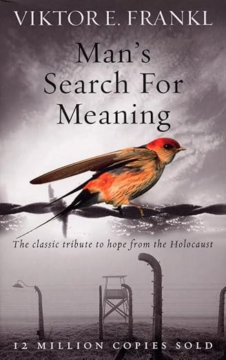
My most productive results came when I stumbled on a classic tome by Viktor Frankl, a prisoner in Nazi concentration camps during World War II. Man’s Search for Meaning no doubt would have been entitled Men and Women’s or People’s Search or The Human Search had it been published more recently, but its subtitle, Saying Yes to Life Nonetheless, explains it all.
Frankl was a certified psychologist and served as a physician throughout the war in the camps. This is where he developed his psychotherapeutic method, logotherapy. If a person has a purpose for his life, via either completion of tasks, or caring for another person, or facing suffering with dignity, he’ll be able to focus in positive manner on moving toward that goal rather than becoming more depressed and discouraged.
For me, becoming involved with Third Act, a national organization of people over the age of sixty determined to change the world for the better, an elder-led movement for climate action and democracy protection, provided the goals. Ever since I became involved some months ago, I’ve avoided the intense depressions I had been experiencing. Activities are free, simple, and not terribly time consuming, yet I feel I’m part of the segment of our society trying to improve ourselves, our lives, our society.
Frankl called this logotherapy. Now, despite studying psychology in college three generations ago, “logo” to me indicates a marketing technique in which a graphic image captures somehow the artistic and energetic power of an idea. But to Frankl, it was the “Third Viennese School of Psychotherapy” (along with Freud’s psychoanalysis and Alfred Adler’s individual psychology, an existential analysis focusing on Kierkegaard’s will to meaning), the premise that the primary motivational force of individuals is to find meaning in life.
I like to think that many of us occasionally wonder, “What is the meaning of life?” or “Why am I here?” or “Why are there so many crackpot crazies wandering around doing evil?” Frankl’s approach provides an uncomplicated manner to move toward feeling we might eventually be able to answer these inexplicable queries. We can ignore our feelings of disquiet, anxiety, foreboding, assign them to our subconscious, and choose to concentrate on whatever we wish, delaying answers for the unsolvable, thus finding purpose for our lives, as Frankl tells us.
I’ve come to believe that action can, indeed, equal progress, or at least help us feel we’re evolving or improving. I also have known for decades that I can’t control everything that occurs, whether natural, human, personal, or induced by malevolent OR benevolent forces. The world is probably better off that I can’t, since I’m not perfect. So I have to let most everything go and tend to itself. But I’m thankful I stumbled across Frankl’s treatise to enable me to be optimistic about life in general.
Each of us must find our life’s purpose on our own, if this important to us. Some are fortunate to accomplish this through a religious faith; some must search, wonder, study, dream; others may settle the question through avoidance or fantasy. I’m still trying to figure out my path.
***
Enjoying the content on 3QD? Help keep us going by donating now.