
The God Test: Artificial Intelligence and Our Coming Cosmic Reckoning (2026) is Robert Wright’s sixth book. It builds on themes and concerns in the previous five books, which I’ll get to at the end. As the title indicates The God Test is about artificial intelligence.
Until OpenAI released ChatGPT in late 2022 AI existed mostly in science fiction, a collection of genres that has become increasingly popular in the last five decades. The intellectual discipline was relatively small, problematic, and often institutionally precarious. Moreover those within the discipline were sometimes/often motivated as much by cultural mythology as by the challenges presented by the discipline itself. Curiosity kept researchers engaged in problem solving while mythology told them why those problems are important.
The particular approach to AI that produced ChatGPT, so-called deep learning, has a characteristic that differentiates it from much earlier work in AI and from all other work in computing: We don’t know how it works. And by “we” I don’t mean only the general public or intellectual specialists outside the discipline. By “we” I mean everyone, including the scientists and engineers who have developed the technology.
The standard line about computers, that they only do what they’re programmed to do, doesn’t apply to large language models (LLMs), the particular technology that dominates the current scene. The engineers program a transformer to “examine” (or, if you prefer, ”consume”) a large corpus of texts, and the transformer constructs (“emits”?) a “model” of the language in those texts – Wright discusses this process in “Chapter Two: The Great Inversion.” The inner mechanisms of that model, however, are opaque. The engineers who programmed and ran the transformer can’t see into it to see how it works – something Wright discusses in “Chapter Four: The Evolution of a Large Language Model.”
What strange beast
Subsuming these factors, deeper than any of them, and more elusive is the simple fact that contemporary chatbots and their siblings are deeply STRANGE. They’re not animal, vegetable, or mineral; they’re a new kind of thing that doesn’t fit into pre-existing cultural categories. They’re inanimate things with which we can converse like we would with another human.
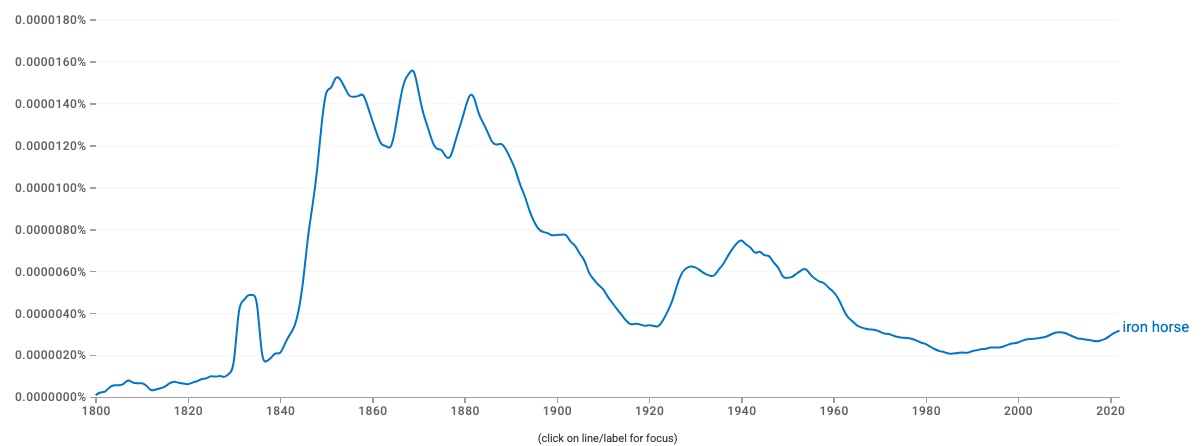
In the 19th century the term “iron horse” arose to characterize steam locomotives. Why? Because it moved autonomously over the surface of the earth like a horse, but it was made of iron and therefore inanimate. Consider this passage from Henry David Thoreau’s “Sound” chapter in Walden (1854):
When I meet the engine with its train of cars moving off with planetary motion . . . with its steam cloud like a banner streaming behind in gold and silver wreaths . . . as if this traveling demigod, this cloud-compeller, would ere long take the sunset sky for the livery of his train; when I hear the iron horse make the hills echo with his snort like thunder, shaking the earth with his feet, and breathing fire and smoke from his nostrils, (what kind of winged horse or fiery dragon they will put into the new Mythology I don’t know), it seems as if the earth had got a race now worthy to inhabit it.
There you have it, the iron horse and the fire-breathing dragon. Now we have the electronic brain, as it was known in my youth, the thinking machine.
A Cultural Rorschach Blot
These factors make any attempt to explain the technology and its implications a bit like trying to describe a Rorschach blot. There’s something real there but characterizing it is difficult. Consequently any account you give has a large element of projection in it. AI thus functions as a cultural Rorschach blot onto which we project our hopes and fears, who we are and what we are, where we want to go.
That’s what The God Test is, Robert Wright’s interpretation of this strange cultural Rorschach blot. That makes it a very elusive thing to review: Am I talking about Wright’s ideas or the cultural matrix in which they are embedded? He’s using concepts that were forged and came into usage before ChatGPT blasted through barriers of preconceived ideation, as are all of us in the LLM whisperer business. We’re working in a conceptual world that is being consigned to the dust heap of history by the phenomenon we’re trying to apprehend.
This particular Rorschach blot, The God Test, draws two kinds of projection out of Wright. He expresses them in fifteen chapters and an appendix. There is Wright’s account of how contemporary A.I. works; he concentrates on LLMs (large language models). That material is concentrated in chapters two, four, five, and six, though some is here and there elsewhere in the book. Wright uses the rest of the book (chapters one and three, seven through fifteen, and the appendix) to establish a cosmic context – his phrase – for his argument, which is about the significance of A.I. for human life and the future of humankind. This is the important material, this is why I’m attempting to review the book, and it is not very tightly coupled with the material on how this technology works.
I suppose that’s inevitable, because, as I’ve indicated, most of the thinking and writing that’s been done about artificial intelligence has been based on little more than the idea that one day we’ll create a computer system that’s as smart as we are, quite possibly even smarter, and even very much super-duper giant economy size smarter. That thinking hasn’t actually had to deal with, interact directly with, that kind of a system. Now we have no choice. It’s unsettling.
Thus I would say that my own belief in the power of this technology is grounded primarily in my experience using chatbots over the last three and a half years, which necessarily includes how much they have improved in that time. I take that experience in the context of my general life experience, which of course includes my experience interacting with other human being and with other computer systems. It is into THAT that I project various attempts to explain what these chatbots are doing.
If you don’t have much direct experience of chatbots, then you are not going to understand why so many people are talking and writing about them. If you do have some experience with them, more than a little, but not necessarily a whole lot – I know, kinda’ vague, isn’t it? – and you aren’t impressed, then nothing I say, or Robert Wright says, or anyone else, whether Geoffrey Hinton, Yann LeCun, or even Gary Marcus for that matter, nothing anyone else says will convince you otherwise.
If you don’t already believe that this technology is powerful and important, it is unlikely that Wright will convince you otherwise, nor, for that matter, will you find the rest of the book compelling. If you already believe in the technology, then Wright’s account of how it works serves a purpose that’s more rhetorical and even clinical than explanatory. He doesn’t know how it works, nor does anyone else, but he’s not crazy for trying to understand it and neither are you. There’s something there, really.
Still, if you’re satisfied on the score you can skip over my next section, which is a brief note on meaning, and go right onto “Klaatu barada nikto,” where I transition to cosmic mode.
The Problem of Meaning
Let’s consider a typical passage. “Searle” is the philosopher John Searle and in 1980 paper is the one the introduced the Chinese Room thought experiment, perhaps the best-known thought experiment of the last 50 years.
If a human being looked at an apple and said, “That’s an apple, and it’s an edible fruit, and you can use it to make an apple pie,” Searle would say the human is exhibiting understanding. And, to judge by his 1980 paper, that wouldn’t be because the human has the subjective experience of understanding. Rather, it would be because the human’s brain is performing the functions that the paper associates with understanding—assigning meaning to words and doing so not just by mapping the relative semantic relationships among them but by mapping them onto things in the real world. And that’s something AIs can now do. (p. 72)
Notice that final contrast between “mapping the relative semantic relationships among” and “mapping them onto things in the real world.” The contrast is obvious, but its implications are not at all what Wright thinks they are.
Yes, the real world is full of things we can point to, apples, oranges, birds, bees, trees and flowers, mountains, lakes, the sky, clouds in the sky, the sun, the moon, the stars. But what of abstract things, such as truth and justice? Where do we see them? How do we point to them? What about atoms? Yes, they are physical things, but no one has ever seen an atom. These things are abstract. We understand them through complex webs of conceptual relationships, relationships which we track through the relationships between words.
Back in 2016 Steven Harnad and his colleagues published a paper about the relationships between words in dictionaries, The Latent Structure of Dictionaries. They found that a set of only 1% of the words in the dictionary was sufficient to define all the other words. The meanings of that 1% are then grounded in physical referents in the external world.
Semantic relationships between words are thus far more important that Wright acknowledges. This is important for our understanding of LLMs, which are grounded entirely in a world of words, though we can now connect them to the visible world through models that are trained on images. Semantic relations between words, that’s where almost all the action is.
Just how this criticism affects Wright’s account is not clear – things are never clear in these matters – but the issue he’s wrestling with is whether or not LLMs can really understand language in the sense that humans do. On that issue I’m attracted to a remark that Harnad uttered in a podcast at The Gradient: “What is most remarkable about [LLMs] is what they can accomplish without understanding.”
I’ve got other problems with Wright’s discussion of how LLMs work, but I want to move on. If you want to explore those kinds of issues, Bert Idem has published a useful discussion at Finite Ape. It’s time to zoom out to Wright’s cosmic context.
Whether or not you have seen the 1951 science fiction film, The Day the Earth Stood Still, you may be familiar with the most famous line in the film – one of the most famous lines in all of science fiction, right up there with “Beam me up, Scotty” – “Klaatu barada nikto.” Powerful aliens have detected atomic weaponry on earth and have sent an emissary, Klaatu, to warn us to clean up our act or they will be forced to destroy us. This that and the other happens and Klaatu is killed. His guardian robot, Gort, is about to destroy earth when a woman named “Helen” utters “Klaatu barada nikto.” Gort relents, revives Klaatu, and the citizens of earth are put on notice.
In effect, Robert Wright’s The God Test is an extended commentary on that situation. A.I. is playing the role of the alien civilization who sent Klaatu and Gort to warn earth. Wright never quite goes as far as some AI Doomers, who believe that at some point in the future – maybe only five years, perhaps 50 or more years, but sometime for certain, that’s for darn sure! – AI will “take off” through a process known as “recursive self-improvement (RSI)” and become an autonomous force powerful enough take over the world. It may even destroy humanity if it has no need for us. Though, who knows? maybe it’ll keep us around as pets.
As I say, Wright doesn’t go that far, but he does believe that AI presents problems that require international cooperation, as does climate change, nuclear weapons, bioweapons, and immigration. That’s been a major theme of his for years, and it’s an important one. It’s a reason for reading this book.
AI moves easily across borders, for whatever interpretation you place on “moves across borders.” Chatbots can range over the internet as freely as any other app regardless of where their home server is physically located. Moreover, as recent incidents (e.g. the Hugging Face incident) have demonstrated, controlling how and where they move is difficult. And so-called “open weight models” can be implemented on any server with sufficient capacity.
That concern, the need for more international cooperation, has been with Wright for a long time. I want to conclude this review by taking a quick blitz through Wright’s career by looking at his previous five books, in order. I should note that I’ve only read one of them, but I’ve been following his journalism since he began writing for The New Republic in the late 1980s and I’ve been following his podcasting since Meaningoflife.tv in 2002 and Bloogingheads.tv in 2005. I think I’ve got a reasonable idea of what makes him tick.
1989 Three Scientists and Their Gods: Looking for Meaning in an Age of Information. Notice that title, science, god, and meaning (not to mention information), all of which show up in The God Test. The scientists:
- Edward Fredkin: A computer scientist who advanced the idea that universe is a giant computer. He shows up in “Chapter Fifteen: Fredkin’s Mission.”
- Edward O. Wilson: Founded sociobiology which gave rise to evolutionary psychology, which is the subject of Wright’s next book.
- Kenneth Boulding: General systems theory and the need for worldwide organization on a variety of issues. In The God Test Wright remarks that Boulding “thought the world needed international institutions that were stronger than the United nations, but he was wary of highly centralized power” (p. 278).
1994 The Moral Animal: Why We Are the Way We Are: The New Science of Evolutionary Psychology. Some themes from evolutionary psychology show up in The God Test, including game theory as a way of thinking about behavior and the idea of mental mechanisms arising through an evolutionary process.
1999 Nonzero: The Logic of Human Destiny. This is the book I’ve read, as I’ve developed a complimentary approach to cultural evolution – Wright’s subject – back in the 1990s with David Hays (e.g. The Evolution of Cognition). Wright’s title comes from game theory. Zero sum games are games where one player’s win is necessarily another player’s loos. In nonzero sum games both players (or several) can benefit. Over the long haul, Wright argues, human society has evolved by creating ever more and wider opportunities for cooperation interaction. I agree. The process has direction, but does not presuppose a being that is orchestrating the process. Rather, the direction is in inherent in the process itself (something David Hays and I discuss in A Note on Why Natural Selection Leads to Complexity, 1990). The emergence of AI is calling us to take our game up a level.
2009 The Evolution of God. This is from the Wikipedia entry:
… a 2009 book by Robert Wright, in which the author explores the history of the concept of God in the three Abrahamic religions through a variety of means, including archaeology, history, theology, and evolutionary psychology. The patterns which link Judaism, Christianity, and Islam and the ways in which they have changed their concepts over time are explored as one of the central themes.
One of the conclusions of the book that Wright tries to make is a reconciliation between science and religion. He also speculates on the future of the concept of God.
While Wright doesn’t go so far as to speculate that an artificial superintelligence (ASI in the lingo) would be a god, there are those who do and he discusses some of them. Here and there he quotes from the Bible.
2017 Why Buddhism is True: The Science and Philosophy of Meditation and Enlightenment. Buddhism comes in many forms. Wright is interested in a secular Westernized form which focuses on mindfulness meditation, a discipline which Wright practices and which he has featured frequently in his podcasts. Wright devotes a chapter to this kind of material, “Chapter Fourteen: Enlightenment Now,” which also gets mixed in with a teleology discussion. But Wright is also interested in how meditation gives you a more distant perspective on life, helps free you from cognitive bias, and dissolves the boundaries between you, others, and the rest of the world (if only temporarily).
It comes down to this (from The God Test, p. 266):
I mean, let’s face it: The gap between where our species is and where it needs to be is almost comically vast. We need to have the kind of cohesion a group has when united by a big common threat–because humankind is in fact facing a big common threat–because humankind is in fact facing a big common threat: an intelligence revolution whose effects, in the absence of wise national and international governance, will probably lie somewhere on the spectrum between dangerously destabilizing on a global scale and global-thermonuclear-war-level catastrophic. And the fact that his technology could, in the presence of wise governance, bring untold blessings only raises the stakes further.
Frankly, I’d like to think that we could reach that level of cohesion without facing a common threat.
* * * * *
There’s a lot in The God Test. Just what it is, though, isn’t exactly clear. In the end it comes off as a philosophical meditation, not so much in paragraph-to-paragraph exposition and argument, but in the overall vibe. But also a wake-up call, a plea, an earnest “Klaatu barada nikto” bounced off the future and directed at the present.
* * * * *
I’ve written a number of blog posts in which I try to figure out how to review The God Test. For my version of AI-in-cosmic-context, see Welcome to the Fourth Arena – The World is Gifted, 3 Quarks Daily, June 20, 2022.
Enjoying the content on 3QD? Help keep us going by donating now.