
by Thomas Fernandes

A common sensational science fact that used to be mentioned is that matter is mostly empty space. Crazy right?!
It comes from a real observation that at the atomic level, there are only a few very tiny electrons to occupy the vast distance between nuclei, leaving most of the space technically empty.
Physicists tend to find this framing annoying. They would object that the wave function of an electron occupies all this supposedly empty space continuously, as a probability function. And the Pauli exclusion principle would repel anything trying to enter it anyway. Duh.
But I never found the correction satisfying either. It replaces one intuitive but incomplete picture with an impenetrable explanation.
Unless I did the math myself or followed along (and sometimes even then), I need to understand by visualizing, usually through analogies. The one I thought of in this case is a wheel. Take a wheel with a single spoke. Most of the interior is empty. Now spin it fast. To your eyes it looks full, a solid disc. And not just to your eyes, throw a tennis ball at it and it will bounce back. For all practical purposes, as far as anything interacting with it can tell, it is a completely filled circle. Not more emptiness.
I thought the analogy was good and wanted to see how far it could go. How much of quantum mechanics can particles depicted as infinitely-fast-tiny-spinning-wheels (quantum wheels) actually explain? Here is my attempt to understand quantum mechanics and explain it using wheels.
Wave-particle duality and quantum fields
Light and electrons do something counterintuitive (actually all they do is counterintuitive it seems). In some experiments they behave like particles, discrete and localized, hitting a detector at a single point. In others they behave like waves, spreading out, interfering with themselves, producing patterns that only make sense if the thing passing through the experiment was everywhere at once. How can one thing be both?
Well, back to the wheel. We already have an idea. If the wheel is spinning then it is like a wave everywhere at once. If we somehow stop the wheel say by interacting with it and blocking the spoke rotation then it behaves as a particle, a singular spoke.
Quantum field theory, the most complete description of matter we have, says that what is fundamental are fields. Invisible entities that pervade all of space. Particles are excitations of those fields. An electron is what the electron field does when disturbed, the same way sound is what air does when disturbed. There is no sound-stuff distinct from air-stuff. There is no electron-stuff distinct from field-stuff.
This fits the wheel analogy even more naturally than the classical wave picture does. We never assumed we had spokes AND blurs, we imagined one spoke causing the blurring. Quantum field theory would say there was only a blurring that, once disturbed, resolved into what looks like a spoke. So, we had it backwards, the spoke is a stopped blurring rather than the blurring being a moving spoke. If we can manage this somewhat counterintuitive description of the quantum wheel, I think we can explain the rest of the properties.
According to this principle, certain pairs of properties cannot both be precisely defined at the same time. Position and momentum are the classic example. The more precisely you know where a particle is, the less precisely you can know how fast and in which direction it is moving, and vice versa. This is not a limitation of instruments. It has been shown to be a fundamental property through the mathematics of non-commutativity of position and quantum momentum.
The wheel makes this intuitive without any mathematics at all, once we accept that the quantum wheel is truly a blur that can become contained in a spoke by interacting with it. We can either study the blur and get a direction and speed of rotation by throwing tennis balls at it and studying how they bounce off. But doing this makes the position of the spoke at any given time unknowable. Or we can interfere with the blurring until it resolves into a spoke at a measurable position, but lose all information about the speed and direction of the blur in the process.
Probably the most famous part of quantum mechanics, the Schrödinger equation and the famous Schrödinger’s cat being dead and alive at the same time. Before you measure a quantum particle’s position, it does not have one. The particle exists in a superposition of all the possible positions its wave function assigns probability to. There is no position to find, even in principle.
“A quantum particle in a superposition, contrary to common belief, is not really in two (or more) states at once. Rather, a superposition means that there is more than one possible outcome of a measurement. For an object at everyday scales, described by classical physics, that makes no sense — it is either here or there, red or blue. If we can’t say which it is, that’s just because of our ignorance: We haven’t looked. But for quantum superpositions, there simply is no definite answer — the property of “position” is ill-defined. » Philip ball in a quanta magazine article
This is captured well by a spinning wheel. Once set spinning, all outcomes are possible, with probability based on the relative angle of the circle each occupies. You cannot say what outcome it will resolve into until you stop the wheel. Like the cat example, though, this understates the weirdness of quantum superposition.
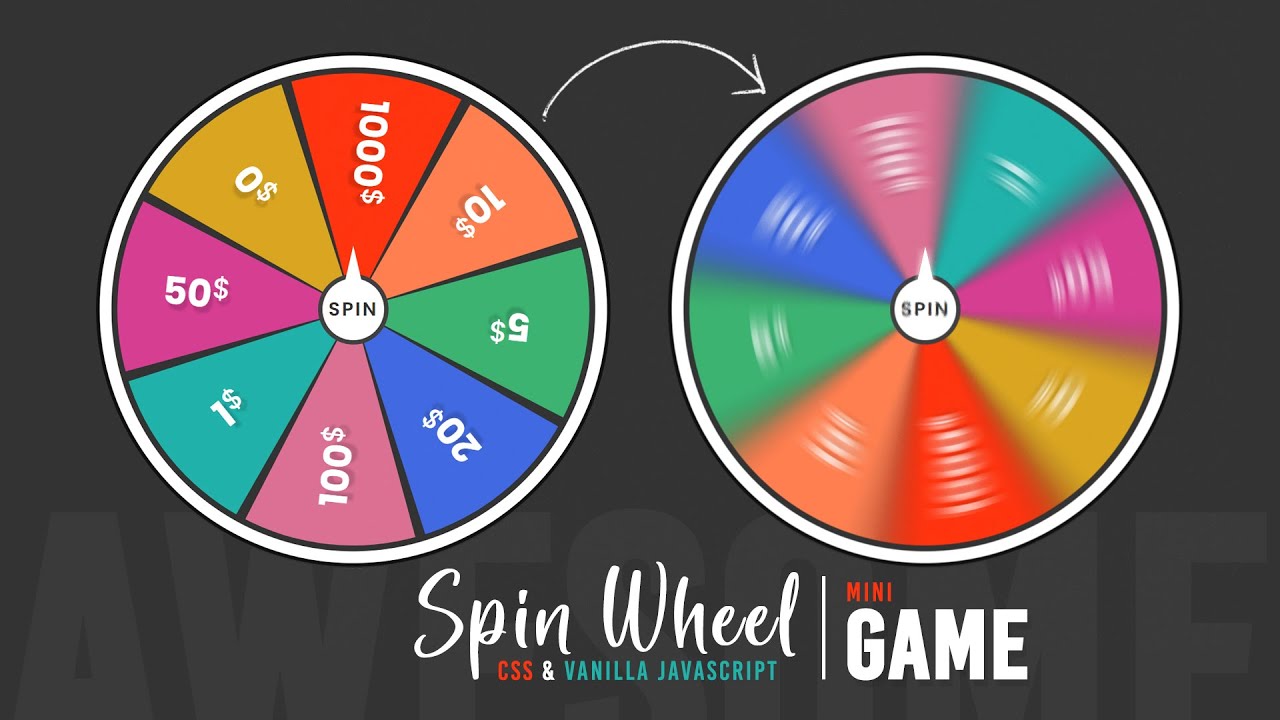 In a physical spinning wheel, once you spin it, force, inertia and friction set the outcome. It only feels uncertain because we cannot predict it. According to the superposition principle, all states are truly equally possible. This is represented by our quantum wheel since it is intrinsically a blur and the spoke is only the manifestation it takes when interacting with something. Before you collapse the blur into a spoke there is absolutely no prediction to be made. The wheel would have happily remained pure possibility.
By the uncertainty principle, the direction of rotation is also in superposition, not just the position of the spoke. Looking at a spinning wheel, you cannot tell if it is spinning clockwise or counterclockwise. Both are equally probable before you measure it, say by throwing a tennis ball at it and seeing how it deflects.
If quantum superposition is the natural state of things, why does the world look classical?
The short answer is that quantum wheels are extraordinarily fragile. Any interaction with the surrounding environment, a passing photon, a neighboring atom, a fluctuation in temperature, is enough to force the blur to resolve into a definite spoke. Physicists call this decoherence.
When two quantum particles interact, they can become entangled, meaning they can no longer be described independently. The state of one predicts the state of the other, even though both states remain individually undefined.
One of the most common ways to create entangled particles is to split a photon in two photons using a special crystal. The two daughter photons share a single quantum state. Individually, neither has a definite polarization, but their polarizations are perfectly correlated so that taken together their joint properties reflect the original photon’s polarization.
In wheel terms, consider a two-spoke wheel with spokes exactly 180 degrees apart. It splits into two single-spoke daughter wheels, each taking one spoke, but still weakly connected at the axle. Both daughter wheels are spinning, both spokes are blurs, and everything we saw before still holds. The axle connection ensures the geometry of the original wheel is still enforced. At any given time, the spoke of one wheel points exactly 180 degrees from the other.
When you interact with one wheel enough to resolve its blur into a measurable spoke, two things happen simultaneously. The other wheel’s spoke is now determined, pointing in the opposite direction. And the fragile axle connection breaks. Left to spin again they will behave as two fully independent single-spoke wheels, no longer linked.
What I just mentioned, that when you measure a quantum particle the blur of possibilities resolves into a single outcome, is the cause of many theories and debates.
How can multiple possibilities resolve into one outcome? If truly random why do multiple observers always agree on what they saw? How is the outcome chosen? What happens to the other possibilities?
Common theories about why are:
Copenhagen: Don’t care. We know the probabilities of where the spoke will be. We know collapsing will be in one of those only. That’s it.
Many-Worlds: There’s no real collapse. Instead, every possible outcome becomes real in a different branch of the universe, and we just experience one. Like a Marvel multiverse.
Quantum Bayesianism: There is no collapse. Quantum mechanics isn’t describing reality itself but represents the information you have. Before measurement you don’t know. After you know.
Relational mechanics: There is a collapse, but it is not universal. It is relational. One possibility of the many is fixed by a given interaction but it might be another in a future one.
Another less known one is the Pilot-wave theory, which is basically the wheel theory! According to it there is no collapse because particles are real objects with defined positions. Always. The wave function is only a guide for the particle, but it is the particle itself that stays definite all along. This looks a lot like saying there is really a spoke that is guided by the wheel and appears like a blur only to an observer that cannot determine its position without intervening.
With all the arrogance of someone who doesn’t really understand quantum physics, this entire debate seemed weird to me. Multiverses and information-only realities I can live with. What I can’t get past is that measurement always requires some interaction.
Our eyes and classical microscopy used the bouncing photon of a light source to see. Electron microscopy uses the bouncing electron from an electron beam. Quantum measurement is different in kind, I am sure, but I imagine it still causes enough interference for decoherence to happen and force the blur into a definite spoke. So, for me ‘collapse’ and ‘decoherence’ are really the same thing except one happens by interacting with the particle you use to measure and the other when you are not looking by interacting with other particles.
Initially, collapse was introduced to explain why observers see a single spoke while it behaves like a blur when unmeasured. This was decades before decoherence research.
A recent attempt (my favorite) to answer this properly is Wojciech Zurek’s quantum Darwinism, which bridges the gap between quantum and classical without invoking collapse or parallel worlds.
His answer connects entanglement to decoherence. The environment causing decoherence is copying the quantum system, not just disrupting it.
Think of the spinning wheel and photons as tennis balls thrown at it. A single ball bouncing off the wheel becomes correlated with the wheel’s motion in the way it is deflected. The deviation of the ball is consistent with being hit from this angle at this speed at this time. Each ball then carries away a tiny imprint of the wheel’s motion. In a way the ball and the wheel are now entangled like the daughter wheels of before. The deviation of the ball must correspond to the spinning of the wheel. Another ball hits, another deviation, another correlation. Another ball deviates. Another. Within a single microsecond, photons from sunlight imprint the position of a grain of dust approximately 10 million times. Each carrying the same information of the spinning speed and direction that can interact with other particles in turn and be observed.
Zurek calls the states that can be robustly copied or imprinted pointer states. As Zurek puts it, pointer states “can survive the process of copying, and so the information about them can multiply.” Hence quantum Darwinism. Pointer states therefore correspond to classically observable properties of position, charge, momentum at human scales. They are measurable because they are encoded and repeated in every interaction.
The quantum properties like superpositions are not pointer states because they dilute. With every interaction the superposition principle extends to entangled particles. Looking at the wheel before any interaction the superposition is clear, it could be spinning left or right. After one interaction, it is about the wheel AND the deviated ball. Either the wheel spins left and the ball was deviated left, or the wheel spins right and the ball was deviated right. Entangled particles are linked so what we cannot observe is the wheel turning left and the ball deviated right, that would violate conservation of momentum. So, the alternative spinning trajectory can no longer be observed in the wheel alone, it is a property to be observed in all the particles that are entangled with it.
In the now decoherent system, it has become spread to the millions of balls entangled with the wheel. This is unobservable, and it becomes unobservable extraordinarily fast. For a dust grain, the estimated timescale for decoherence in open air is around 10-31 seconds, less than the time it takes light to cross the width of a proton. By the time you try to observe the full system it is now billions of new entangled particles. Oops, it’s trillions now.
The quantum properties are shared with each interaction, not duplicated. This makes them unfit for the copying process and so cannot appear in the observable world made of millions of particles. The experience of ‘collapse’ during measurement then is just entanglement on a large scale that allows pointer states to be measured but makes the spread quantum properties unobservable. And decoherence can be better understood as being measured by the world.
This does not settle the debates on the interpretation of why only one outcome is experienced out of many possibilities. It merely sharpens the mechanism by which this outcome emerges.
Buoyed by my newfound (superficial) understanding of quantum physics I will try to extend it to something that was never clear to me, quantum computing. I never felt it was well explained, even during the years it was hyped before AI took over the conversation, and I imagine many people feel the same. How is a quantum computer actually supposed to work? I bet it has something to do with wheels.
***
While you wait for the quantum computing installment, you can find my other essays at Librotium. Fair warning, none of them are about quantum physics. You can consider it either a feature or a bug depending on who you are.
Enjoying the content on 3QD? Help keep us going by donating now.