
A collage essay by River Lerner
Look #1: I am nine, it is a Sunday, and I am sitting in the back of a college classroom amidst children slightly older and significantly smarter. The theory professor sits before us at the piano, his hands obscured by a cloak of black wood. Intervals and chords stain the air with their harmonics. He looks at each of us expectantly.
We all know how this game goes, though for all I can tell, it’s strictly guesswork. A mystery why some answers please while others don’t. Though most classmates struggle somewhat with the pitch identification exercise, none are as chronically challenged as I am. There was recent murmuration of holding me back a year.
This day is different. From the far end of the room, even lacking the necessary eyeglasses prescription I’d wait another few years for, I find myself able to peer over my teacher’s shoulder at his long fingers caressing the keys. Each note speaks its name aloud to me as it is played, almost nakedly. Was it always this easy? Am I allowed this knowledge? Who or what am I cheating?
I offer new answers – tentatively at first. Then I recite what should have been my classmates’ answers. He plays three, four, five notes at a time. I continue with increasing zeal.
The teacher’s look arches over my head to my parents. At the end of class, he pulls them aside. They whisper and occasionally glance at me. Shortly thereafter, I am told to audition for conservatory.
“My GF is a pianist and has perfect pitch (since childhood). She says all elite instrumentalists have it (I don’t know if that’s true). She is really annoying in this regard but sometimes useful, e.g., I can be listening to a song, and ask, ‘what key is it in,’ and she will tell me right away, along with what the chords are, except this also contains lots of eye-rolling.”1u/kgk, Reply to: “Anyone have perfect pitch? What’s your experience?” Cracking the Code Forum, 2021, https://forum.troygrady.com/t/anyone-have-perfect-pitch-whats-your-experience/5913/10.
“To stump someone with perfect pitch, play highly detuned (microtonal) notes, unusual timbres, or dense, stacked atonal chords. Because people with absolute pitch memorize standard concert tuning (A4 = 440 Hz), breaking these rules causes confusion.”2Advice from Google AI.
“I’m still trying to stump Dylan. I think I need to try a little harder!”3Beato, Richard. “Using perfect pitch with complex chords.” YouTube, 27 June 2016, https://www.youtube.com/watch?v=OrSHnYN2RDU
Look #2: Twenty years later, at a friend’s urging to join her chorus, I stand in front of a small jury, auditioning. The conductor reviews my list of qualifications, including a handful of years indeed spent in conservatory. I temper the delta between my on-paper trajectory and reality-based shortcoming by reiterating the practice injury I sustained a decade prior. No matter, he says; let’s see how you do.
As he guides me through warm-up exercises, I wonder why the piano is a semitone off. It is irritating, to say the least. My brow furrows as I clarify the key in which we’re singing.
He looks at the other juror, saying nothing. He looks back at me. We keep singing.
When I attend rehearsal as a fresh tenor, I am dismayed to find this piano dismally out of tune as well. I rapid-transpose Bernstein and Whitacre to mitigate the discordance between the notes on the page and what I’m hearing.
I do this for months. I fantasize about playing the piano during break time – verboten per chorus rules – and proving to myself how wrong it must be.
“I’m sorry to say, for our listeners with absolute pitch, it’s probably coming.”4West Marvin, Elizabeth. “Demystifying perfect pitch with Elizabeth West Marvin.” Notes from the Staff, 1 March 2022, https://notesfromthestaff.podbean.com/e/demistifying-perfect-pitch-with-elizabeth-west-marvin/.
It takes over a year of rehearsal before it hits me: the piano isn’t out of tune. I am.
“[I]t seems that many with AP find that at some time during midlife their perception of AP begins to ‘shift,’ eventually mapping once-learned pitch-class names onto incorrect pitches (Vernon 1977; Ward 1999, 28081). This midlife perceptual shift seems to affect all listeners in the sharp direction – that is, if presented with the sound of A440, they would perceive it as B’ a semitone higher. The effect seems to widen as subjects get older: I have spoken with musicians over seventy years of age who report their AP shifting by as much as a third.”5Karpinski, Gary Steven. Aural skills acquisition: The development of listening, reading, and performing skills in college-level musicians. Oxford University Press, 2000.
“In another study McKetton did, a 70-year-old man said he had perfect pitch but got every note wrong when he was tested. She then noticed that all of his responses were one tone off. […] When she asked him to adjust his answers by one tone, he was 100 percent accurate.”6Miller, Beth. “Perfect pitch neuroscience: UD’s Keith Schneider finds brain distinction in those with rare ability.” University of Delaware, 11 February 2019.
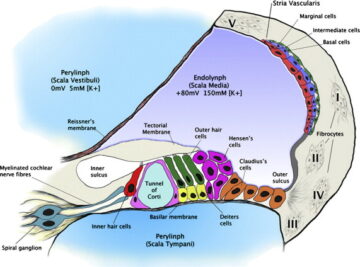
“Age-related hearing loss is characterized by the progressive loss of the sensory hair cells of the inner ear, which are responsible for encoding sound into neural signals. Unlike other cells throughout the body, sensory hair cells in the inner ear cannot regenerate, and these cells are progressively lost over the course of life…”7Lin, Frank R. “Age-related hearing loss.” New England Journal of Medicine 390, no. 16 (2024): 1505-1512.
“…[A] case could be made for a parallel between PM [paracusis musicalis] and presbycusis […] For example, a sensory type of ARHL [age-related hearing loss] involves loss of cochlear outer hair cells of the inner ear, compromising fine-tuning as auditory filters widen (Wang et al., 1997) and high-frequency thresholds increase (Liberman, 2020). The latter could be consequential to pitch recognition since high-frequency content provides valuable auditory cues (spectra) for identifying fundamental frequency—the pitch perceived from a tone.”8Baker, Barry L., and Youkyung Bae. “Paracusis musicalis: Insights on age-related absolute pitch decline.” Psychology of Music (2025): 03057356251399802.
My hair cells have gotten a crew cut.
My hair cells had an overzealous barber.
My hair cells took matters into their own hands with a buzzer.
My hair cells stopped liking the music I favor and zone out when I play it.
My hair cells wrote a letter stating until they receive equal wages, they will detune everything I hear by a half step, as the master tuner is on strike.
My hair cells were placed under a curse that no one knows how to break.
My hair cells huddle together in the heart of the cochlea, eyeing the light with wary, untrusting eyes.
I forgot to renew my hair cells on time from God’s library, so he took them back.
Everything is now closed-captioned.
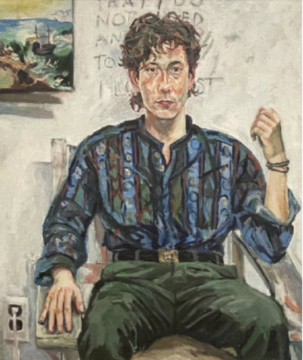
“This striking painting explores coded queer desire through an intimate portrait of Damien, one of Pittore’s students and the subject of his most intense relationship. […] A reproduction of Bruegel’s Landscape with the Fall of Icarus, ca. 1560, in the background suggests feelings that might bring the artist too close to the sun […] The mysterious partial inscription, “That I do not need an…,” deepens the enigma.”9Ogunquit Museum of American Art, American Conversations: Fashioning Ourselves, current exhibit, 2026, https://guides.bloombergconnects.org/en-US/guide/theOgunquitMuseumOfAmericanArt/item/787b1bd7-ba92-4e44-940e-1f0e4015e4e4.
Look #3: Damien and I gaze into each other’s eyes. We wear similar haircuts. He looks over my shoulder as Icarus slips behind me, too. Neither of us knows whether Icarus’ sun rises or sets, but the gallery midday sun puts the question aside.
“[C]ochlear conductive type ARHL [age-related hearing loss] involves basil membrane stiffening (Schuknecht & Gacek, 1993), possibly changing the membrane’s displacement properties—a critical consideration to one’s perception of pitch from an incoming acoustical signal. ‘Pitch remapping’ may result from membrane elasticity changes due to age, in which musical notes are uniformly heard as different pitches.”10Baker & Bae.
My shins fracture, hair silvers, features etch, membrane stiffens. Things don’t heal anymore.
I hear “thirty is the new twenty” so often it reveals itself to be a nursery rhyme for lulling dread. My friends debate whether to start with minoxidil or finasteride. They sit a circle and point out features on each other and themselves where they should inject paralytics and fillers.
They warn me that if I am a twink, I have already died.
“Although [absolute pitch] has often been regarded as an immutable gift, evidence increasingly suggests it degrades with age. Renowned 20th-century pianist, Sviatoslav Richter, described his experience with [paracusis musicalis] as ‘sheer torture’…”11Baker & Bae.
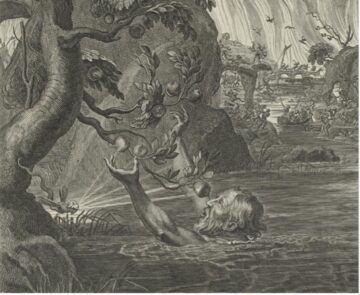
We all know what happens to those who challenge the gods. For both Icarus and Tantalus, the heavens pull away from them, widening the chasm between ourselves and our transcendence. “Just out of reach” is enough to kill us.
There was a door to which I found no key:
There was a veil past which I could not see:
Some little talk awhile of me and thee;
There was – and then no more of thee and me.12Khayyam, Omar, Rubaiyat (12th century), trans. Edward FitzGerald (1859), arr. Emma Lou Diemer for SATB choir (1967).

Forgive my hubris, for the shore was not mine – but I do remember what those clear waters of perfect pitch felt like. The unbridled confidence. The film of the unknown peeled away. The raw turned effable.
Now when I listen to the radio, though a key or a chord comes intuitively, automatically, doubt poisons the once-smug joy. Is it really B-flat? Wouldn’t the artist have had an easier time composing for this instrument in A?
The waves involute; the waters recede from my bay. They follow a moon whose face no longer turns favoringly toward mine. They pull away and I miss the cue to come.

I go alone. Over and over. I enclose myself in booming darkness. I wear earplugs but the bass rattles through my innards without impedance. It shakes my limbs how it wishes from within. The best rave music is anti-music – no notes to decipher, just grating, pulsing noise, such as the perversion of a vacuum cleaner or carbon monoxide alarm. Once does not dance – one shakes, twitches, convulses. It is a relief to have nothing to decipher and be undecipherable. Time arrests in me. A better church than the conservatory ever offered.
Except for the second-floor practice rooms where I sequestered myself in fifteen-minute blocks between lessons. I’d stare out the window across Broadway to the large stone cathedral. Stripes of gray light would illuminate the piano. Melodies would meander through the walls, mixing with the street traffic. I’d compose songs that sounded like rain.
Look #5: age twelve, my face in the windowpane, my hair long and curled on itself, unsilvered, unetched, yet unhappy.
I ask a six-year-old what age he most looks forward to. He can’t wait, apparently, for his late twenties to early thirties. He insistently clarifies that “you can go to the movies whenever you want.”
Precocious child he is. The week prior – I’ll admit to you – I theater-hopped from The Drama to Wuthering Heights, missing only fifteen minutes of the latter. A prime perk of adulthood indeed.
My shoulders heaved the walk home, missing Attunement’s graceful hands guiding them. If only I had glanced toward Attunement beside me throughout the double feature, holding its popcorn toward my outstretched fingers such that I didn’t need to look away from the moving picture.
“Perhaps then, a trust fall establishes a bounded, three-part predicate of trust, such that the faller can reasonably say: I trust you to catch me if I fall. […] Three-part predicates could also be further complicated by expressive qualifiers: I trust you to catch me gracefully or carefully.”13Vidrin, Ilya, and Amy Laviers. “Can a robot do a trust fall? Absurdity as a component of human intelligence and embodiment.” Creative Computing (2020).
“In great agony, the novice cried out “Teacher! You’re hurting me!” The Zen master looked at the novice. “Just now you said that the nose doesn’t exist. But if the nose doesn’t exist then what’s hurting?”14Nhat Hanh, Thich, “The insight that brings us to the other shore [Heart Sutra],” reason for retranslation of the Prajna Paramita (“story of a Bhikkhu who came with a question to the Eminent Master Tue Trung.”)
“Fearing age is a manifestation of fearing our own power.
The lie we’ve been sold is that those outside of ourself determine our value.
I hope you savour this sacred initiation.
Things only get better from here.”15MP, Birthday card, sometime 2020-2022.
***
Enjoying the content on 3QD? Help keep us going by donating now.
Footnotes
- 1u/kgk, Reply to: “Anyone have perfect pitch? What’s your experience?” Cracking the Code Forum, 2021, https://forum.troygrady.com/t/anyone-have-perfect-pitch-whats-your-experience/5913/10. ↩︎
- 2Advice from Google AI. ↩︎
- 3Beato, Richard. “Using perfect pitch with complex chords.” YouTube, 27 June 2016, https://www.youtube.com/watch?v=OrSHnYN2RDU ↩︎
- 4West Marvin, Elizabeth. “Demystifying perfect pitch with Elizabeth West Marvin.” Notes from the Staff, 1 March 2022, https://notesfromthestaff.podbean.com/e/demistifying-perfect-pitch-with-elizabeth-west-marvin/. ↩︎
- 5Karpinski, Gary Steven. Aural skills acquisition: The development of listening, reading, and performing skills in college-level musicians. Oxford University Press, 2000. ↩︎
- 6Miller, Beth. “Perfect pitch neuroscience: UD’s Keith Schneider finds brain distinction in those with rare ability.” University of Delaware, 11 February 2019. ↩︎
- 7Lin, Frank R. “Age-related hearing loss.” New England Journal of Medicine 390, no. 16 (2024): 1505-1512. ↩︎
- 8Baker, Barry L., and Youkyung Bae. “Paracusis musicalis: Insights on age-related absolute pitch decline.” Psychology of Music (2025): 03057356251399802. ↩︎
- 9Ogunquit Museum of American Art, American Conversations: Fashioning Ourselves, current exhibit, 2026, https://guides.bloombergconnects.org/en-US/guide/theOgunquitMuseumOfAmericanArt/item/787b1bd7-ba92-4e44-940e-1f0e4015e4e4. ↩︎
- 10Baker & Bae. ↩︎
- 11Baker & Bae. ↩︎
- 12Khayyam, Omar, Rubaiyat (12th century), trans. Edward FitzGerald (1859), arr. Emma Lou Diemer for SATB choir (1967). ↩︎
- 13Vidrin, Ilya, and Amy Laviers. “Can a robot do a trust fall? Absurdity as a component of human intelligence and embodiment.” Creative Computing (2020). ↩︎
- 14Nhat Hanh, Thich, “The insight that brings us to the other shore [Heart Sutra],” reason for retranslation of the Prajna Paramita (“story of a Bhikkhu who came with a question to the Eminent Master Tue Trung.”) ↩︎
- 15MP, Birthday card, sometime 2020-2022. ↩︎