
by Mark Harvey
All the territorial possessions of all the political establishments in the earth–including America, of course–consist of pilferings from other people’s wash. —Mark Twain, Following the Equator
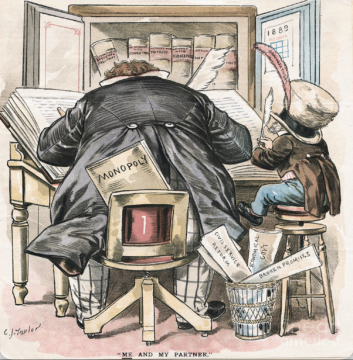
There’s a wonderful story from Paul Bunyan Swings His Ax about how a heat wave in Iowa made all the field corn pop until the whole state was covered in ten feet of popcorn. Then a terrific wind blew all the popcorn over to Kansas, where cattle mistook it for snow and froze to death. Somehow that story captures the absurd myths about the West that drew settlers into a dry forsaken land. Myths about the West and how it was “won” abound and some of them were meant for the movies before movies existed. But much of western mythology has to do with square-jawed cowboys fighting for what’s right, and one day meeting a bonneted school mistress transplanted from the east. After a gunfight or two defending the lass’s honor, a golden life on the prairie begins.
The real history of the West is far more colorful and much less savory. It has a lot of graft, fraudulent misrepresentation, speculative puffery, and truly clever schemes to outwit the government and the gullible. If cinema truly captured the Wild West, it would be less John Ford and more Steven Soderberg. Where to begin?
The tools of western conquest in the cinematic version are six shooters, covered wagons, and fleet horses. There was some of that, but much of what moved thousands of people to the western states and made some men rich and others desperate had more to do with stuffy laws written in Washington, The General Land Office, survey chains, and crooked speculators. Start with the Homestead Act of 1862.
The Homestead Act promised a simple bargain: any adult citizen could claim 160 acres of public land, and after living on it for five years the property was theirs. In a progressive twist for the time, the law allowed women and Black Americans to claim land alongside white men. The act had stalled in Congress for years because Southern legislators feared it would create new abolitionist states and upset the balance of power in the Senate. It finally passed only after the South seceded from the Union.
The strongest champion of the Homestead Act was a congressman with the wonderfully allegorical name Galusha Grow. Grow had a nearly religious belief in the “honest toiler” and the moral virtue of giving ordinary citizens a chance to own land. Opening millions of acres of public domain to those willing to work it struck him as both practical and just. On paper, the idea made perfect sense.
But buried in the law was a small provision that would open the door to enormous fraud: the commutation clause. Instead of living on the land for five years and receiving it for free, a claimant who could prove six months of residence could purchase the property outright for $1.25 an acre.
For men with enterprise, a clever mind, and perhaps a flexible sense of morality, the clause opened an endless horizon of forgery and cheap land.
Almost immediately, speculators with cash began to exploit the law. Their method was simple: hire “dummy entrymen” to file claims, pretend to live on the land for six months, and then swear before the General Land Office that they had met all the legal requirements. Sometimes the entrymen built a crude shack or plowed a token furrow so their affidavit had some semblance of truth. The land offices were overwhelmed with applications and lacked the resources to verify them, so they largely relied on sworn testimony. The entrymen were paid handsomely for their services, sometimes as much as one hundred dollars. That was a lot of money for six months of make-believe farming.
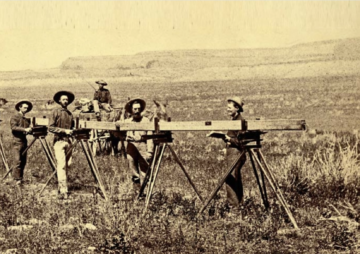
Once the entrymen received title, they quickly transferred the property to their sponsor. The entrymen themselves might be laborers, relatives, or almost anyone respectable enough to sign a document and in need of a buck. Some made multiple claims, altering the spelling of their names or using a middle name as a surname. Because the land offices were poorly coordinated, it was easy to move from district to district filing new claims. So began a quiet labor market for phoney signatures.
Large cattle interests accelerated the process in the 1870s by filing strategic claims near water sources. They understood that in the arid West, control of water meant control of the surrounding range. The tactic became known as “keying the land,” and large ranchers were the first to organize the fraud at scale.
The General Land Office tried to staunch the racket by issuing circulars specifying minimum requirements for homestead dwellings: they had to measure at least 12 by 14 feet and include one door and one window. Legend has it that some claimants responded by building structures roughly the size of birdhouses—twelve by fourteen inches—and conveniently neglected to specify the units of measurement in their affidavits. Because glass was expensive and often scarce, enterprising settlers even rented portable windows, briefly installing them for inspections before moving them on to the next claim.
Some speculators solved the problem quite efficiently. They built portable cabins that were just shacks mounted on wheels that could be rolled from claim to claim so a witness could swear that a dwelling stood on the property. A single roving cabin could be used to “prove up” dozens of claims in a single week.
If any law of the era rivaled the Homestead Act for its abuse, it was the Timber and Stone Act of 1878. The statute allowed citizens to claim 160 acres of land deemed “unfit” for agriculture but valuable for timber or stone at $2.50 per acre. In the forests of the Pacific Northwest, still thick with massive old-growth trees, much of that land was worth many times the asking price.
A later study found that by 1909 roughly twelve million acres had been claimed under the Timber and Stone Act. Ten million of those acres had passed into the hands of corporations and large timber interests, suggesting widespread fraud. The government collected about $30 million for land estimated to be worth closer to $240 million.
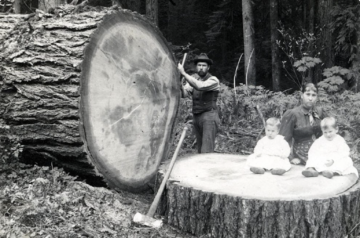
One of the greatest land scams in American history unfolded in eastern Oregon at the turn of the twentieth century, sometimes called The Blue Mountain Forest Reserve Land Fraud. It relied on a tangle of federal statutes—the Land Ordinance of 1785, the Forest Reserve Act of 1891, the lieu-land provisions, and the Timber and Stone Act of 1878—combined with the ingenuity of a small group of very determined schemers who were gifted in bending the law.
The scheme began with a rumor. Word spread that the federal government planned to set aside several million acres in eastern Oregon as a forest reserve to protect a watershed. Much of the proposed reserve was checkerboarded with state school lands granted to Oregon at statehood. Four savvy men, unburdened by scruples and who knew both the land and the law, recognized an opportunity too rich to pass by.
Their plan banked on the “lieu land” provision, which allowed any private land inside a newly designated forest reserve to be exchanged for an equal amount of unclaimed federal land elsewhere. State school lands could be purchased cheaply—about $1.25 an acre—while the best timber lands were priced at $2.50. An equal-acreage exchange therefore doubled the book value of the claim. The men quickly set about acquiring school lands they knew would soon fall inside the proposed reserve. Because each individual could file only one claim, they hired strings of dummy entrymen, fronted the purchase money, and paid them for their affidavits.
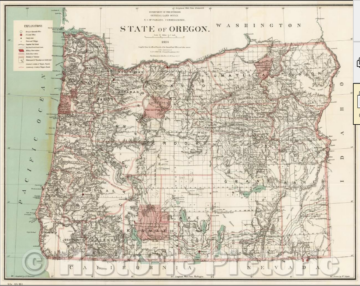
At the same time, they helped encourage the creation of the reserve itself. They coopted the then Forest Superintendent Salmon Ormbsby, by offering him two sections within the proposed reserve for free. Ormbsby ended up lobbying for the reserve despite plenty of local opposition.
The scheme lasted a little more than ten years beginning in 1892 when the men began proving up school lands to 1906 when the men were finally brought to trial. The trials that followed were a sensation in Oregon. An aggressive prosecutor, Francis Heney, methodically convinced a jury of the men’s guilt and all were given fines and prison sentences.
The Oregonian described the prosecutor’s skills in the florid language of the time:
As the surgeon in clinic ruthlessly slices through flesh and muscle to reach the seat of the disease, the glittering knife carefully avoiding vein and artery and twitching nerve, while his class sits with gaze riveted on the subject strapped to the operating table, so did Mr. Heney’s trenchant review of the Government’s charges against the defendants uncover the most minute and deeply-buried phases of the alleged conspiracy for the benefit of the spell-bound men in the jury box.
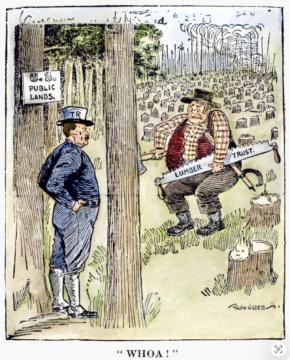
The history of the West is filled with characters ranging from the truly scurrilous to lovable rogues—sometimes in the same body. There were certainly quick draws with a six-shooter in Dodge City, Kansas, and Tombstone, Arizona. But many of the real outlaws were men in three-piece suits poring over plat maps and the fine print of federal law.
A survey of the American West in the late nineteenth century might make a person wonder if anyone on the frontier was obeying the law. Or whether every man, woman, and child saw rules as a quaint challenge and something to be bent and tested. Mark Twain captured the spirit of treasure hunting in the West, whether it was for land or gold, when he said, “It is better to take what does not belong to you than to let it lie around neglected.”