
by Scott Samuelson
I had a long drive ahead of me. Sick of podcasts that all blur together, news programs with their predictable slants, and algorithm-controlled radio stations, I dug around in a pile of old CDs and found a mixtape labeled “Songs for Sisyphus,” compiled for me by my friend Jane Drexler (who also happens to be one of the world’s great teachers of philosophy).
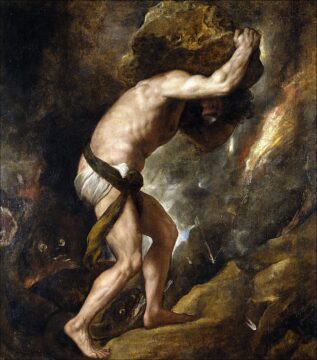
The origin of this CD goes back to a conversation between me and Jane about Albert Camus’s famous essay “The Myth of Sisyphus,” which symbolizes the human condition with the image of the legendary Greek figure who’s on an endless loop of pushing a boulder up a mountain only to have it roll down again. The idea is that we inevitably project ideals only to have the universe make a mockery of them. Existence is just a series of rinse-and-repeat cycles of beauties and tragedies, desires and boredoms, endeavors and failures, rises and falls, ups and downs, lives and deaths, with no final end to redeem our labors—at least none that lasts longer than it takes for Sisyphus’s boulder to teeter atop the mountain.
Jane asked me what might be added to Sisyphus’s fate to make it bearable. “The first thing I’d want is some music,” I blurted out. Then we got into a discussion about what kind of music we’d play if we were in Sisyphus’s shoes.
Jane pointed out how the roots of all great American music are in something disturbingly like Sisyphus’s fate: the singing of Black Americans being forced into hard labor only to have the fruits of their labor brutally snatched from them. We talked about the sorrow songs. We talked about the hard and joyful wisdom of the blues. We wondered if the otherworldly hope of Sunday morning’s gospel music was a necessary complement to the this-worldly affirmations of Saturday night’s boogaloo. We marveled at the aptness of the name “rock and roll.”
A week later, we were trading mixtapes called “Songs for Sisyphus.”
Looking forward to hearing the mix again, I got in my old Honda Accord and injected it into the console. The CD player slurped it up. I was whisked into the tunes like never before. For an hour of the car ride, I was Sisyphus. These were my tunes.
Jane started me off with a song that had fortuitously just come out after our conversation: Andrew Bird’s “Sisyphus,” which begins, “Sisyphus peered into the mist, / A stone’s throw from the precipice.” The line that stood out to me was, “I’d rather fail like a mortal than flail like a god on a lightning rod.” For all the ruefulness of the vocals, I was struck by the consoling truth that human life is preferable to immortality.
Next up, Aretha Franklin, “Rock Steady.” Another obvious choice that hit me with fresh meaning. The backs-and-forths and ups-and-downs of Sisyphus aren’t just about a rock and a mountain; they’re the very forces that keep him alive; they’re life itself. So, why not celebrate these mortal forces as groovy rhythm? It felt like Aretha was singing directly to me: “Step and move your hips with a feeling from side to side. / Sit yourself down in your car and take a ride— / And while you’re moving, rock steady. / Rock steady, baby.”
Then Jane hit me with Andra Day belting out “Rise Up.” I went from rocking steady to climbing the mountain.
You’re broken down and tired
Of living life on the merry-go-round.
And you can’t find the fighter,
But I see it in you, so we gonna walk it out,
Move mountains . . .
I’ll rise up,
And I’ll do it a thousand times again.
The music made me understand in my bones the famous last line of Camus’s essay, “We must imagine Sisyphus happy.” I was tingling with the must. The must is happiness—the raw energy of transcendence, of turning a treadmill into a mountain.
Then, a brilliant twist: a Sisyphean repetition. Another Aretha Franklin song: “Think.” I imagine Jane had on her mind the following passage from Camus’s essay:
I see that man going back down with a heavy yet measured step toward the torment of which he will never know the end. That hour like a breathing-space which returns as surely as his suffering, that is the hour of consciousness. At each of those moments when he leaves the heights and gradually sinks toward the lairs of the gods, he is superior to his fate. He is stronger than his rock.
Camus is telling us to think. Aretha is telling us to think. But here too was a twist. Aretha was telling Sisyphus and all his fellow blues brothers and sisters to think about how they’re treating people, how we’re all prone to inflicting the tortures of our fate on those we love. Freedom—freedom!—involves breaking out of the cycle of playing games and taking scores.
The next song brought tears to my eyes: Mahalia Jackson, “Move on Up a Little Higher.” On the one hand, this was a classic expression of otherworldly hope, the kind of “philosophical suicide” scorned by Camus, the dream of laying down the heavy burdens of Sisyphus and finding immortal glory, which nobody expresses more convincingly than Mahalia. On the other hand, this wasn’t simply about leaving behind the Sisyphean punishment. This was about transformating it into a glorious register. In Mahalia’s song, heaven itself is another mountain. We keep on climbing. After every glorious stop, we move on up a little higher. Now I really was imagining Sisyphus happy.
The tears kept flowing with the next piece of music: the opening movement of J.S. Bach’s first cello suite. I’d been focused on what the voices and the lyrics had been telling me. Now I saw Sisyphus in the music itself. What is music but the transformation of meaningless repetition into the splendor of variation? I thought of Nietzsche’s line from Twilight of the Idols, “Without music, life would be a mistake.”
The songs kept coming with fresh revelations. Billy Joel’s “Vienna” reminded me that the top of the mountain could wait. George Harrison’s “Here Comes the Sun” brought me the peace of each new day. R.E.M.’s “It’s the End of the World as We Know It (And I Feel Fine)” filled me with Stoic absurdism about the disconnected messages that our culture bombards us with. Billy Bragg’s “No One Knows Nothing Anymore” consoled me with radical skepticism: “But what if there’s nothing—no big answer to find? / What if we’re just passing through time?” Bob Dylan’s “Dignity” seemed to sum everything up as a vast pluralistic search for meaningfulness.
I saw the grandeur of Camus’s essay. We’re all pushing our various rocks up our various mountains. Every song is a song for Sisyphus. Every philosophy and religion is a song for Sisyphus. The key to life is learning to sing our song. I can imagine Sisyphus happy. I must imagine Sisyphus happy.
You see what I mean? Jane is a great teacher of philosophy.
The mix soared to a close with the Isley Brothers’ “Freedom”: “Sing the song you wanna sing. / Free, free, free!” I ejected the CD and looked out at the landscape scrolling by. Where even was I going?
Eventually, I flipped on the radio to catch the news. Another war for regime change in the Middle East. Soldiers from my home state had been killed. A school full of children had been bombed. Oil prices were going up. The economy was going down.
I slipped the CD back in. Maybe it would reveal new messages to me. Andrew Bird started singing again, “Sisyphus peered into the mist, / A stone’s throw from the precipice.”
***
Scott Samuelson is the author of several books. To Taste: On Cooking and the Good Life comes out this fall.
Enjoying the content on 3QD? Help keep us going by donating now.