
by David Greer
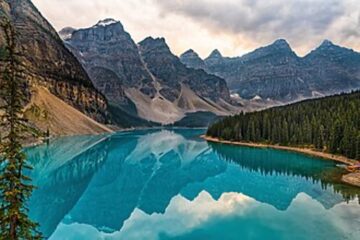
It’s a magical scene not easily forgotten—snow-covered peaks reflected in calm turquoise lakes ringed by stately pines. It’s a view that likely inspired the romantic ballad “The Blue Canadian Rockies”, about a lonesome guy pining for a faraway sweetheart who unaccountably refuses to abandon the mountains she loves to join him somewhere beyond the sea. Sung by Gene Autry in the 1952 movie of the same name, the tune was later covered by artists as diverse as Jim Reeves, Vera Lynn, The Byrds and, perhaps most plaintively, Wilf Carter a.k.a Montana Slim, who added a longing, contemplative yodel to his rendition.
Now imagine the same picture devoid of snow and with the turquoise waters faded to a murky blur. No magic there, just a dull landscape unworthy of a second glance.
That transition is already underway and starting to accelerate as the impacts of human-caused climate change become more pronounced and global efforts at mitigation become more fractured. As it stands now, the striking turquoise hue of some lakes in the Rockies is already beginning to fade, and the glaciers to which those lakes owe their remarkable color will likely be all but gone in a generation or two, so if you haven’t yet enjoyed the magnificence of the blue Canadian Rockies, now may be the time.
I was recently reminded of this on retrieving the Sunday New York Times from my doorstep a couple of weeks ago. Adding to its usual substantial heft was a separate section titled “52 Places to Go”, an annual feature that reminds readers beset by ice pellets and sleet that winter will eventually end and jets will stand ready to fly you to the destination of your dreams, assuming you haven’t already been deported to the destination of your nightmares.
Only one Canadian location merited mention in the feature—a “limited-time train” excursion through the Canadian Rockies. “The route,” explains the article, “will whisk you to pristine alpine meadows in Alberta, where you can enjoy some of the continent’s most spectacular scenery between Jasper and Banff”. What it neglects to mention is that there is no actual train track connecting Jasper and Banff, only a highway. A glance at the Rocky Mountaineer website reveals that what the company’s several packages actually include are trips combining travel on the east-west transcontinental train routes (the northern one passes through Jasper, the southern through Banff and Lake Louise) with bus tours of the picturesque Icefields Parkway that winds its way north-south between Jasper and Lake Louise.
Whatever your mode of transportation, there’s little doubt that the Icefields Parkway (a.k.a. Highway 93) is one of the most scenic highways in the world, thanks in large part to its abundance of snowy peaks and turquoise lakes. The Rocky Mountaineer excursions, including hotel stays along the way, have an entry point of around five grand, with some options going for double or close to triple that. It’s an item worth considering for a bucket list if you have never set eyes on the Canadian Rockies and have a spare ounce or two of gold at hand.
Alternatively, you could experience those blue Canadian Rockies on the cheap. Though I’ve travelled the route several times, my fondest recollection is of a three-day bicycle trip from Jasper to Lake Louise—a similar duration to an across-the-continent train trip from Toronto to Vancouver, which I also did several times back in the days when a coach ticket across the country set me back fifty bucks, or around one per cent of the minimum asking price for a Rocky Mountaineer excursion today. Gold was cheap too then, also around fifty bucks an ounce, and if I’d been smarter, I might have pocketed a few ounces and stuffed them under a mattress somewhere, ideally remembering to move the stash the few dozen times when the location of mattresses changed. A buck today is worth around eight times what a buck was worth in the early 1970s. Gold a hundred times, give or take.
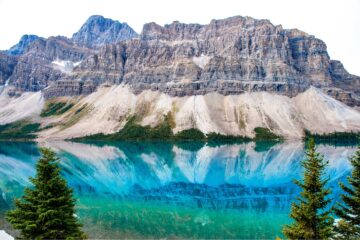
But back to cycling the Icefield Parkway, whose wide paved shoulders provide peace of mind against wide loads and drivers distracted by snowy peaks and turquoise lakes. Commercial trucks you don’t need to worry about at all, as they’re prohibited on the Parkway over a certain weight. There’s nothing quite as exhilarating as exhausting yourself on a non-electric bike laboring an hour or so up to the summit of a pass, finally to be rewarded by the unmatchable ecstasy of freewheeling long minutes down the other side with the breeze rushing through your hair and the spiraling songs of Swainson’s thrushes echoing from the roadside forest. It’s a rush like no other. Rinse and repeat, hill after hill, and, at the end of the day, the bliss of rewarding spent muscles with the sleep of the dead. Towards the end of the ride, we stopped for a hike at Bow Lake, where we fed friendly Canada jays in the forest before repairing to the patio of a lakeside lodge for gin and tonics.
***
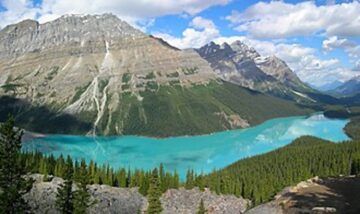
Lakes such as Bow and Louise and Peyto and Moraine owe their turquoise color to microscopic particles of rock suspended in the water, absorbing red and yellow wavelengths and scattering shorter blue and green wavelengths back to the viewer’s eye, a phenomenon known as the Tyndall effect. These particles, carried into the lake as silt in glacial melt, originate in bedrock ground to infinitesimal fragments under the weight of countless tons of ice advancing at (of course) a glacial pace.
The icefields that feed these glaciers expanded over eons from accumulations of compressed snow. The largest icefield in the Rocky Mountains, the Columbia, formed well over 100,000 years ago, is currently about 17 miles long, ranges in depth from about 300 to 1,200 feet, and feeds six large glaciers. It’s so massive that it straddles a triple Continental Divide, its meltwater descending to lakes and rivers flowing east and west and north, including the Saskatchewan, the mighty Columbia and the Athabasca. Small wonder that the Columbia Icefield is known as “the mother of rivers”.
Until a century or so ago, the tongue of the Columbia Icefield’s Athabasca Glacier ran right up to the Icefield Parkway. The parkway parallels the Continental Divide that follows the crest of the Rockies and separates waters flowing east from those flowing west. I once observed a striking example of the effect of the Divide when I cycled to Divide Creek, a small watercourse near Kicking Horse Pass close to the British Columbia-Alberta border. From a viewpoint, I was able to look downstream and see the point where the creek divided into two, the right branch flowing to the Bow River and thence (via the Saskatchewan) to Hudson Bay and the North Atlantic, the left to the Kicking Horse River and thence (via the Columbia) to the Pacific.
At close to a hundred square miles in area and almost a quarter mile in depth in some places (roughly the height of the Empire State Building), the Columbia Icefield is an awe-inspiring spectacle. Its Athabasca Glacier is a major tourist attraction in its own right, though not a particularly cheap one. A hundred and twenty-five bucks (Canadian) buys you a seat on the Ice Explorer truck, which transports you to the surface of the glacier, where you can stand upon it and be thankful for the barriers preventing you from hurtling into a crevasse and becoming a footnote in Rocky Mountain history. The price of a ticket also includes a stroll along the Icefield Skywalk, a long glass platform overlooking the Sunwapta Valley 300 yards below your feet.
If you suffer from neither acrophobia nor claustrophobia and harbor an irresistible urge to disappear into a crevasse despite the warning signs, that option is available as well, for a fee, with suitable rappelling equipment provided together with instruction on how to employ it without taking a more sudden descent into the hidden depths. This experience you will no doubt remember when you’re old and grey and full of sleep though, unlike the memory of cycling the Icefields Parkway, you are also likely to recall the cost. You also may be grateful simply to recall the existence of the Athabasca Glacier, a memory likely to be denied to future generations, as things currently stand.
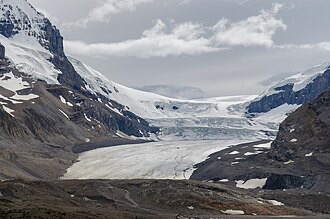
Since 1900 the Athabasca Glacier has receded by almost a mile, continues to do so at an accelerating pace, and appears destined to vanish entirely by the end of this century if the international community is unable to agree on an effective strategy to slow current warming trends. A 2025 study published in the journal Science found that if the average temperature of the planet increases to 1.5°C above pre-industrial temperatures, 81 per per cent of western Canadian and U.S. glacier mass will melt by 2100. During 2023 and 2024, for the first time ever, the average planetary temperature exceeded 1.5°C for twelve consecutive months. If the average temperatures of the planet rises by 2.7°C by the end of the century, western Canada is predicted to lose 98 per cent of its glacier mass. Between 1985 and 2020, more than 1,100 glaciers disappeared in British Columbia and Alberta.
The reasons why icefields and snowy peaks are likely to be all but gone within a couple of human generations aren’t really a mystery. The usual suspects all have a role to play, along with a couple of newcomers, all of them related to an addiction to fossil fuels that we find so hard to break. Record warm summers and warmer winters combine to increase melting and reduce snowfall. Melting ice eventually exposes the dark rock underneath, which absorbs more heat and consequently promotes more melting. Add to that the melting effect of soot drifting onto glaciers from wildfires becoming ever larger and more frequent throughout the west, and the long-term future of icefields looks decidedly grim.
Everything is connected in nature, and when one component collapses, domino effects are sure to follow. When the glaciers are gone, gone too will be the glacial silt that washes into the alpine lakes. The lakes will gradually lose their distinctive turquoise color, and quite possibly their watery content as well, and the blue Canadian Rockies will be but a fond memory. A recent short Canadian National Film Board documentary, “Losing Blue“, provides a poetic salute to the fading turquoise of the lakes.
Then there will be the effects farther downstream. The erosion of glaciers will inevitably diminish the flow of water to rivers, with predictable negative impacts on freshwater availability for agriculture, hydro, and community water supplies. Diminished flows will also mean warmer river temperatures, potentially harming aquatic species, including fish that rely on cooler water for spawning.
Meanwhile the Swiss, known for innovative solutions that defy the imagination of lesser countries, are reportedly experimenting with covering glaciers with tarps and damming lakes at risk of emptying.
***
In 2016, all but a handful of countries signed the Paris Agreement, committing to a goal of keeping the rise in global surface temperature to well below 2°C above pre-industrial levels and ideally limiting the increase to 1.5°C.
That also happened to be the year that the United States elected a president who prided himself on making fabulous deals. The problem with international cooperation on mitigating something like climate change is that there are no clear winners and losers, no immediate benefits, nothing that easily lends itself to being named after you.
One of President Trump’s first executive orders was to announce his intention to withdraw the United States, the world’s second largest emitter of greenhouse gases after China, from the Paris Agreement. His successor President Biden restored American participation, after which Mr. Trump acted even more forcefully on being elected for a second term, re-withdrawing the United States from the Paris Agreement on his first day in office, while declaring human-caused climate change to be a hoax and promising to remove all obstacles to coal production and oil drilling in his country.
On February 12, 2026, Mr. Trump abruptly revoked the bedrock scientific determination that gives the government the ability to regulate climate-heating pollution. The “endangerment finding”, which states that the buildup of greenhouse gases in the atmosphere endangers public health and welfare, has since 2009 allowed the Environmental Protection Agency (EPA) to limit heat-trapping pollution from vehicles, power plants and other industrial sources. The revocation removes the government’s ability to impose requirements to track, report and limit climate-heating pollution from cars and trucks. Transportation is the largest source of climate pollution in the U.S., and the U.S. historically has emitted a larger quantity of greenhouse gases than any other country. Trump proudly called the move “the single largest deregulatory action in American history”.
Five years ago, such an announcement would have resulted in screaming headlines for days on end, but such has been the recent onslaught of once unthinkable announcements that it was barely mentioned a day or two later.
In the grand scheme of things, losing pleasing scenery—in this case turquoise lakes and snowy peaks—as a result of misguided political decisions is neither here nor there, but it’s distinctly easier to visualize than the graver and potentially more widespread consequences of famine, flood, fire, war, and pestilence.
***

Mountains are picturesque from a distance and full of surprises at close quarters. I experienced two of such surprises high above Paradise Valley on an otherwise unremarkable summer day. The first was a wolverine that I surprised in a scattering of larches, a lifetime first for me. The second, higher up, was a large patch of snow stained with pinkish blotches. “Watermelon snow”, as I later found out, is a type of algae that thrives in snow (the “cryophilic” in cryophilic chlorophyte algae means “ice-loving”). Watermelon snow can also contribute to melting by absorbing heat.
On another occasion, while climbing the gentler side of Mount Rundle, which overlooks the town of Banff, a friend and I paused for lunch an hour or so above tree-line. The Bow River was a barely visible hairline far below, Rundle’s jagged peak looking impossibly far above. As I quartered an apple with my Swiss Army knife, my gaze wandered to the smooth rock face against which I was leaning. I was surprised to see there a faint array of tiny circles and swirls, decidedly organic in their complexity. I assumed they must be fossils, though fossils of what, and why on a mountain peak, I had no clue. I stuffed into my pocket a fragment containing what looked like a sculpin’s jawbone and thought no more about it, until much later the fragment re-entered my consciousness and curiosity got the better of me.
I then read about the rising of Rundle, 50 or 60 million years ago, when two tectonic plates collided and pushed the seabed up until, in due course, it took a new shape as mountainous slopes. Over 400 million years earlier, what is now the Canadian Rockies had been an underwater basin teeming with early life forms beneath a tropical sea, somewhere near the equator. Those life forms included the tiny creatures, later entombed in mud that eventually hardened into shale, that were now the object of my fascination. Understanding their history helped remind me how very brief, in evolutionary terms, has been the existence of homo sapiens on this planet (a couple of hundred thousand years, give or take). That’s a blink of an evolutionary eye when you pause to consider that most of our fellow travelers on the planet have had many millions of years to develop the attributes needed for a stable and sustainable existence—around 100 million years in the case of birds, over 200 million in the case of amphibians such as frogs, a mere 50 million in the case of whales, which counted among their own ancestors terrestrial hoofed mammals before their renaissance as marine mammals. In that context, humans are evolutionary toddlers who rapidly evolved large brains and opposable thumbs and other attributes useful for survival in the short term, but do we have what it takes to be a lasting presence on the planet?
Time will tell, I suppose—what else there to say about that? Just that such social and empathic skills that we have developed seem too often to be canceled out and smothered by lust for power and dominance that ultimately seems to result in short-term satisfaction, at least for those who hold the power, and long-term downfall of civilizations. We’ve seen it time and time again, the difference now being that we have developed the ability to destroy ourselves in the short term through ever-advancing military technology and in the long term by so befouling our planetary nest with our industrial excrement as to make it unlivable for the children and grandchildren whose interests we profess to count as our first priority, and by choosing as our leaders monomaniacal men (almost exclusively) who lack the capacity and insight to consider worthy anything that fails to flatter their own glorification.
This is a head-scratcher, for sure, and one that has been an inspiration for many great works of art, which serve the very useful purpose of getting people to stop and think about the state of things and their own place in the world and what they might personally do to improve the lot of their fellow human beings and the planet that deigns to support our existence, albeit briefly. One of those great artists was Shakespeare, one of whose most memorable characters was Macbeth, whose obsession to be all-powerful king led him to do some rather horrible things to pave his path to the throne. This turned out well to begin with, if somewhat bloodily, and then not so well at the end. When all around him was in ruins and Macbeth was forced to face up to the reality that Act V would not be all unicorns and rainbows, the penny dropped that the rewards of being a ruthless authoritarian weren’t all that they were cracked up to be, which led to his following introspective musing:
Life’s but a walking shadow, a poor player,
That struts and frets his hour upon the stage,
And then is heard no more. It is a tale
Told by an idiot, full of sound and fury,
Signifying nothing.
Was Shakespeare guilty of being a Polyanna for making the assumption that a character such as Macbeth would be capable of an insight that his lust for power and attention had been a pointless obsession? Perhaps so, but there are many examples in history of tyrants who eventually perceive and acknowledge the futility of their ambitions. Equally, there are examples to the contrary. At the moment, it seems an open question whether current authoritarian leaders, who seem to be on the upswing in recent years, have what it takes to eventually question whether their self-serving mania was worth it.
The bottom line, of course, is that nature bats last, so if we as a species are not up to the task of keeping the planet in good repair for our descendants, nature will in due course restore equilibrium in the absence of homo sapiens, in which case other species and species yet to evolve will live happily ever after. Though, personally, I can’t help but remain hopeful that humans will yet find a way to act in their descendants’ best interests.
In the case of the blue Canadian Rockies, perhaps that simply means doing whatever is in our power as individuals to advocate for the climate change mitigation measures needed to help enable the survival of the icefields and glaciers that support not only the visual magnificence of the mountains and their lakes but also the well-being of those downstream who ultimately depend on the glaciers for their quality of life. In a world in which truth is increasingly under assault, advocacy necessarily begins with verifying facts while respecting divergent points of view.