
by David Greer
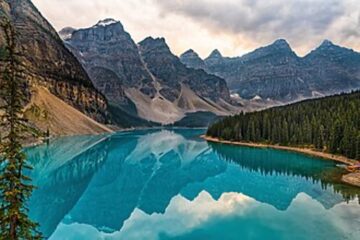
It’s a magical scene not easily forgotten—snow-covered peaks reflected in calm turquoise lakes ringed by stately pines. It’s a view that likely inspired the romantic ballad “The Blue Canadian Rockies”, about a lonesome guy pining for a faraway sweetheart who unaccountably refuses to abandon the mountains she loves to join him somewhere beyond the sea. Sung by Gene Autry in the 1952 movie of the same name, the tune was later covered by artists as diverse as Jim Reeves, Vera Lynn, The Byrds and, perhaps most plaintively, Wilf Carter a.k.a Montana Slim, who added a longing, contemplative yodel to his rendition.
Now imagine the same picture devoid of snow and with the turquoise waters faded to a murky blur. No magic there, just a dull landscape unworthy of a second glance.
That transition is already underway and starting to accelerate as the impacts of human-caused climate change become more pronounced and global efforts at mitigation become more fractured. As it stands now, the striking turquoise hue of some lakes in the Rockies is already beginning to fade, and the glaciers to which those lakes owe their remarkable color will likely be all but gone in a generation or two, so if you haven’t yet enjoyed the magnificence of the blue Canadian Rockies, now may be the time.
I was recently reminded of this on retrieving the Sunday New York Times from my doorstep a couple of weeks ago. Adding to its usual substantial heft was a separate section titled “52 Places to Go”, an annual feature that reminds readers beset by ice pellets and sleet that winter will eventually end and jets will stand ready to fly you to the destination of your dreams, assuming you haven’t already been deported to the destination of your nightmares.
Only one Canadian location merited mention in the feature—a “limited-time train” excursion through the Canadian Rockies. “The route,” explains the article, “will whisk you to pristine alpine meadows in Alberta, where you can enjoy some of the continent’s most spectacular scenery between Jasper and Banff”. What it neglects to mention is that there is no actual train track connecting Jasper and Banff, only a highway. Read more »