
by David J. Lobina
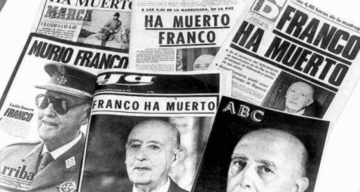
Having lived in Madrid through much of my teen years, I remember the “20-N” rather well – November the 20th being the date Francisco Franco, the last of the far-right European dictators, died in his bed, and a date that is commemorated ever since by the far-right in Spain. The 20-N was always a tricky day in Madrid in the 1990s, my decade (but apparently it was much worse in the 80s): during the day the old guard would be out in the usual squares with their songs and salutes, but at night there were plenty of youth out “hunting”, including many who came from overseas, especially from Germany and Italy (there were also antagonist groups on the look-out for “neo-Nazis”, as skinheads were invariably called then; I was of course nowhere near any of the action).
The far-right crowd also commemorate the death of José Antonio Primo de Rivera on the 20-N, the founder of Falange Española (Spanish Phalanx), a party that was created after the model of Italian Fascism (actual fascism!), but which eventually Franco brought under the control of the Movimiento Nacional party, diluting its fascist character somewhat. Primo de Rivera died early on during the Spanish Civil War, on November the 20th, 1936 (the war started in July 1936), and under circumstances that suggest Franco did little to save him (they were in fact rivals at the time, both vying for leadership of the nationalist side in the war, as discussed in Paul Preston, A Concise History of the Spanish Civil War).
This very week happens to be the 50th anniversary of Franco’s death, and so there’ll be celebrations and remembrances of various kinds – by Franco admirers, on the one hand, and by people celebrating democracy instead, on the other. There’ll also be plenty of critical retrospectives and condemnations – again, of Franco and his regime (call it Francoism), on the one hand, and no doubt of Spanish democracy too. It is also the 50th anniversary of the restoration of the monarchy in Spain, and naturally now the so-called emeritus King of Spain (defenestrated as he was in 2014, after one too many scandals) has had the brilliant idea of publishing his memoirs about his time in power (in French only, so far), a publication where he shows genuine affection for Franco – Juan Carlos I de Borbón, for it is he!, was made King of Spain by Franco, after all. Not this post, though, which shall fall squarely on the side of a critical appraisal of Francoism, and quite the laser-focused one at that.
Ideally, I would want to discuss who Franco was, what kind of regime he and his acolytes imposed upon Spanish society, and what his legacy actually is. A massive topic, of course, and basically unapproachable in such a short post, so I shall concentrate on two aspects of the Franco years that are often somewhat neglected: Franco’s own character and background in the military; and following from this, Franco’s predisposition (and that of his regime overall during and immediately after the Civil War) to absolutely offer no quarter whatsoever to the defeated, even after death, and with cruel and inhumane thoroughness to boot. And the result is a case of denied justice, which Spain has been unable to rectify 50 years after the end of Franco’s dictatorship – the real legacy of Francoism, one might say.
I will devote this Part I to a brief discussion of Franco’s character and background in the military, and next month I shall come back to the issue of denied justice. A particular illuminating window into Franco’s character is, in this respect, his 1922 booklet, Diario de una Bandera (Diary of a Flag), a diary account of Franco’s years with the Spanish Legion in North Africa, where Spain held a colony and was fighting a rebellion in the 1920s (this link is to an edited 1956 version of diary, whilst this paper offers a critical analysis of various versions of the book; see below). A military man through and through – he came from a military family, and from a region in Spain (Galicia, in the north-west) with a long tradition of military service – Franco’s ascent in the Spanish army was fast, becoming a leader from an early age. He was first sent to Morocco in 1912, where Spain kept a Protectorate (this lasted from 1912 to 1986), and a year later he joined a shock troop unit (the regulares). He would serve in Morocco until 1926, though with some breaks for service in Spain (he led Spain’s main military academy, in Zaragoza, in 1928, for instance). He joined the Spanish Legion as second in command in 1920, furthermore leading the so-called “first flag” unit (each unit was referred to as a flag), and it is the period of 1921 that the Diario focuses on.
The context is the Rif War Spain and France were fighting in Morocco at the time, and more precisely the Battle of Annual, where Spain suffered a major defeat against Riffian Berber tribes, losing some thirteen thousand troops (it is usually called the Disaster of Annual in Spain, in fact). Franco made his name at this time as his unit came to the rescue of the Spanish enclave of Melilla, in Morocco, making him a celebrity of sorts in the military. The Diario covers much of this operation, but more relevantly for my purposes, it also highlights the sort of mentality on display at the Legion at the time (and in parts of the military).
The original version of the diary contains various examples of some of the atrocities committed by the Legion in Morocco, and includes the disparaging views Franco and the legionnaires had of Moroccans and Arabs in general as well – beheadings and displays of the result, in addition to the carrying of victims’ ears as a war trophy, seem to have been a common occurrence (some of the most offensive episodes were excised from later editions, not least to avoid offending the Moor troops who fought alongside Franco and the nationalist side in the Civil War). And equally shocking is the cruelty the Legion showed towards its own troops in the form of punishments that were meted out, which included the death penalty for what today we would see as minor offences (this will be of special relevance for Part II of this series).
But more pertinently still are Franco’s comments regarding the civil government in Spain, and in particular how the government seemed to have viewed the North African campaign (and the Spanish troops in Africa more generally), at least as Franco saw matters. At a time when Spain was being run by a corrupt political system according to which the Conservative and Liberal parties would each be in government for two years each time, and where political strife was widespread, with regional revolts and general strikes pretty common, the main sentiment expressed by Franco in Morocco is one of abandonment – the overall country seems indifferent to what’s happening in the Protectorate, he complains, especially when it comes to valuing the army’s actions and sacrifices, and this despite all the lives being lost.
Franco is especially exercised by an article published in the official magazine of the armed forces, which is not reproduced in the diary, but which he describes as involving various ideological projects for the reorganisation of the Spanish army in North Africa, and which he regards as condemning the African troops to never return to Spain. He adds a reply to this news in the diary, though it was apparently never published in the official magazine. The campaign in Africa is the only practical school the Spanish army has, Franco claims, and adds that it is in fact through such campaigns that one makes and creates a homeland, not a little cryptically. In his concluding remarks to the diary, and perhaps rather presciently, Franco argues that civil politics and the military need to go hand in hand in every single thing a country does, and ends proceedings by decrying that the tragedy of the African campaign is the apparent fact that political action had been absent and the army has been left to its own devices.
Franco would get his wish before he knew it, with the 1923 coup d’état headed by the General Miguel Primo de Rivera (father to the other Primo de Rivera, mentioned earlier), who eventually headed a dictatorship lasting until about 1930. Primo de Rivera’s dictatorship was to often serve as a guide to Franco during the latter’s much longer dictatorship, as a recent new history of Franco’s years in power has shown – namely, Nicolás Sesma’s 2024 book Ni Una Ni Grande Ni Libre (Neither One Nor Great Nor Free, roughly; link here), which shall be my guide for Part II of this series on the question of the treatment of the defeated after the Civil War. Primo de Rivera’s ruling was music to Franco’s ear indeed: it put an end to the Rif War with a victory; it defended an ultranationalist agenda, with emphasis on the unity of Spain and promoting the dissemination of a patriotic sentiment; it had a strong Catholic identity; and it subordinated politics to the principle of authority so beloved by military men everywhere (and it is mostly men). It is precisely these values and principles that underlie Franco’s Diario, even if some of these only appear in germinal form.
In this sense, and rather fittingly, the title of Sesma’s book is a reference to Francoist propaganda that Spain was only One (that is, it comprised one single nation and, thus, was not a federation of nations), that it was Great (perhaps because of its Imperial past), and that it was Free (free from communism and masonry, in particular, two obsessions of Franco’s and his regime, and which he often associated to Jewish influence). In one sense, therefore, there was a continuation of sorts between the Primo de Rivera and Franco’s dictatorships.
Sesma’s book will serve us well for the objective Part II, as Sesma’s own aim is to offer a history of the dictatorship for a new, younger audience in Spain, from the end of the Civil War in 1939 to the end of the dictatorship around 1977, two years after Franco’s death, and I think the audience of this post will benefit from my selected discussion of the book in Part II too. The book does a pretty good job at what it aims to do, not least because it is rather exhaustive but remains a publication for the general public, with the main point the reminder that Franco’s repression was extensive and expansive, starting during the Civil War and becoming particularly cruel in the few years after the end of the war. Part II shall make for a depressing reading indeed.[i]
But to come back to the issue of the events and commemorations around the 20-N, my own take on this is that 50 years after the death of Franco we have an opportunity to reclaim the date for other celebrations – after all, the Republican side also lost prominent figures on this very date during the Civil War, in particular the anarchist militant Buenaventura Durruti, who died in strange circumstances on the very same day Primo de Rivera the son was executed. Por allí viene Durruti…
[i] A weak point of the book, however, is Sesma’s characterisation of the nature Franco’s regime, which he defines as ‘asymmetric fascism’, but only does so in the book’s Epilogue, and after a far too briefly discussion (also, the scholarship this argument is inspired by does not seem to support the conclusion all that well); as a matter of fact, Sesma spends an ordinate amount of space in the book emphasising (overemphasising, in my view) how close to both Italian Fascism and German Nazism Francoism actually was, and this is a bit of a distraction throughout (and it reads like the conclusion to an argument rather than a demonstration, which undercuts how compelling the point is; but this is for another time, though see here for my short take on this specific issue).
Enjoying the content on 3QD? Help keep us going by donating now.