
by Charles Siegel
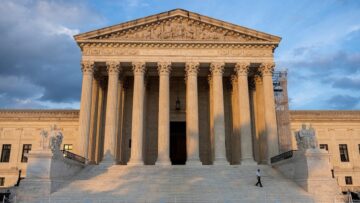 In the first part of this depressing column, I looked at Congress’ spineless surrender of its power to Trump’s turbocharged executive. In the second part, I tried to set out how that same executive has waged war on the judicial branch, and has rapidly transformed the Department of Justice into its private law firm. Perhaps most disheartening in this sorry saga, however, is how obliging the Supreme Court has been in the steady weakening of the “third branch.” Our highest court — the ultimate symbol of the judicial branch and the temple of its authority — seems perfectly content to let Trump steadily erode its power. In some ways, the Court is actively complicit in Trump’s war.
It is hard to comprehend that we are less than eight months into this administration, such has been the sheer ferocity and speed of Trump’s actions. Blizzards of executive orders, arbitrary firings, wholesale liquidations of entire agencies, mass deportations, ICE abductions, the military in our streets. All of this has resulted in hundreds of lawsuits, many of which (perhaps even most) are seeking relief on an emergency basis. The lower courts have done their level best to deal with the onslaught. But when cases have come to SCOTUS, as inevitably some would, the Court has acted in singularly unhelpful ways.
The Court has sided with Trump and his Department of Justice — and yes, that’s the only way DOJ can be described these days – in the vast majority of cases. The only issue of any importance on which Trump has lost has been the due process rights of persons detained under the Alien Enemies Act, who are about to be deported. There, the Court ruled that they are entitled to “notice …within a reasonable time and in such a manner as will allow them to actually seek habeas relief.” Even then, this decision was enormously helpful to Trump’s agenda, as discussed below. Beyond that, the Court has largely deferred to the executive.
To be fair, many of the Court’s rulings have been on procedural issues, and not on the actual substance of Trump’s measures. But the procedural decisions themselves often have immense practical consequences. For example, several district courts struck down Trump’s infamous “birthright citizenship executive order as unconstitutional. One district judge in Seattle, a Reagan appointee, called it “blatantly unconstitutional.” He also stated — and this was less than three weeks after Trump took office — that “it has become ever more apparent that to our president, the rule of law is but an impediment to his policy goals. The rule of law is, according to him, something to navigate around or simply ignore, whether that be for political or personal gain. Nevertheless, in this courtroom and under my watch, the rule of law is a bright beacon which I intend to follow.” He entered an injunction barring enforcement of the order anywhere in the country. Two other district courts, in Maryland and Massachusetts, entered similar injunctions, and in all three cases, the courts of appeals largely left the orders intact.
When DOJ appealed these rulings to SCOTUS, though, they didn’t appeal the substance of the district courts’ holdings that the executive order was unconstitutional. Rather, they simply attacked the power of a single district court to enter a nationwide injunction. SCOTUS duly obliged and held that such orders cannot be entered; a single court can only enjoin the parties before it or parties within its jurisdiction.
Nationwide injunctions have been controversial for many years. Presidents from both parties, including Biden, have challenged them.
These attempts never succeeded — until now. In Trump v. CASA, the Supreme Court suddenly discerned that in fact, nationwide injunctions have never been authorized, and held further that the government would be “irreparably harmed” if the district court orders were to stay in place.
The ruling was similar to several others by the Court in that it did not reach the merits of some outrageous thing Trump did; it simply held that the outrageous thing must be challenged in much more diffuse, time-consuming ways. Other examples include the Court’s holding that persons seeking to challenge their detention and/or deportation cannot sue in a district court that would be the natural venue for their suit — e.g., the district where they lived and were seized. Instead, detainees must file habeas corpus petitions, and those can only be filed in the district where they are being detained. What this has led to in practice is ICE flying thousands of people, within hours of their initial arrest, to Texas or Louisiana. Both states are in the Fifth Circuit, which is the most conservative court of appeals in the country by some distance. So detainees like my client Leqaa Kordia, for example, (see my column from a few months ago, Don’t Deport Protesters, or Defund Universities, in My Name) who lives and was arrested in New Jersey, was flown to Texas and has been held in a detention center 40 miles outside of Dallas since March. Her story is not unique; there are many cases like hers, working their way in slow, patchwork fashion through dozens of courts around the country.
Another example concerns funding terminations. Three weeks ago SCOTUS issued a strange, fractured ruling in National Institutes of Health v. American Public Health Ass’n. The Court held that plaintiffs challenging cancellations of grants or contracts — of which there have been many — must generally file separate suits, in both the Court of Federal Claims and in district court. This obviously makes such challenges lengthier and more costly.
Nearly all of these decisions have been rendered on the Court’s so-called “shadow docket.” That is, they have been rulings on applications for emergency relief — most such applications coming from the administration, for which everything is an emergency — and they are usually short, even terse, and issued without full briefing or oral argument. Often they are simply confusing.
Most problematically, however, by their nature they are not definitive holdings on the merits of a case. Instead, they are holdings about whether a stay should be lifted. This means that they are simply predictions by the justices as to how they would likely rule on the merits, once the case has been fully litigated in the trial and appellate courts. This leaves lower courts to guess about whether existing precedents are still good law.
And when they have trouble doing this, or they make educated guesses that displease the Court’s conservatives, condescension rains down from on high. In the NIH case last month, Justice Gorsuch, joined by Justice Kavanaugh, reproached Judge William Young, a Reagan appointee who has served on the federal district bench in Boston for over 40 years, for not sufficiently divining the meaning of an earlier shadow docket ruling. Judge Young, a highly respected veteran jurist, must have been mortified, at this stage in his distinguished career, to be called on the carpet by two Supreme Court justices. So in a hearing in the case last week he apologized, stating that he had not intended to “defy precedential action of the Supreme Court…. I have served in judicial office now for over 47 years. Never before this admonition has any judge in any higher court ever thought to suggest that this court had defied the precedent of a higher court — that was never my intention.”
Or as the New York Times put it, Judge Young “had not realized he was expected to rely on a slim three-page order issued with minimal legal reasoning in April to his case dealing with a different agency.”
Last week NBC News published an extraordinary story, detailing interviews with a dozen federal judges. All of them agreed to talk only on the understandable condition that they not be named or described in identifiable terms. Some of the findings were truly striking:
“Federal judges are frustrated with the Supreme Court for increasingly overturning lower court rulings involving the Trump administration with little or no explanation, with some worried the practice is undermining the judiciary at a sensitive time.”
“In rare interviews with NBC News, a dozen federal judges — appointed by Democratic and Republican presidents, including Trump, and serving around the country — pointed to a pattern they say has recently emerged: Lower court judges are handed contentious cases involving the Trump administration. They painstakingly research the law to reach their rulings. When they go against Trump, administration officials and allies criticize the judges in harsh terms. The government appeals to the Supreme Court, with its 6-3 conservative majority. And then the Supreme Court, in emergency rulings, swiftly rejects the judges’ decisions with little to no explanation.”
“Ten of the 12 judges who spoke to NBC News said the Supreme Court should better explain those rulings, noting that the terse decisions leave lower court judges with little guidance for how to proceed. But they also have a new and concerning effect, the judges said, validating the Trump administration’s criticisms. A short rebuttal from the Supreme Court, they argue, makes it seem like they did shoddy work and are biased against Trump.” “It is inexcusable,” a judge said of the Supreme Court justices. “They don’t have our backs.”
“The Supreme Court, one judge said, is effectively assisting the Trump administration in ‘undermining the lower courts,’ leaving district and appeals court judges ‘thrown under the bus.’”
“Ten of the judges, both Republican and Democratic appointees, agreed the court’s lack of explanation is a problem. Judges must follow Supreme Court precedent, but they can find it difficult to assess what the justices are asking them to do.”
Another federal district judge isn’t having it. The day after Judge Young apologized, Judge Allison Burroughs, who serves in the same Boston courthouse as Judge Young, issued her thorough decision largely setting aside Trump’s freezing of federal grant funds for Harvard. In a passage I was particularly pleased to read (again see my column above), she found as follows:
The idea that fighting antisemitism is Defendants’ true aim is belied by the fact that the majority of the demands they are making of Harvard to restore its research funding are directed, on their face, at Harvard’s governance, staffing and hiring practices, and admissions policies—all of which have little to do with antisemitism and everything to do with Defendants’ power and political views.
Free speech has always been a hallmark of our democracy. … As pertains to this case, it is important to recognize and remember that if speech can be curtailed in the name of the Jewish people today, then just as easily the speech of the Jews (and anyone else) can be curtailed when the political winds change direction.
And in a footnote, she respectfully but firmly had this to say to Justices Kavanaugh and Gorsuch:
The Court is mindful of Justice Gorsuch’s comments in his opinion in APHA and fully agrees that this Court is not free to “defy” Supreme Court decisions and is, in fact, “duty-bound to respect ‘the hierarchy of the federal court system.’ ” Consistent with these obligations, this Court (and likely all district courts) endeavors to follow the Supreme Court’s rulings, “no matter how misguided [it] may think [them] to be.” That said, the Supreme Court’s recent emergency docket rulings regarding grant terminations have not been models of clarity, and have left many issues unresolved…. This Court understands, of course, that the Supreme Court, like the district courts, is trying to resolve these issues quickly, often on an emergency basis, and that the issues are complex and evolving. Given this, however, the Court respectfully submits that it is unhelpful and unnecessary to criticize district courts for “defy[ing]” the Supreme Court when they are working to find the right answer in a rapidly evolving doctrinal landscape, where they must grapple with both existing precedent and interim guidance from the Supreme Court that appears to set that precedent aside without much explanation or consensus.
One hopes that, up on Olympus, at least some of the justices will take this suggestion seriously.
One also hopes that trial court judges, and their colleagues on the courts of appeals, continue to work as diligently and as conscientiously as they have been doing since January. It is hard, thankless work, yet we must honor it and thank them. I will end this depressing series of pieces by thanking Judge Thomas Cullen, a Trump appointee to the federal bench in Virginia and member of the Federalist Society. In part 2 last month, I mentioned that the DOJ had actually sued all of the federal district judges in Maryland, who had adopted a standing order prohibiting the government, for just 48 hours, from transferring to another jurisdiction anyone who had filed a habeas corpus petition. This modest rule was instituted “to preserve existing conditions and the potential jurisdiction of the court over pending matters while the court determines the scope of its authority to grant the requested relief.” It had been necessitated by the extreme increase in the number of such petitions, which, of course, was tied to the huge rise in detentions. The judges, who were forced to hire private counsel at their own expense, moved to dismiss the case.
Two weeks ago, Judge Cullen granted the motion. In the course of his opinion, he noted that “over the past several months, principal officers of the Executive (and their spokespersons) have described federal district judges across the country as ‘left-wing,’ ‘liberal,’ ‘activists,’ ‘radical,’ ‘politically minded,’ ‘rogue,’ ‘unhinged,’ ‘outrageous, ‘overzealous,’ unconstitutional,’ ‘[c]rooked,’ and worse. Although some tension between the coordinate branches of government is a hallmark of our constitutional system, this concerted effort by the Executive to smear and impugn individual judges who rule against it is both unprecedented and unfortunate.” And as for the case before him, he wrote that “the Framers of the Constitution sought to provide a comprehensive system that made the United States of America—not a single branch—the sovereign, by ‘dividing and allocating the sovereign power among three co-equal branches.’ The coordinate branches together form the government of the United States of America, and together they are the sovereign in this Nation.” “Regrettably, this lawsuit effectively pits two of those branches against one another. But it is important to remember that, at bottom, all branches—and the public officials who serve in them—share the same core sovereign interest: To support and defend the Constitution.”
Finally, finding that DOJ’s arguments “relied on a logically fallacy and half-true citations to case law,” Judge Cullen came to “the unsurprising conclusion that the United States District Court for the District of Maryland is entitled to sovereign immunity,” and dismissed the case.
Two days later, naturally, DOJ appealed.