
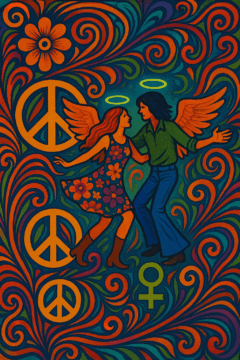
The Saint Matthew Passion – yes, I know, by Bach – was a rock band I played in back in the ancient days, 1969 through 1971, when I was working on a master’s degree in Humanities at Johns Hopkins. Before I can tell you about that band, however, I want to tell you something about my prior musical experience, both when I was just a kid growing up in Johnstown, Pennsylvania, in the Western part of the state. Football country, Steeler country. Then I entered Johns Hopkins, where I finally allowed myself to like rock and roll. That’s when I joined the Passion. After that, ah after that, indeed.
I started playing trumpet in fourth grade, group lessons at school, then private lessons at home for a couple of years.
Next I started taking lessons with a man named Dave Dysert, who gave lessons out of a teaching studio he’d built in his basement. When I became interested in jazz, he was happy to encourage that. I got a book of Louis Armstrong solos. He’d accompany me on the piano. Made special exercises in swing interpretation. Got me to take piano lessons so I could learn keyboard harmony. I learned a lot from him: My Early Jazz Education 6: Dave Dysert. Those lessons served me well, when, several years later, I joined The Saint Matthew Passion.
When I entered middle school I joined both the marching band and the concert band. Marching band was OK, sometimes actual fun. But the music was, well, it was military music and popular ditties dressed up as military music. I even fomented rebellion in my junior year, which was promptly quashed. Concert band was different. We played “real” music – movie scores, e.g. from Ben Hur (“March of the Charioteers” was a blast), classical transcriptions, e.g. Dvorak’s New World Symphony, Broadway shows, e.g. West Side Story, and this that and the other as well. We were a good, very good, both marching band and concert band.
I also played in what was called a “stage band” at the time. It had the same instrumentation as a big jazz band – trumpets, trombones, saxophones, rhythm section (drums, bass, guitar, piano) – and played the same repertoire. One of the tunes we played was the theme from The Pink Panther, by the great Henry Mancini. I was playing second trumpet, the traditional spot for the “ride” trumpeter, the guy who took the improvised solos. Since this arrangement was written for amateurs, there was a (lame-ass) solo written into the part. I wanted none of that. I composed my own solo. I’d been making up my own tunes for years, and Mr. Dysert had given me the tools I needed to compose a solo – another step further and I’d have been able to improvise on the spot, but that’s not how we did it back then, at least not in the sticks. So I composed my own solo. Surprised the bejesus out of the director the first time I played it in rehearsal. But he took it well.
That’s what I had behind me when, in the Fall of 1965, I went off to Johns Hopkins.
I had to audition. The director was Conrad Gebelein, “Gebby.” As I recall, word was that played guitar and studied with the great Andrés Segovia. I have no idea whether or not it was true, but it was certainly plausible.
I forget just how the audition went. Did I bring some music with me to play so I could strut myself? Probably. Did I have to site-read some music on the spot? Possibly. I don’t know just what I played. All I remember is that I didn’t play it for very long before Gebby stopped me and said: “I can tell you’re very musical. What can I do to help you.” I didn’t know what to say. I think I said I was looking for a fake book. It’s a book with melodies of songs and chord changes but nothing else.
For whatever reason Gebby didn’t come through with a fake book. But I joined the band anyhow. We worked up some kind of routine for the first football game. All I remember about it is that one half of the band ended a tune a full eight measures before the other half. What a freakin’ embarrassment. I quit the marching band, but stuck around for concert band. Did that for 1965-66 and then 1966-67.
In May of 1967 the Beatles released Sgt. Peppers Lonely Hearts Club Band. I decided that it was OK for me to like rock and roll. Why do I put it like that? Back in high school I thought of myself as a “nonconformist” (and proud of it). I was into jazz, like my teacher, David Dysert, who couldn’t stand those guys who could only play three-chord tunes. So, that was my stance. I didn’t like rock and roll. But every once in a while I’d hear some rock and roll – couldn’t avoid it – and tell myself that I kinda’ liked some of it. The Beatles forced my hand. I publicly admitted that I liked rock and roll.
I did more than like it. I OD’d on it. I disavowed both jazz and classical music and even – I kid you not, swear to god – I even put away my trumpet. Sometime in the summer of 1969 I decided that enough was enough. I took out the trumpet and started practicing again. It took me a month to get my chops back.
While I’d graduated in the spring of 1969, I stuck around Hopkins for a masters in Humanities – a circumstance forced on my by the exigencies of the military draft. I wasn’t sure where I’d be or what I’d be doing, so rather than go away for graduate school I decided to stay at Hopkins. So I joined the Hopkins Concert Band in the Fall of 1969.
That’s when Jon Siskind came up to me after rehearsal one day and recruited me to join a band he was starting up. What kind of band? A rock band with horns, like Blood, Sweat, and Tears, or Chicago Transit Authority (aka Chicago). You see, back in the 1950s when I was just getting started, rock and roll bands typically consisted of a vocalist, who often played an instrument as well, plus guitar, bass, drums, sax, and sometimes keyboard as well. When the British invaded in the 1960s the sax was dropped. Then late in the decade several groups got the idea of adding a small horn section and so combine jazz with rock. That’s what Jon was putting together.
Two Tunes We Played
For What It’s Worth
We would call ourselves The Saint Matthew Passion. Just why, I don’t know. It was Mal Henoch’s idea. He was one of Jon’s roommates and played bass in the band. It’s kind of an odd name for a rock and roll band. But then a lot of bands had odd names, Procul Harum, Moby Grape, Vanilla Fudge, The Kinks, and many others, almost all of which I’ve forgotten. In that crowd “The Saint Matthew Passion” was just another odd name with a weird kind of left-handed vibe. I dug it.
Jon was leader, lead vocals, and keyboardist. Mal was on bass. Mike Casher played guitar. Steve Heller (another of Jon’s roommates I believe) was on alto sax and flute. Marvin Gross played trombone. All of us were from Hopkins. Mike Dore played drums and was from the Maryland Institute, College of Art (MICA). As I recall, for some reason the ladies liked him. We rehearsed in Jon, Mal, and Steve’s apartment.
“For What It’s Worth” was something of an anthem by Buffalo Springfield.
There’s something happening here
But what it is ain’t exactly clear
There’s a man with a gun over there
Telling me I got to beware
I think it’s time we stop
Children, what’s that sound?
Everybody look, what’s going down?
There’s battle lines being drawn
Nobody’s right if everybody’s wrong
Young people speaking their minds
Getting so much resistance from behind
It’s time we stop
Hey, what’s that sound?
Everybody look, what’s going down?
And so it goes.
It seems like I heard it everywhere all the time. I particularly associate it with the riots that took place in Baltimore in April of 1968 after the assassination of Martin Luther King, Jr. The song had nothing to do with the riots, absolutely nothing. But Baltimore was put under martial law, I saw military vehicles on the streets, and the guys in the basement below me would play that song on their stereo. I’d go down, smoke a joint with them, and zone out on music. That song in particular. It’s etched into my brain.
As I recall, we had no particular horn arrangement for the tune. Must have been some hits, some fragments, here and there. But I don’t recall what they were. What I do recall is that during one rehearsal the horns were playing some riffs at the end as the song began to fade away. I decided to make some riffs just a little more elaborate. Somehow the guys thought I was taking a solo and let me go on. I had no intention of taking a solo. But as I spun out the riffs they got more elaborate and, once I’d realized what was happening, I went with the flow and moved from riffs to a more or less coherent solo.
That was my first improvised solo with a band. On that song – “For What It’s Worth” – and on that day, whatever it was, I became a soloist. With The Saint Matthew Passion.
I was given other solo spots, but I don’t recall what they were. Mike Casher, guitarist, was a major soloist. Steve and Jon took their licks as well, Marvin less so. I don’t recall any bass or drum solos, but my recall is far from perfect.
That’s not the only thing I did for the band. I wrote some arrangements as well. I wrote a little fugue for Procul Harum’s “A Whiter Shade of Pale,” which was a little Bachish anyhow. That was one of our staples. Late in the band’s life, I did arrangements of two Beatles tunes, “Something” and “Hey Jude.” They never got much play, but they got some, enough for me to know that the arrangements worked.
Other tunes in our repertoire (I’m reading off an old set list Jon sent me): You’re My Everything (the Temps), Free Will Fantasy, Something Goin’ On, I Can’t Quit Her, How Long Before I’m Gone, Light My Fire (The Doors! with that jazzy keyboard solo), More and More, South California Purples, Dead End Street, Honkey Tonk Woman (but not like Tina Turner, can’t touch her!), Colour My World (Steve got to play pretty flute on this), Better Times, Born Under a Bad Sign (da’ bluz, by Albert King), Beginnings, I’m a Man, Smiling Phases (Erik Satie), The Weight (Bob Dylan! A tune I’m still playing here in Hoboken, NJ), She’s Not There, Just Like a Woman, Season of the Witch (a little evil scratchy guitar, Donovan), Soul Searchin’, I Love You More Than You’ll Ever Know. That last tune is from the first Blood, Sweat, and Tears Album – Child is Father to the Man, a name swiped from Billy Wordsworth. It ends on a long fade where the horns play long tones that get higher and higher. I kept saying that someday I’d nail that high G, but I never quite managed it. A man can dream, no?
Our first gig was in Rick Pfeffer’s basement. Rick Pfeffer was a popular political science professor at Hopkins. I don’t remember much but the vibe and the general layout. The ceiling wasn’t very high, high enough though. There was no stage. We just set up in a corner. The line between us and the revelers was thus rather fluid, though no one ever got in range of Marvin’s trombone slide.
I remember it as one of the best nights of my life. When the music’s good, life is good. What more could you ask. I remember compliments being tossed our way, “you guys are great,” “this is wonderful,” “the best.” Of course you know I just made those up because I don’t actually remember what was said, or what we might have said back – because someone surely said something. That I remember. I just don’t remember who or what.
I remember we played for the Black Student Union at Adelphi. Jon wrote to me:
I remember that Adelphi gig, with some of my hometown bandmates, but others were more memorable. But, more than that, I remember the weekend road trip – my car overheating at every exit on the Jersey Tpke., going to hear a band on which I hoped to model SMP (or wait, was that a different weekend?) and then crashing at my parents’ house.
I wrote back:
I remember we did some gig for a DJ or some local TV personality [Kirby Scott]. Don’t remember much about the gig, but he heard us rehearsing/playing in Levering Hall (why were we there?). We were going through “Hey Jude” and he remarked something to the effect: “I’ve never heard such an aggregation.” In my head my instant response: What aggregation? We’re a band, you nitwit. More later.
Jon to me:
I can’t say I remember doing Hey Jude but when I see Arnie [our manager] at reunions, he always brings up the Kirby Scott show, which I remember vaguely. Aggregation? I’ll take that as a compliment.
Another note from Jon:
I don’t remember all the gigs, certainly not the last, but a few stand out in my memory:
A Sigma Nu frat party in their basement. I was sick with a fever, huddled over the piano shivering in a long winter coat with barely any voice. Steve had to do a lot of the singing that night.
Two road trips out to Hood College in Frederick with a caravan of five or six cars, including close to a dozen friends who had descended on our apartment from out of town for the weekend.
The Hopkins Hospital 1970 Christmas Party was the most fun and our best in terms of crowd reaction, probably because of the open bar.
I think there was also a Goucher mixer or two and one more party in Rick Pfeffer’s living room. Also, the Kirby Scott thing, which I really don’t remember much. Did we actually get to play?
I think we did, but just what or where, how would I know? I’m an old guy with an old guy’s memory. So’s Jon. We were so much younger then.
I don’t remember much about our last gig. I think it was in a basement or a rec room. Marvin, our trombonist couldn’t make it.
Here’s how I describe it in a document I’ve been circulating on the web for over a decade, Emotion and Magic in Musical Performance:
On “She’s Not There” the three horns would start with a chaotic improvised freak-out and then, on cue from the keyboard player, the entire band would come in on the first bar of the written arrangement.
On our last gig it was just me and the sax player; the trombonist couldn’t make it. We started and got more and more intense until Wham! I felt myself dissolve into white light and pure music. It felt good. And I got scared, tensed up, and it was over. After the gig the sax player and I made a few remarks about it—“that was nice”—enough to confirm that something had happened to him too. One guy from the audience came up to us and remarked on how fine that section had been.
That’s the only time I’ve ever experienced that kind of ego loss in music. For a few years I was very ambivalent about that experience, wanting it again, but fearing it. But the memories faded & the ambivalence too. I’m playing better than I ever did. What I can now do on a routine basis exceeds what I did back then.
A Seed Had Been Planted
Remember, this experience happened to me in the countercultural 60s (which extended well into the 1970s). ASCs, as they were sometimes called, altered states of consciousness, were of intense interest to many of us, whether they were achieved through the use of drugs, or through systematic meditation, or they just happened, we wanted to know what to make of them. I’d read a great deal about such things, including Aldous Huxley’s classic, The Doors of Perception (from which the rock group, The Doors, took their name), Mircea Eliade’s magisterial Yoga: Immortality and Freedom, Carlos Castenada, The Teachings of Don Juan: A Yaqui Way of Knowledge, various pieces by Alan Watts, I probably read something by Timothy “tune-in turn-on drop-out” Leary, but I forget just what. And I read scientific reports of all kinds, such as those collected in Charles Tart’s 1972 anthology, Altered States of Consciousness. Then there’s William James’s classic, The Varieties of Religious Experience: A Study in Human Nature, based on The Gifford Lectures he delivered at University of Edinburgh in 1901 and 1902.
Of these many mental phenomena, the strangest and most foreign were those in which the ego dissolved and one was just, well, ONE. In those few seconds of music I’d entered that zone. Now, I know, it’s all true. Another reality zone. Oh, not all of it, a lot of what’s been written is petty scholasticism, but there was a deep truth under all those words, and I had glimpsed it.
The thing is, many people have these experiences, and in our culture (by which I mean Western intellectual culture), they have no way of dealing with them, of placing them into context both in their live, and in the larger world. Perhaps they dismiss them entirely, or maybe the wonder whether or not something’s wrong with them (no, nothing’s wrong). It’s not a happy situation.
On the other hand, those evenings like Saint Matthew’s gig at Rick Pfeffer’s party, or the 1970 Christmas party at Hopkins Hospital, those are fairly common. Any reasonably good band has gigs like those (I mention some in my article about Out of Control). Sure some of those gigs are better than others, but they’re all in the same happiness zone. Happiness researchers talk of affective happiness, “immediate responses to events.” We all need more such evenings in our lives, at least once a week, a night out on the town, a private party, a good sports event, a movie, a picnic, whatever. They’re revivifying. The more often we revive our lives, the more likely we are to experience a high level of evaluative happiness, “a more contemplative or systemic matter, mapping a person’s overall appraisal of life and whether they are satisfied with theirs.”
Right now the world is running low on happiness, any and all kinds of happiness. We need more bands like The Saint Matthew Passion, and we need more places where those bands can play for live audiences. When we get that, maybe those mysterious glimpses of a different reality, maybe they’ll take care of themselves.
Playing with The Saint Matthew Passion showed me that I could pursue music for the rest of my life without having to be a full-time professional musician. I have done so, and with great joy, in many forms: jazz, Afro-Cuban, classical symphony, street music of various kinds, RnB, a polka or three, and – would you believe it – The Grateful Dead. Just last night I was at jam session where we ran down Scarlet Begonias/Fire on the Mountain. Great for guitar players, but they don’t lay well on trumpet. Had to give up half my technique just to play those damn tunes. The joy was the same. That comes from the heart.
Over the years I’ve written a number of posts about my Baltimore years. You can find the posts at my home blog, New Savanna, at this link. Here’s a list of the articles I’ve published at 3QD:
- Why I am a Patriot: Vietnam, the Draft, Mennonites, and Project Apollo
- Old School: Torpor and Stupor at Johns Hopkins
- Ecstasy at Baltimore’s Left Bank Jazz Society
- Break! How I Busted Three Trumpeters Out of a Maryland Prison
How I used AI in writing this article
I wrote a complete draft and uploaded it to ChatGPT, asking it for a critique. We began working on the image I’ve placed at the top of the article. Then I went back a reworked the article with ChatGPT’s remarks in mind. When I’d finished that I again asked ChatGPT for its opinion. Much better. It suggested new title, which I’ve used. Finally, we finished working on the image.
Enjoying the content on 3QD? Help keep us going by donating now.