
by Kevin Lively
“What this country needs is a good war.”, my Grandfather declared in 2008 while we were gathered at his table in Buffalo with Fox News playing in the background, the TV lit up red with crashing market charts. “It’s the only thing that will fix the economy” he continued. No one pointed out that as these words were spoken, there were, put together, around 200,000 US troops deployed in Afghanistan and Iraq. Now, my grandfather was a good man, hard working, pious, and hardly prone to such statements. Yet, like many Americans who lived through the Great Depression, it was also deeply ingrained in his psyche that the event which led to prosperity during his adulthood, the greatness many are eager to return to, was also the bloodiest human driven catastrophe in history, WWII.

This is of course a widely accepted truism among US economists and historians, as the state department’s Office of the Historian will tell you. It is also part of the cultural fabric to extol the moral virtues of this particular war, given that it destroyed a regime which essentially defines the modern conception of evil. Of course, as with everything else in history, some of this triumphalist patting ourselves on the back is white-washed. It turns out there was more support in the USA for Nazism before the war than is often remembered, including in the business arrangements of the Bush dynasty’s progenitor. This should not be too surprising given that leading medical journal editors in the USA were urging that the public be persuaded on moral grounds to adopt similar eugenics policies as the Nazis enforced in the 1930s.
In any case, the other accepted truism about this turn of events is that America, as the victorious industrial superpower, realized that its isolationism had only helped lead to the calamity. Therefore, like it or not, it must shoulder the burden of power, stand against the rising communist threat to make the world safe for democracy, and establish the Pax Americana which we have enjoyed since.
As with any good myth, much of this is true. Modern Germany and Japan are prosperous democracies (mostly) at peace with their neighbors and have undergone an unbelievable cultural transformation away from their Prussian and Bushido imperial pasts. The Marshall plan and the extraordinary decision to forgive subsequent German debts was an inarguable moral good to the starving and bombed populations of Europe. I would even go further and say this was a just reparation for the choice to strategically bomb civilian populations. After entrenching the occupation of Europe and East Asia, and shifting to a quasi-permanent war economy, employment and economic activity did boom throughout the 1950s and 60s, not only in the USA but in the newly “allied” countries. Indeed, life in western democracies is better for most people most of the time than in our authoritarian counterparts, and we do have freedom of movement, association and speech, mostly. Furthermore, despite what are probably hundreds of close calls with the complete destruction of civilization, we have nonetheless not had a conflict as destructive as WWI or WWII for 80 years.
But, as with any myth, the magnanimity of the protagonists and the nobility of their achievements begin to break down upon closer inspection. Beyond the primacy of our moral imperative as citizens of ostensible democracies, inspection of the reality of the structure of post-war power is timely at this juncture. Given that the oft-cited phrase of Fukuyama seems itself at it’s own end, we are apparently on the verge of re-starting history. Although a casual glance through the headlines may serve to convince you that point, allow me to contextualize the mood of the defense sector specifically.
The moves towards re-industrialization, especially of of critical supply chains, which were pursued by both the Biden and Trump administrations goes beyond a desire to have us all employed making sneakers by the end of the year. In fact it likely has much more to do with military concerns. After supplying both Ukraine and Israel’s armies simultaneously, the defense establishment has been in a furor about the capacity for domestic production. Ukraine burned through one year’s worth of artillery ammunition production in eight weeks and the Center for Strategic and International Studies predicts that the USA would run out of munitions in a conflict with China over Taiwan in one week. Simultaneously the Pentagon has been screaming about the “Davidson Window“, claiming — based on the testimony of one admiral — that China is preparing for conflict by 2027 and further asserting that their shipbuilding capacity exceeds America’s by 232 times (so long as one generously mixes civilian and military statistics).
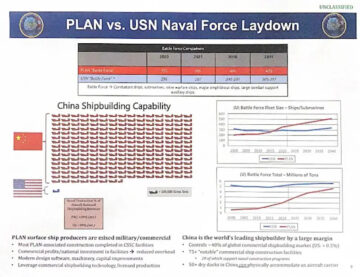
Anyone familiar with the usual ploys of the defense sector to stir up business for itself, from the non-existent bomber and missile gaps to Colin Powell’s (willing or unwitting) lies to the UN will at this point be reaching for a glass of water to wash down the kilos of salt that such statements must be taken with. But there is clearly something to be said for the role of manufacturing capacity to win wars, given that this competitive advantage is widely regarded to be the main reason the US backed allies won the war after the initial advantage of German and Japanese blitzkrieg wore off. For those who scoff at the notion of actually fighting a hot war between nuclear armed powers I would remind you that, rightly or wrongly, credibility in international relations is defined as the capacity to act on threats and that such threats unfortunately seem to form the basis for otherwise civil relations between countries, at least so far as the security planners with actual decision making powers are concerned. So this story is not so much about the actual use of violence between countries actually capable of fighting each other at length, so much as the credible threat of a capacity for violence should a prolonged conflict break out.
One sector of the American business community which is leaping in to grab their share of the nearly $1 trillion proposed defense budget is the dragon’s hoard of Venture Capital (VC) markets in Silicon Valley. This is, apparently, a relatively novel development which is likely coming from decades of low taxes and outsized capital flow into tech companies and their founders, whose resources far outstrip the R&D spending of traditional defense primary contractors. Jeff Bezos for example has cited the VC sector in the USA as the primary reason why the largest tech firms are essentially all American. Reluctance in the valley to invest in or work for defense contracts such as Google employees striking in 2018 over Project Maven — an AI project for the Pentagon — has been waning and companies willing to step in such as Peter Thiel’s Palantir have been filling the gap.
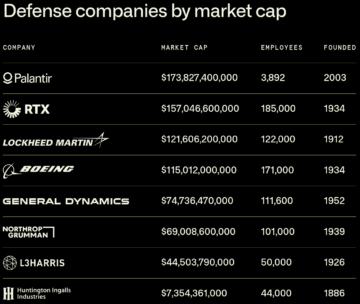
Palantir was founded in 2003 and focuses on dual-use AI, trained across economic sectors in order to commoditize large language models such that client companies can attain “enterprise autonomy” i.e. AI empowered to quasi-independently produce wealth. In the stated philosophy of the outspoken CEO Alex Karp and CTO Shyam Sankar the civilian applications are a subsidy in order to support the primary focus of Palantir which is to “power the West to its obvious, innate superiority“, through its central client, the US defense department, which is a moral stance since “we are at war with China” in the form of an AI arms race. Apparently this is a successful strategy as since its public listing in 2024, Palantir has surpassed the market cap of the other five prime defense contractors: Lockheed-Martin, Northrup-Grumman, General Dynamics, RTX and Boeing.
This is according to Sankar’s screed, The 18 Theses of the Defense Reformation: “nail[ed to the] Pentagon Metro entrance not because I hate the Department and my nation, but because I love them profoundly”, where he lays out proposals to streamline defense spending and increase innovation. To be clear I’m not giving a knee-jerk criticism of this stance, many critiques brought up here, such as cost-plus contracts, are shared by institutions critical of Pentagon spending. However, the exploding number of defense tech companies, and their open enthusiasm for AI integrated lethal systems such as the tech stack that Anduril is developing (I would very strongly encourage you to actually click on this particular link and watch the CEO for a minute or two discussing some of this tech to get a serious idea of what I mean) should be cause for reasoned, rational discussion in public. When VC investors are saying that a potential problem for the defense tech sector is that we will not be able to develop Skynet, which is “the goal”, then we are well past the point where we should be asking “Why are we developing this weaponry?” and demanding oversight for how it will actually be deployed in our name.
This brings me back to the questioning of the myth of the Pax Americana I raised before. What was it that really drove US policy planners, senators and presidents to build and maintain a uniquely American system of overseas military bases, at least three times as many as all other countries combined, which by 2021 numbered around 750 spread across 80 countries? By comparison, China, whom I trust you are now dutifully afraid of, has five. If it’s for supporting democracy then why are at least 45 of our host countries cited as non-democratic and 19 of them considered fully authoritarian? How much peace was there really when during the Korean war, US bombers ran out of targets to strike, maybe up to 3.8 million people were killed in Indochina throughout the US intervention there, tens of thousands were killed and tortured by the CIA backed Contras in Nicauragua throughout the 1980s, up to a half a million children were starved in Iraq through the 1990s by US sanctions, and maybe a million more civilians killed in Iraq during the US occupation? This is only cases where there is direct US intervention, ignoring the long list of US backed coups, dictators and massacres.
Obviously there were atrocities in Soviet Russia, Cambodia, and many, many other places but as a basic moral rule, actors are responsible primarily for their own actions and therefore US citizens, living in an ostensible democracy, should at a minimum be aware of this history and its implications for present and future US foreign policy. Unfortunately we only have sporadically leaked or decades-old declassified documents to go off of, but the story of American hegemony as seen from the planners themselves is much different than that which my and possibly your grandfather may have believed. More on that next time.
***
Enjoying the content on 3QD? Help keep us going by donating now.