
Tag: youtube
Wednesday, September 11, 2013
Who did you hear, me or your lying eyes?
From KurzweilAI:
What did you hear?
“For the first time, we were able to link the auditory signal in the brain to what a person said they heard when what they actually heard was something different. We found vision is influencing the hearing part of the brain to change your perception of reality — and you can’t turn off the illusion,” says the new study’s first author, Elliot Smith, a bioengineering and neuroscience graduate student at the University of Utah. “People think there is this tight coupling between physical phenomena in the world around us and what we experience subjectively, and that is not the case.”
The McGurk effect
The brain considers both sight and sound when processing speech. However, if the two are slightly different, visual cues dominate sound. This phenomenon is named the McGurk effect for Scottish cognitive psychologist Harry McGurk, who pioneered studies on the link between hearing and vision in speech perception in the 1970s. The McGurk effect has been observed for decades. However, its origin has been elusive. In the new study in the open-access journal PLOS ONE, the University of Utah team pinpointed the source of the McGurk effect by recording and analyzing brain signals in the temporal cortex, the region of the brain that typically processes sound. The researchers recorded electrical signals from the brain surfaces of four epileptic adult volunteers who were undergoing surgery to treat their epilepsy. These four test subjects were then asked to watch and listen to videos focused on a person’s mouth as they said the syllables “ba,” “va,” “ga” and “tha.” Depending on which of three different videos were being watched, the patients had one of three possible experiences as they watched the syllables being mouthed:
— The motion of the mouth matched the sound. For example, the video showed “ba” and the audio sound also was “ba,” so the patients saw and heard “ba.”
— The motion of the mouth obviously did not match the corresponding sound, like a badly dubbed movie. For example, the video showed “ga” but the audio was “tha,” so the patients perceived this disconnect and correctly heard “tha.”
— The motion of the mouth only was mismatched slightly with the corresponding sound. For example, the video showed “ba” but the audio was “va,” and patients heard “ba” even though the sound really was “va.” This demonstrates the McGurk effect — vision overriding hearing.
More here.
Tuesday, September 10, 2013
How they make Raspberry Pi in the UK
Video on the making of the Raspberry Pi, a credit-card-sized single-board computer developed in the UK by the Raspberry Pi Foundation with the intention of promoting the teaching of basic computer science in schools:
Monday, September 9, 2013
On Not Having a Live Arm and the Currencies of Passion
by Tom Jacobs
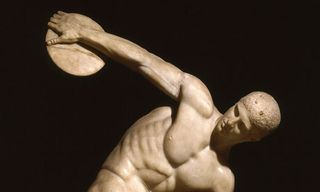
There are people who have thrown a sixteen pound sphere nearly eighty feet. There isn't much to see when you witness this, other than a subtle unleashing of human energy, but it's hard to actually see: it all happens too fast. To watch someone throw a shotput upwards of eighty feet is not like watching the pas de deux of tennis, where two people seek, chess-like, to anticipate how to checkmate the other by thinking several moves ahead. It's not like that at all. But still there is something quite watchable there: there is an incredible confluence of torque and spin and speed and will that wind up and are released in a way that can be jaw dropping, at least if you know what to look for. Like watching the discus or the high jump or the long jump (none of which will ever really draw spectators in the way that less brief and intense performances ever will), there is something very blue collar but also quietly superhero-like about it. How, for instance, can someone jump over a bar that is actually taller than they are? And what ontological, metaphysical, or even just physical sense does that make or mean? It's a bit like jumping out of your own skin.
Here are some remarkable chucks over the course of many years (and apologies for the music…):
this kid threw a 5 kg (a little over 11 pound shot put) 23 meters, or roughly 75 feet.
Then there’s this kid:
There's something Emersonian about this sort of thing. You and yourself and the universe and this singular object, each conspiring against or cooperating with the other. Here's a heavy thing. How far can you throw it away from yourself? And how does this act make you feel, even if your results are mediocre?
Sunday, September 8, 2013
berlin on romanticism
bernstein working mahler
borges
Amitabh Bachchan & Abhishek Bachchan Live in Concert
Two Guys You’ve Never Heard Of Just Released the Song of the Summer
Neetzan Zimmerman in Gawker:
Sure, summer is almost over. And we've already had plenty of worthy pretenders to the “Song of the Summer” throne. But that just makes this unknown duo's accomplishment that much more impressive.
Perhaps calling Bård Ylvisåker and Vegard Ylvisåker “unknown” is somewhat unfair. They're plenty known in their home country of Norway where they go by “Ylvis” and have their very own talk show on TVNorge.
And as part of the promotion campaign for that show's upcoming season premiere, Ylvis released a music video for a song unassumingly called “The Fox” which went on to set the world of sound on fire.
Don't read another word. Just, uh, just listen to it. Seriously, stop reading. Go listen. Stop. Go.
Saturday, September 7, 2013
Victor Borge: Phonetic punctuation
[Thanks to Farrukh Azfar.]
Thursday, September 5, 2013
Cancer’s origins revealed
From Sanger Institute:
Researchers have provided the first comprehensive compendium of mutational processes that drive tumour development. Together, these mutational processes explain most mutations found in 30 of the most common cancer types. This new understanding of cancer development could help to treat and prevent a wide-range of cancers. Each mutational process leaves a particular pattern of mutations, an imprint or signature, in the genomes of cancers it has caused. By studying 7,042 genomes of people with the most common forms of cancer, the team uncovered more than 20 signatures of processes that mutate DNA. For many of the signatures, they also identified the underlying biological process responsible. All cancers are caused by mutations in DNA occurring in cells of the body during a person's lifetime. Although we know that chemicals in tobacco smoke cause mutations in lung cells that lead to lung cancers and ultraviolet light causes mutations in skin cells that lead to skin cancers, we have remarkably little understanding of the biological processes that cause the mutations which are responsible for the development of most cancers.
More here.
The prime minister of Australia, Kevin Rudd, on gay marriage
Wednesday, September 4, 2013
Joe Wong at RTCA Dinner
Sunday, September 1, 2013
spike driver blues
all my little words
seamus heaney — digging
Saturday, August 31, 2013
Paul McCartney Kennedy Center Honors
For Azra and Sughra:
Friday, August 30, 2013
Seamus Heaney reads Scaffolding
Kittens On The Beat
Thursday, August 29, 2013
Saluting a Dream, and Adapting It for a New Era
From The New York Times:
President Obama stepped into the space on Wednesday where the Rev. Dr. Martin Luther King Jr. once stood, summoning his iconic dream of a colorblind society in a celebration of a half-century of progress and a call to arms for the next generation. On a day of overcast skies and misty rain, tens of thousands of Americans — black, white and every shade in between — returned to the site of Dr. King’s “I Have a Dream” speech to listen to the nation’s first black president pay tribute to the pioneers who paved the way for his own ascension to the heights of American government. “Because they kept marching, America changed,” the president said as Dr. King’s family watched. “Because they marched, a civil rights law was passed. Because they marched, a voting rights law was signed. Because they marched, doors of opportunity and education swung open so their daughters and sons could finally imagine a life for themselves beyond washing somebody else’s laundry or shining somebody else’s shoes.
“Because they marched,” he added, “city councils changed and state legislatures changed and Congress changed and, yes, eventually, the White House changed.” The symbolic journey from Dr. King to Mr. Obama on the steps of the Lincoln Memorial animated the 50th anniversary of the March on Washington for Jobs and Freedom more than any oratory. While Mr. Obama’s line about the White House changing was his only reference to his unique place in history, the power of his presence was lost on no one.
More here.