by Akim Reinhardt
 For about 450 years, the western European colonial powers shit all over the world in spectacular fashion. Genocide across the Americas and the trans-Atlantic slave trade were the main drivers during the first phase. By the mid-19th century, European colonialism was approaching its bloody apogee with more genocide in Australia, the carving up of much of Asia, and eventually the scramble for Africa.
Wherever they went, European colonizers were not content to just kill, maim, and rape, or simply work people to death. From the jump, Europeans bought into their own bullshit, firmly believing they should subject the surviving colonized subjects to vast campaigns of cultural genocide. First and foremost, ban their religions when possible and make them worship the European (as in, blue-eyed) Jesus. After that, forcibly rearrange their marriage and family practices to your liking, and if possible, have them speak your particular European language. Beyond that, no detail was too mundane. It went so far as to make the colonized dress in European clothing and play European games.
And thus, soccer is the world’s most popular sport.
Want proof that European colonialism is the real reason for, or at least the original factor in, soccer’s global popularity? Look at the nations that were not under European control during the late 19th or early 20th centuries, and you’ll mostly find countries where soccer is not the top spectator sport. The United States broke away from Great Britain long before the rise of soccer, and it has a bevy of its own sports that are far more popular (baseball, basketball, American football, and on a good day hockey). Canada, New Zealand, and Australia never rebelled, but rather faded away in time for their most popular sports to be, respectively: hockey, rugby, and cricket (summer) and Australian rules football (winter). Finland, up at the edge of the world, prefers hockey. Mongolia, at the center of the world, prefers wrestling. Ireland, forever looking to do whatever the English do not, very much prefers hurling and Gaelic football. China was never culturally colonized, and basketball is its most popular spectator team sport, with various individual sports also attracting huge fan bases. Read more »
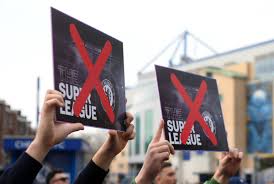 Two weeks ago European soccer world was rocked by an announcement that 12 of the top clubs had agreed among themselves to form a European Super League (ESL) to replace the existing European Champions League (ECL). The “dirty dozen” were Real Madrid, Barcelona, Atletico Madrid, Juventus, Inter Milan, AC Milan, Manchester United, Manchester City, Liverpool, Arsenal, Chelsea, and Tottenham. These teams were to be joined by another 8, bringing the total up to 20. A defining feature of the ESL would be that 15 of its members would be guaranteed their place in the competition no matter how they performed the previous year or in their domestic competitions.