
by Andrea Scrima
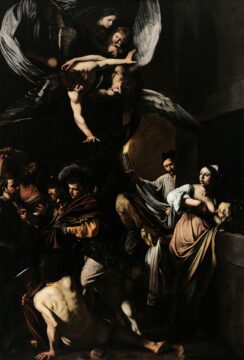
Sette Opere di Misericordia, the famous altarpiece by Caravaggio commissioned in 1607 by the charitable Confraternità del Pia Monte della Misericordia in Naples, where it still hangs today, depicts the seven Biblical acts of mercy on a single large canvas. The dense composition is made up of at least fourteen visible and another three or four semi-hidden figures intertwined in dramatic enactments of the titular scenes: caring for the sick, tending to the imprisoned, sheltering the homeless, clothing the naked, giving drink to the thirsty, burying the dead, and feeding the hungry. The first five of these are crowded together on the left side of the painting, shrouded partly in darkness. On the right is a young woman suckling an elderly man and, behind her, two men carrying a corpse only the feet of which are visible. Hovering above the teeming confusion are the Virgin Mary and Christ Child; below them, two angels are locked in a mid-air embrace.
Traditionally, the chiaroscuro in the painting—the stark orchestration of light so emblematic of Caravaggio’s revolutionary style—has been interpreted as the expression of God’s will shining down on humanity and imbuing it with divine mercy. The angel’s pose is based on Michelangelo’s fresco The Conversion of St. Paul in the Vatican’s Capella Paolina, in which Christ, appearing in the heavens, extends his hand down to Earth to give manifestation to His divine power. Read more »