by Andrea Scrima
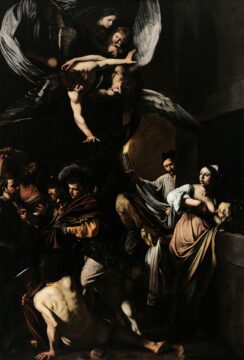
Sette Opere di Misericordia, the famous altarpiece by Caravaggio commissioned in 1607 by the charitable Confraternità del Pia Monte della Misericordia in Naples, where it still hangs today, depicts the seven Biblical acts of mercy on a single large canvas. The dense composition is made up of at least fourteen visible and another three or four semi-hidden figures intertwined in dramatic enactments of the titular scenes: caring for the sick, tending to the imprisoned, sheltering the homeless, clothing the naked, giving drink to the thirsty, burying the dead, and feeding the hungry. The first five of these are crowded together on the left side of the painting, shrouded partly in darkness. On the right is a young woman suckling an elderly man and, behind her, two men carrying a corpse only the feet of which are visible. Hovering above the teeming confusion are the Virgin Mary and Christ Child; below them, two angels are locked in a mid-air embrace.
Traditionally, the chiaroscuro in the painting—the stark orchestration of light so emblematic of Caravaggio’s revolutionary style—has been interpreted as the expression of God’s will shining down on humanity and imbuing it with divine mercy. The angel’s pose is based on Michelangelo’s fresco The Conversion of St. Paul in the Vatican’s Capella Paolina, in which Christ, appearing in the heavens, extends his hand down to Earth to give manifestation to His divine power.
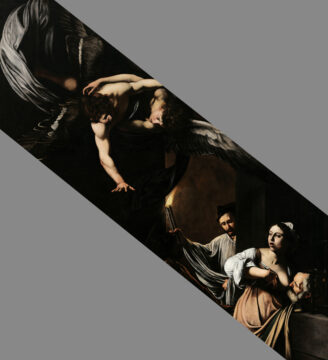
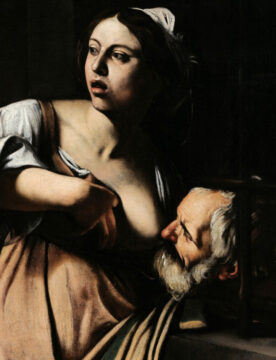
In Caravaggio, however, the gesture feels quite different: gazing at the young woman below, the angel seems hesitant and even a bit fascinated; he neither bestows nor intervenes, but watches and waits as the woman, who is lactating, pulls out her breast and performs her extraordinary act of compassion. His outstretched hand seems less an instrument of power than a means of catching his balance, of preventing himself from tumbling down and interfering in the human sphere. This scene of a young mother nursing an old man is derived not from a biblical story, but from an ancient Greek and Roman parable known as “Caritas Romana” or “Roman Charity,” in which Pero breastfeeds her imprisoned father Cimon to save him from starvation—a popular trope of filial piety related by Valerius Maximus and Pliny the Elder that dates back to pre-antiquity. Aberrations from Christian iconography are not unusual in Caravaggio’s visual cosmos, and once again, his insistence on human autonomy feeds the work’s psychological intensity and obscures what might otherwise be regarded as heresy.
Drawing from a source that predates Church doctrine, Caravaggio charges the image with an emotional urgency that subtly underscores its transgressive erotic potential, leading centuries of artists to emulate him in countless variations on the motif, some of them veering off into the semi-pornographic. Commissioned to create an altarpiece for a Christian charity run by noblemen, Caravaggio elevates the simple deed of a peasant woman to an exemplar of an inherent human morality independent of religious dogma, locating the paragon of human mercy not in the splendidly garbed nobleman cutting his cloak in two to clothe the naked man below him—presumably, the nobleman has many more fine cloaks at home—but in the young mother, who is risking arrest or worse. Prohibited from bringing her father food or drink, she can do nothing more than offer up her own full breast to keep him alive.

The woman is in no need of divine inspiration; aware of the danger and potential repercussions of her deed, her expression is both apprehensive and defiant. The decision is entirely hers. All the diagonals and all of the painting’s sweeping movement—from the arm of the angel and the two candles in the hand of the priest to her left to the curve of his draped tunic; from the lighting on the skin of the naked figure and the nobleman’s upper thigh to the folds in the young mother’s dress—converge at her breast: she is the compositional center, the painting’s locus, the primary act. Caravaggio’s is a subversive vision: in the end, it is humanity’s own capacity for spontaneous compassion that will save it, a capacity that Caravaggio in all likelihood witnessed on the cruel and squalid streets of Naples, with their unexpected moments of mercy and grace.