
Elizabeth Landau in Quanta Magazine:
 Weighing in at a single ounce, the white-crowned sparrow can fly 2,600 miles, from Mexico to Alaska, on its annual spring migration, sometimes traveling 300 miles in a single night. Arctic terns make even longer journeys of 10,000 miles and more from the Arctic Circle to Antarctica, while great snipes fly over food-poor deserts and seas, sometimes covering 4,200 miles in four days without stopping.
During migration season, many bird species become continent-spanning, high-endurance athletes. “They’re flapping their wings several times a second for up to eight hours at a time,” said Soren Coulson(opens a new tab), who studies migration physiology at the University of Memphis. For humans, an equivalent feat — say, running nonstop without food, water or rest for days at a time — would be unimaginable. “We were just amazed and interested in how can these birds fly for thousands of miles without stopping, at a really high intensity, when most of us can barely run a 5K,” said Paulo Mesquita(opens a new tab), who studies mitochondrial physiology and muscle aging at the Oklahoma Medical Research Foundation.
More here.
Enjoying the content on 3QD? Help keep us going by donating now.
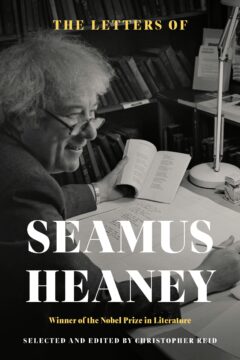 Seamus Heaney was born on April 13,1939 (12 days after me) and 3 months after the death of Yeats. The Letters* begin in 1965, his miraculous year. His first book, Death of a Naturalist, was accepted by Faber & Faber; he got a teaching job at his alma mater, Queen’s University in Belfast; and he married Marie Devlin, whom he was pleased to call Madame and Herself.
 “Reduce, reuse, recycle”: these three words have become as ubiquitous as the plastic waste they attempt to combat. Once seen as a simple roadmap toward sustainability, this mantra now conceals a far more complex and troubling reality. While these principles serve as a starting point for environmental action, they also have a deceptive history rooted in the petrochemical industry’s effort to avoid accountability. The truth is, no matter how diligently we sort our waste products, individual actions alone cannot solve the growing crisis of plastic pollution.
 Three hundred and eighty writers and organisations including Zadie Smith, Ian McEwan, Russell T Davies, Hanif Kureishi, Frank Cottrell-Boyce and George Monbiot have
  Imagine being stuck in a room with Roman Roy — Kieran Culkin’s witty, self-hating “Succession” character — without having gotten any understanding of his psyche to contextualize his machine-gun quips. That’s “Mountainhead,” times four. No one here reveals much of themselves beyond their first, worst impression, with the exception of Youssef’s Jeff, who is — unusually for an Armstrong protagonist — decent but boring.
 The first time I met Alasdair MacIntyre I was twenty-one, and he threatened to kill one of my classmates. Then he told us all that our attention to his work was “profoundly misbegotten.” It was the spring semester of 1991, my senior year at Georgetown University, and my capstone seminar was dedicated to reading everything the Scottish-born philosopher had written up to that point. (It was a lot.) At the end of the semester, he came for a full day of discussion. To call it “vigorous” and “frank” would suggest we were auditioning for the State Department.
 How should states secure funding to support the green transformation, where the state is an actor that is both public and dependent upon private interests? This pressing issue in international political economy (IPE) has so far generated different and dissonant scholarly discussion. This special issue brings analytic and empirical specificity to these conversations in order to map out the possible macrofinancial strategies that states have open to them. We contend that there are three possible policy strategies that states can adopt, albeit with some degree of combination or overlap. The first strategy embraces macrofinancial policies that attempt to ‘nudge’ agents into specific behaviors and/or rely on market signals as the primary drivers in delivering decarbonisation. The second strategy is one of attracting investment from the holders of existing assets through financial incentives, which is what the existing literature most often refers to as ‘derisking’ The third strategy we identify is ‘strengthening the state’ or, more bluntly, coercing private finance into investing, or bypassing them completely. The authors in this special issue ask what the limitations of each strategy are in specific national contexts, and what the coalitional and distributional consequences would be of embracing these policies that nudge, attract, or coerce.
 In the modern West, individualism takes on many forms. Perhaps the most readily apparent is in a political philosophy that puts the freedom and the rights of individuals as its highest values. The social contract theory of Thomas Hobbes and John Locke treats society as originating from an agreement of free, self-interested persons, in which government exists for the purpose of securing individual rights. These views are also reflected in an economic system that encourages individual innovation in the pursuit of wealth, and treats private property as sacrosanct.
 My recent fortnight in Berlin was replete with its usual share of artwalk splendors—the permanent display of room after room of paintings by the incomparable
  There’s no end to the woes that mothers face come summer vacation. All the children are at home. When they’re not in front of the TV, they’re either climbing the guava tree in the front yard or perched on the compound wall. What if one of them falls and breaks an arm or a leg? Then there’s the crying, the laughter, the punishments they inflict on one another based on some arcane system of justice … This was why Razia’s headaches worsened when the summer holidays started. The nerves in her temples throbbed, her hot head felt like it would burst, and it seemed as if the veins at the back of her neck might snap at any moment. One after the other the children rushed in with their complaints, crying and screaming … and then there were their games … abbabbaa … battles with swords and machine guns, bomb attacks … !
 Dear Reader,