Jeffrey J. Williams in Public Books:
 Amitava Kumar’s recent novel, Immigrant, Montana, tells the story of Kailash, an Indian graduate student who has immigrated to the US to study at Columbia University, and his education in love as well as in academe. The novel was a New York Times Notable Book of 2018, and it has been compared to the autofiction of Teju Cole and Ben Lerner. In this interview, Kumar talks about how the novel is and is not autobiographical.
Kumar has also published several books of criticism and of reportage on India and Pakistan.
Jeffrey Williams (JW): Your new novel, Immigrant, Montana, has been widely reviewed and most of the reviews have touted it as autofiction, although it strikes me that it is not really autobiographical. Having known you for a long time, I’d say you conducted a skillful ruse, giving it the air of autobiography.
Amitava Kumar (AK): I worked very hard both to invent things and, at another level, to make it appear as if it were my story. For example, the narrator is called AK-47. I was on a train somewhere, and I thought, he must have a provincial name, Kailash, which is not a name you will hear among many Indians. And then I thought up the idea that an Irish friend of his calls him Kalashnikov, and that becomes AK-47, so it promotes the illusion that it’s about me.
But, of course, so much of it is fabrication, so I had never thought I was doing autofiction. I was very much open to invention, but at the same time I wanted it to read like it was a report from real life. It therefore attempts to insert personal details in a way that people understand as autofiction. For example, as you know, I never went to Columbia, I never studied with Said, I never knew this man called Eqbal Ahmad, on whom the main character, Ehsaan Ali, is based. But they were a great inspiration to me.
More here.

 There are many mysteries surrounding quantum mechanics. To me, the biggest mysteries are why physicists haven’t yet agreed on a complete understanding of the theory, and even more why they mostly seem content not to try. This puzzling attitude has historical roots that go back to the Bohr-Einstein debates. Adam Becker, in his book What Is Real?, looks at this history, and discusses how physicists have shied away from the foundations of quantum mechanics in the subsequent years. We discuss why this has been the case, and talk about some of the stubborn iconoclasts who insisted on thinking about it anyway.
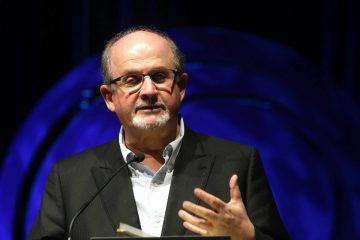 The novel’s protagonists are Indian-born Muslims. Saladin is a voiceover artist and an immigrant from Bombay to London whose shame about his Indian-ness and desire to be anglicised form the backdrop to a complex interrogation of what it means to be rootless and how migrants in a globalised world can find a sense of identity. Gibreel, meanwhile, is a legend of the Bombay movie scene whose recent health crisis has led him to lose his faith and travel to London to be with the woman he loves, Alleluia Cone. Famous for portraying Hindu gods on screen, Gibreel’s newfound archangelic nature sorely tests his mind—a newly godless man condemned to act as God’s (or is that Satan’s?) right hand on earth.
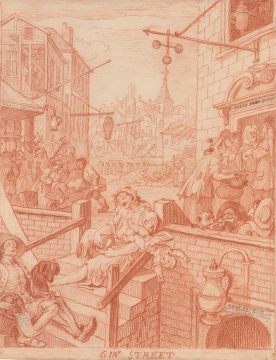 “Cruelty and Humor” may be the subtitle of the Hogarth exhibition on display at the Morgan Library through September 22, but “Beer and Gin” would be more fitting. In the early eighteenth century, the British government (amid heightened tensions with France) instituted a policy to promote gin, a traditionally British drink, at the expense of French brandy. The policy proved too effective: by 1743, the average Brit was—in an intoxicated and nationalist frenzy—drinking 2.2 gallons each year. A satirist, agitator, and, in the words of David Bindman, “self-consciously English artist,” William Hogarth (1697–1764) employed his work in the hopes of chilling the “Gin Craze” of the 1750s.
 The notion of Anne Frank’s diary as a source of redemption, or at least consolation, received a further boost from the American stage play, written by two Hollywood screenwriters, Frances Goodrich and Albert Hackett, in 1955. The famous last words in the play are taken from a diary entry on July 15, 1944: “In spite of everything, I still believe that people are really good at heart”. Thus, the story that would end in Anne’s squalid death was given an uplifting Hollywood ending.
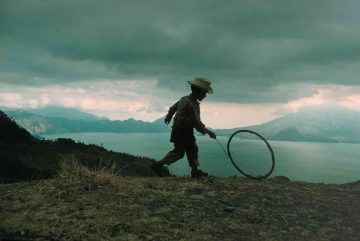 We called it El Lago. The Lake. As kids, growing up in the Guatemala of the 1970s, we probably never even knew its name—Lake Amatitlán. Nor did we care. It was only a winding, half-hour drive from the city to my grandparent’s vacation chalet on its shore. We spent most weekends and holidays of my childhood there, jumping off the wooden dock, learning to swim in the icy blue water, digging out old Mayan pots and relics from the muddy bottom, paddling out on long surfboards while little black fish jumped up through the surface and sometimes even landed on the acrylic board. Gently, we’d nudge them back in.
 Seventy years after partition, the annexation of Kashmir by India is the endgame of Devraj, the Hindu nationalist businessman protagonist of my 2017 novel
 Helen Clapp, a professor of theoretical physics at MIT, recounted the biggest news of 21st century physics, the detection of gravitational waves by the Laser Interferometer Gravitational-Wave Observatory (LIGO), an international collaboration of scientists, resulting from the collision of two black holes more than a billion years ago. Einstein posited the existence of gravitational waves in 1915, Clapp said. “People describe these waves as ‘ripples in spacetime,’ with analogies about bowling balls on trampolines and people rolling around on mattresses, and these are probably as good as we’re going to get. The problem with all of the analogies, though, is that they’re three-dimensional; it’s almost impossible for human beings to add a fourth dimension, and visualize how objects with enormous gravity—black holes or dead stars—might bend not only space, but time.”
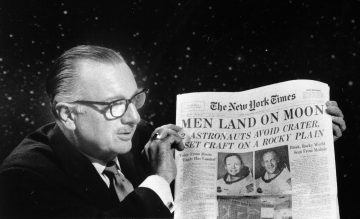 In 1969, W.H. Auden wrote a skeptical poem about the moon landing after he had declined a request to write a celebratory one.
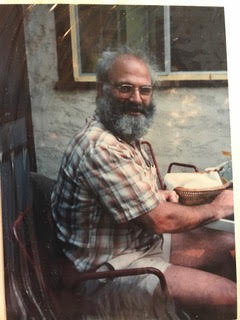 I had just turned twenty-nine and he was forty-eight when we first met out there on City Island, but I quickly realized that he would make a wonderful subject for one of those multi-part profiles the magazine was famous for in those days, and across the next four years, I took on the role of a sort of beanpole Sancho to his capacious Quixote, traipsing about with him on his various rounds and travels, chronicling his in those days floridly neurotic ramblings, indeed, filling up over fifteen notebooks full of them, interviewing his friends and patients and earlier associates, and off to the side, trying to help him through that epic blockage, which, curiously, took the form of graphomania: he’d generated millions of words, just not the right ones, and, for his editors and me, most of the at times Sisyphean work consisted in pruning the damn thing back and then preventing him from mischiefing it yet further.
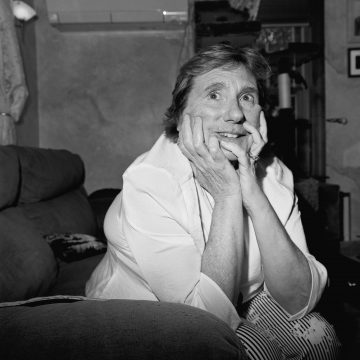 In the years before Transition House existed, violence at home was considered a private matter between husband and wife. In the early sixties, Janet, an undergraduate at a Seven Sisters college, had just married Jonathan, who was in law school. (Both names are pseudonyms.) Jonathan had started beating her up almost daily; each time, he was filled with remorse, but he blamed Janet for provoking him. Janet had not known any violence growing up, so she found the situation disturbing and bizarre and kept it a secret from most people she knew. She explained her black eyes with the usual stories about bumping into things.
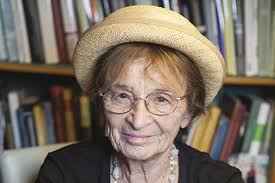 We have been friends, Ági and I, since 1969. I was much younger than she, having been born in the last year of the War in 1944. For a moment perhaps, we might have been, my mother and I, and Ági, in one of the same houses of the international ghetto, under Swedish, Swiss or Vatican weak protection. She was 14 or 15 back then, and her dramatic survival — by jumping into the Danube in front of an Arrow Cross Firing squad — has been often recounted.
 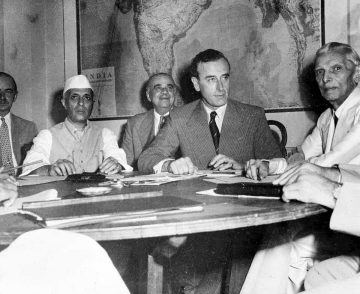 The bloodbath of partition also left the two nations that were borne out of it –
  I think a lot about Toni Morrison’s 1993 Nobel Prize lecture. Morrison, who died last week at the age of 88, was one of the nation’s most revered novelists and thinkers, and has left behind an immense opus that has generated renewed interest. Her acceptance
  For the first time, researchers have teleported a qutrit, a tripartite unit of quantum information. The independent results from two teams are an important advance for the field of quantum teleportation, which has long been limited to qubits—units of quantum information akin to the binary “bits” used in classical computing. These proof-of-concept experiments demonstrate that qutrits, which can carry more information and have greater resistance to noise than qubits, may be used in future quantum networks. Chinese physicist Guang-Can Guo and his colleagues at the University of Science and Technology of China (USTC)