
Galen Strawson in The Guardian:
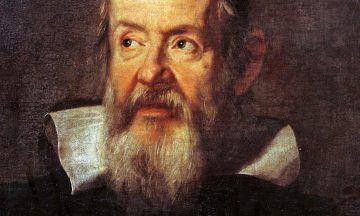 There is no escape from this dilemma – either all matter is conscious, or consciousness is something distinct from matter”: Alfred Russel Wallace put the point succinctly in 1870, and it is hard to see how his colleague Charles Darwin, the great evolutionary gradualist, could disagree. Wallace, however, wanted us to have souls; he believed that consciousness was indeed distinct from matter. Darwin was a staunch materialist; he had no doubt that consciousness was wholly material. As early as 1838 he took it for granted that thought is “a secretion of brain”, using the word “thought” in Descartes’s way to cover any conscious experience. He wondered why people found this harder to believe than the fact that gravity is a property of matter. Darwin didn’t explicitly endorse panpsychism – the view that there is an element of consciousness in all matter, or, somewhat more cautiously, that consciousness is one of the fundamental properties of matter. But he saw the force of the position, and saw that it implied our profound ignorance of the nature of matter: “What is matter? the whole thing a mystery”. Certainly he understood the point that William James made in 1890: “If evolution is to work smoothly, consciousness in some shape must have been present at the very origin of things. Accordingly we find that the more clear-sighted evolutionary philosophers are beginning to posit it there.”
Philip Goff’s engaging Galileo’s Error is a full‑on defence of panpsychism. It’s plainly a difficult view, but when we get serious about consciousness, and put aside the standard bag of philosophical tricks, it seems that one has to choose, with Wallace, between some version of panpsychism or fairytales about immaterial souls. This is of course too simple; Galileo’s Error lays out many of the complexities. It’s an illuminating introduction to the topic of consciousness. It addresses the real issue – unlike almost all recent popular books on this subject. It stands a good chance of delivering the extremely large intellectual jolt that many people will need if they are to get into (or anywhere near) the right ballpark for thinking about consciousness. This is a great thing.
More here.
 During the past eight years, many astute people, inside and outside the scientific community, have worried about the quality of scientific research. They warn of a “replication crisis.” In biomedicine and psychology in particular, it seems that a high proportion of published results cannot be reproduced. The absolute number of retractions for articles in these fields are rising. Whether or not it is right to talk of crisis, it is certainly reasonable to be concerned. What is going on?
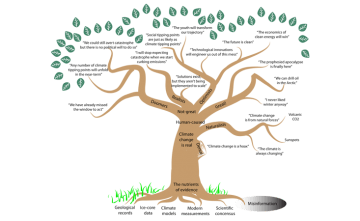 As a paleoclimatologist, I often find myself wondering why more people aren’t listening to the warnings, the data, the messages of climate woes—it’s not just a storm on the horizon, it’s here, knocking on the front door. In fact, it’s not even the front door anymore. You are on the roof, waiting for a helicopter to rescue you from your submerged house. The data is clear: The rates of current carbon dioxide release are 10 times greater than even the most rapid natural carbon catastrophe1 in the geological records, which brought about a miserable hothouse world of acidic oceans lacking oxygen, triggering a pulse of extinctions.2 Despite the evidence for anthropogenic climate change, views about the severity and impact of global warming diverge like branch points on a gnarly old oak tree (below).
 Madison was never expected to live this long. The doctors had told her parents she would probably die at birth. Surprising everyone but her mother, she seized and trembled, and refused to suckle—but she didn’t die. Madison never learned to walk. Her four limbs were spastic. She remained small for her age, and she never learned to speak, not even to say Mama or milk, or no. But she saw and experienced many things beyond seizures, infections, breathing and feeding tubes; beyond Christmases and Easters and birthdays, and the everyday intimacies of childhood. She was her mother’s joy, and knew a fierce and indelible love, breathed over her in a nightly vigil. It imbued Madison with the quiet beauty of a survivor. Whatever trials she endured, there was a sense that she was lit from inside by something sacred.
 These days it is highly fashionable to label consciousness an ‘illusion’. This in turn fosters the impression, especially among the general public, that the way we normally think of our mental life has been shown by science to be drastically mistaken. While this is true in a very specific and technical sense, consciousness remains arguably the most distinctive evolved feature of humanity, enabling us not only to experience the world, like other animal species do, but to deliberately reflect on our experiences and to change the course of our lives accordingly.
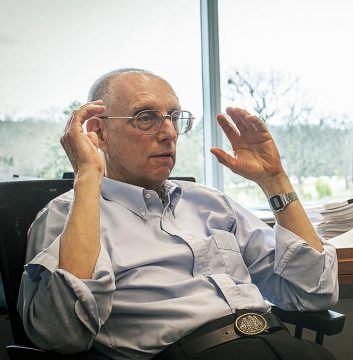 Dennis, let’s start out by asking about the
 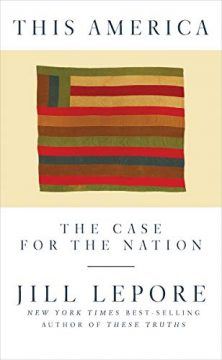 In her latest book, Jill Lepore, a brilliant story teller, offers us the biggest story of all: who we are and how we came to be. She did that superbly in her one-volume history of the nation, These Truths (2018). But here the effort is more pointed; here, Lepore is telling the story of the past in order to fight the battles of today, and she is urging her fellow historians to join her in the campaign. By mapping out the past as a competition between liberal and illiberal nationalisms, the latter most recently reincarnated and promoted by the President of the United States, Lepore is directly entering into the political fray. Unless liberals embrace and reclaim the idea of American nationalism, they will surrender its meaning to Trump and his supporters. What’s needed, and what her history shows is possible, is a full throated defense of civic patriotism, celebrating a “dedication to equality, citizenship, and equal rights, as guaranteed by a nation of laws.” “A new Americanism,” she writes on her final pages, “would mean a devotion to equality and liberty, tolerance and inquiry.”
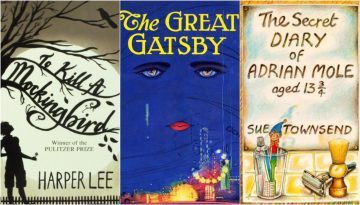 Books, books, books. They will increase your lifespan, lower your stress and boost your intelligence. They will give you fuller, thicker hair.
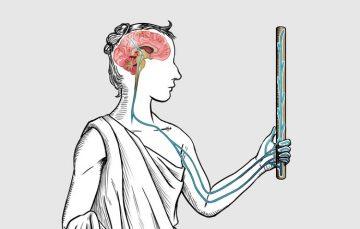 Luke Miller, a cognitive neuroscientist, was toying with a curtain rod in his apartment when he was struck by a strange realization. When he hit an object with the rod, even without looking, he could tell where it was making contact like it was a sensory extension of his body. “That’s kind of weird,” Miller recalls thinking to himself. “So I went [to the lab], and we played around with it in the lab.”
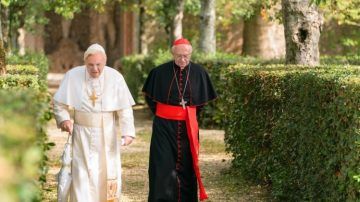 The most glorious journey can begin with a mistake.” This is the observation made by Cardinal Jorge Mario Bergoglio in the opening scene of Fernando Meirelles’s
 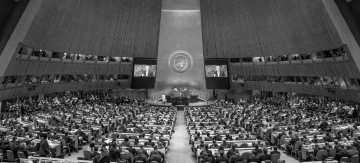 Meanwhile, Saudi Arabia’s Aramco IPO last month was the biggest in world history.
 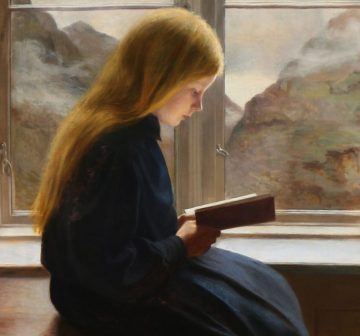 Birkerts’s argument (and mine) isn’t that books alleviate loneliness, either: to claim a goal shared by every last app and website is to lose the fight for literature before it starts. No, the power of art—and many books are, still, art, not entertainment—lies in the way it turns us inward and outward, all at once. The communion we seek, scanning titles or turning pages, is not with others—not even the others, living or long dead, who wrote the words we read—but with ourselves. Our finest capacities, too easily forgotten.
 Welcome to the second annual Mindscape Holiday Message! No substantive content or deep ideas, just me talking a bit about the state of the podcast and what’s on my mind. Since the big event for me in 2019 was the publication of