Sean Carroll’s Mindscape Podcast: Will Wilkinson on Partisan Polarization and the Urban/Rural Divide

Sean Carroll in Preposterous Universe:

The idea of “red states” and “blue states” burst on the scene during the 2000 U.S. Presidential elections, and has a been a staple of political commentary ever since. But it’s become increasingly clear, and increasingly the case, that the real division isn’t between different sets of states, but between densely- and sparsely-populated areas. Cities are blue (liberal), suburbs and the countryside are red (conservative). Why did that happen? How does it depend on demographics, economics, and the personality types of individuals? I talk with policy analyst Will Wilkinson about where this division came from, and what it means for the future of the country and the world.

More here.

Is the United States on the brink of a revolution?

Serbulent Turan in The Conversation:

Of course, every revolution is unique and comparisons between them do not always yield useful insights. But there are a few criteria we identify in hindsight that are usually present in revolutionary explosions.

First, there’s tremendous economic inequality.

Second, there’s a deep conviction that the ruling classes serve only themselves at the expense of everyone else, undermining the belief that these inequalities will ever be addressed by the political elite.

Third, and somewhat in response to these, there is the rise of political alternatives that were barely acceptable in the margins of society before.

More here.

The Arc of Life: Roger Penrose

Stephen Hawking once said of his long-time friend and collaborator Roger Penrose: “although I’m regarded as a radical, I’m definitely a conservative compared to Roger”. Roger Penrose has made ground-breaking contributions to the fields of quantum gravity, general relativity, and cosmology. In this interview with filmmaker David Malone, Penrose looks back on his life’s work and shares new ideas on the subjects of logic and consciousness.

Who’s Afraid of Impeachment? On Presidential Investigation and a 2020 Backlash

Anthont Dimaggio in Counterpunch:

There has been quite a bit of prophesizing among pundits in the news media, on the right and elsewhere, and even among some on the left with which I’ve spoken, in which critics confidently maintain that impeachment is a “gift” to Trump, dividing the nation, but mobilizing and energizing Trump’s base, thereby handing the election to Trump. These claims are almost entirely based on fear and conjecture, not on actual evidence. If we look back to the limited history of this country’s use of impeachment against presidents in modern times, there is little evidence to draw from one way or another, and certainly no cases that are equivalent to this one, in terms of telling us how impeachment will impact an election that is so far into the future – an entire year from now.

Conceding the uncertainty associated with the inquiry against Trump, available evidence suggests there is little reason to be engaging in fearmongering on impeachment. Going back to the looming impeachment of Richard Nixon following the emergence of the Watergate scandal, we see no evidence that the removal strategy harmed Democrats. Republicans lost 49 seats in the House in 1974, while losing another 5 in the Senate. Gerald Ford’s reputation – as measured by his job approval rating – quickly nosedived following his pardon of Nixon, and Jimmy Carter won the 1976 election, defeating Ford, while Democrats gained a seat in the House of Representatives, while losing one seat in the Senate. In other words, there were no observable repercussions for the Democrats for forcing Nixon from office.

More here.

These Ants Use Germ-Killers, and They’re Better Than Ours

Carl Zimmer in The New York Times:

As a microbiologist, Massimiliano Marvasi has spent years studying how microbes have defeated us. Many pathogens have evolved resistance to penicillin and other antimicrobial drugs, and now public health experts are warning of a global crisis in treating infectious diseases. These days, Dr. Marvasi, a senior researcher at the University of Florence in Italy, finds solace in studying ants. About 240 species of ants grow underground gardens of fungi. They protect their farms against pathogens using powerful chemicals secreted by bacteria on their bodies. Unlike humans, ants are not facing a crisis of antimicrobial resistance. Writing in the journal Trends in Ecology and Evolution, Dr. Marvasi and his colleagues argue that fungus-farming ants could serve as a model for drug development. It’s not just that they have antimicrobials — it’s how they use their drugs.

Fungus-farming ants bring leaves or other debris to gardens in their nests, where certain kinds of fungi thrive. The fungi — which can flourish nowhere else — grow into dense webs that the ants feed to their larvae. But the crops are also attractive to a parasitic fungus called Escovopsis. It attacks the gardens and starves the ants. “It’s a war between the ants and the pathogens for the same food,” Dr. Marvasi said. The ants have powerful allies in this war: bacteria that live on their thoraxes. Worker ants coat eggs with certain strains of these bacteria. As an ant matures, it feeds its personal supply of bacteria with secretions from glands on its thorax. The bacteria pay the ants back for this special care by making powerful antimicrobials that kill Escovopsis, protecting the gardens from destruction.

The fact that bacteria make antimicrobials is hardly surprising. The ones that doctors prescribe today were mostly discovered in the soil, made by microbes. What is surprising is that the chemicals used by the ants work so well.

More here.

Tuesday Poem

Praying the Hours At Elkhorn Slough

God. Ocean. Sunrise.
Whatever I am sitting here between,
hello.

Sea otter profile:
backcurved, hooking the tide.

Nothing so distinctive
–so joyfully learned, wondrously greeted
every salt-gift sighting.

Lowtide wader talk.
Coyote brush sun-scented
and the seals hauled out.

My low tide too
but the breeze coming up says
wake. Pray

with one foot
steady-placed, and then
the other.

Something has died. And the pleasant smell
of chaparral cannot hope to cover it up.

The chaparral must die and so must I
–would we not also wish
to leave something behind?

At the last, four notes
ascending their purple staff:
marsh-water-dune-sky.

After the last
……… silent owl-rise.

by Tara K. Shepersky
from
Echotheo Review
9/18/19

Sunday, September 29, 2019

The antidote to endless, thoughtless consumption lies not in purging ourselves of the stuff we own, but rather, redefining our relationship with stuff altogether

Benjamin Leszcz in The Globe and Mail:

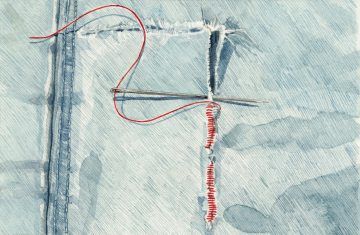
Several years ago, while living in London, England, my wife met Prince Charles at an event associated with the Prince’s Foundation, where she worked. She returned with two observations: First, the Prince of Wales used two fingers – index and middle – when he pointed. Second, Charles’s suit had visible signs of mending. A Google search fails to substantiate the double-barrelled gesture, but the Prince’s penchant for patching has been well documented. Last year, the journalist Marion Hume discovered a cardboard box containing more than 30 years of off-cuts and leftover materials from the Prince’s suits, tucked away in a corner at his Savile Row tailor, Anderson & Sheppard. “I have always believed in trying to keep as many of my clothes and shoes going for as long as possible … through patches and repairs,” he told Ms. Hume. “In this way, I tend to be in fashion once every 25 years.”

As it happens, double-breasted suits are rather on-trend. But more notable is Charles’s sartorial philosophy, which could not be timelier. The Prince comes from a tradition of admirable frugality – the Queen reuses gift-wrap – but his inclination to repair rather than replace, to wear his clothes until they wear out, is an apt antidote to our increasingly disposable times. Most modern consumers are not nearly so resourceful: The average Canadian buys 70 new pieces of clothing each year, about 60 of which ultimately wind up in a landfill.

More here.

On the Evolution of Animal Consciousness

Michael S. A. Graziano in Literary Hub:

Self-replicating, bacterial life first appeared on Earth about 4 billion years ago. For most of Earth’s history, life remained at the single-celled level, and nothing like a nervous system existed until around 600 or 700 million years ago (MYA). In the attention schema theory, consciousness depends on the nervous system processing information in a specific way. The key to the theory, and I suspect the key to any advanced intelligence, is attention—the ability of the brain to focus its limited resources on a restricted piece of the world at any one time in order to process it in greater depth.

I will begin the story with sea sponges, because they help to bracket the evolution of the nervous system. They are the most primitive of all multicellular animals, with no overall body plan, no limbs, no muscles, and no need for nerves. They sit at the bottom of the ocean, filtering nutrients like a sieve. And yet sponges do share some genes with us, including at least 25 that, in people, help structure the nervous system. In sponges, the same genes may be involved in simpler aspects of how cells communicate with each other. Sponges seem to be poised right at the evolutionary threshold of the nervous system. They are thought to have shared a last common ancestor with us between about 700 and 600 MYA.

More here.

How The U.S. Hacked ISIS

Dina Temple-Raston at NPR:

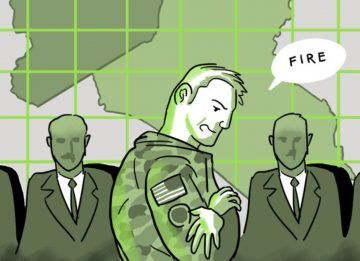
The crowded room was awaiting one word: “Fire.”

Everyone was in uniform; there were scheduled briefings, last-minute discussions, final rehearsals. “They wanted to look me in the eye and say, ‘Are you sure this is going to work?’ ” an operator named Neil said. “Every time, I had to say yes, no matter what I thought.” He was nervous, but confident. U.S. Cyber Command and the National Security Agency had never worked together on something this big before.

Four teams sat at workstations set up like high school carrels. Sergeants sat before keyboards; intelligence analysts on one side, linguists and support staff on another. Each station was armed with four flat-screen computer monitors on adjustable arms and a pile of target lists and IP addresses and online aliases. They were cyberwarriors, and they all sat in the kind of oversize office chairs Internet gamers settle into before a long night.

“I felt like there were over 80 people in the room, between the teams and then everybody lining the back wall that wanted to watch,” Neil recalled. He asked us to use only his first name to protect his identity. “I’m not sure how many people there were on the phones listening in or in chat rooms.”

More here.

How Boeing’s Managerial Revolution Created the 737 Max Disaster

Maureen Tkacik in The New Republic:

Nearly two decades before Boeing’s MCAS system crashed two of the plane-maker’s brand-new 737 MAX jets, Stan Sorscher knew his company’s increasingly toxic mode of operating would create a disaster of some kind. A long and proud “safety culture” was rapidly being replaced, he argued, with “a culture of financial bullshit, a culture of groupthink.”

Sorscher, a physicist who’d worked at Boeing more than two decades and had led negotiations there for the engineers’ union, had become obsessed with management culture. He said he didn’t previously imagine Boeing’s brave new managerial caste creating a problem as dumb and glaringly obvious as MCAS (or the Maneuvering Characteristics Augmentation System, as a handful of software wizards had dubbed it). Mostly he worried about shriveling market share driving sales and head count into the ground, the things that keep post-industrial American labor leaders up at night. On some level, though, he saw it all coming; he even demonstrated how the costs of a grounded plane would dwarf the short-term savings achieved from the latest outsourcing binge in one of his reports that no one read back in 2002.

More here.

Misunderstanding Susan Sontag

Merve Emre in The Atlantic:

To experience a thing as beautiful means: to experience it necessarily wrongly,” Friedrich Nietzsche wrote in The Will to Power. It is a line that Susan Sontag quotes toward the end of her 1977 essay collection, On Photography, about how photographs aestheticize misery. It is a line that Sontag’s authorized biographer, Benjamin Moser, quotes to describe Sontag’s susceptibility to beautiful, but punishing, lovers. And it is a line that I am quoting to summarize how Moser’s monumental and stylish biography, Sontag: Her Life and Work, fails its subject—a woman whose beauty, and the sex appeal and celebrity that went along with it, Moser insists upon to the point of occluding what makes her so deeply interesting.

The fascination of Sontag lies in her endurance as a cultural icon, the model of how a woman should think and write in public, even though her thinking and writing weren’t very rigorous. What is intriguing about Sontag is less who she was than how we understand our desire for her, or someone like her, to occupy a rare position in American literary culture: that of a dark-haired, dark-eyed, apparently invulnerable woman capable of transforming intellectual seriousness into an erotic spectacle. What need does such a presence and performance satisfy?

More here.

Yes, capitalism is broken. To recover, liberals must eat humble pie

Richard Reeves in The Guardian:
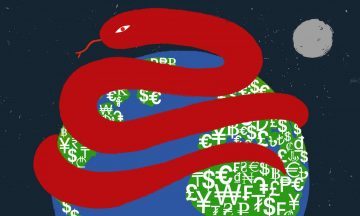
Capitalism reigns. But capitalism is in trouble. Therein lies the paradox of our age. For the first time in human history, a single economic system spans the globe. Of course there are differences between capitalism Chinese-style, American-style and Swedish-style. Close up, these differences can seem significant. But viewed through a wider lens, the distinctions blur. As the economist Branco Milanovic writes in his new book, Capitalism Alone, “the entire globe now operates according to the same economic principles – production organized for profit using legally free wage labor and mostly privately owned capital, with decentralized coordination”. After the fall of Soviet communism in 1989, and China’s embrace of the market, crowned by the nation’s entry into the World Trade Organization in 2001, it seemed, for a brief flicker of human history, that the world was converging on a political economy of free markets in liberal democracies. As it turned out, markets spread, but without necessarily bringing more democracy or liberalism along with them.

Capitalism without democracy was assumed to be at most a passing phase. Eventually, so western liberal thinking went, China and other Asian nations adopting what Milanovic calls “political capitalism” – free markets, but authoritarian politics – would have to adopt liberal political institutions, too. But, so far, the liberalization thesis remains unproven. China has successfully adopted a market system – and, even more importantly, a market culture – without liberal democratic institutions.

More here.

Sunday Poem

Dishwater

Slap of the screen door, flat knock
of my grandmother’s boxy black shoes
on the wooden stoop, the hush and sweep
of her knob-kneed, cotton-aproned stride
out to the edge and then, toed in
with a furious twist and heave,
a bridge that leaps from her hot red hands
and hangs there shining for fifty years
over the mystified chickens,
over the swaying nettles, the ragweed,
the clay slope down to the creek,
over the redwing blackbirds in the tops
of the willows, a glorious rainbow
with an empty dishpan swinging at one end.

by Ted Kooser
from
Delights and Shadows|
Copper Canyon Press, 2004

Saturday, September 28, 2019

The Soviet Union and the Birth of Human Rights

Eric D. Weitz in the LA Review of Books:

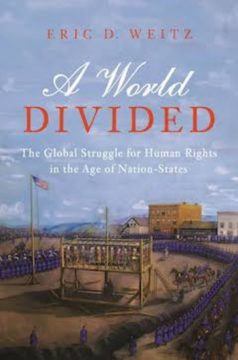
THE MODERN HUMAN RIGHTS SYSTEM, an assemblage of international treaties, state laws, and thousands of NGOs, is the work, to a very significant degree, of the Soviet Union. This simple contention is likely to inspire screams of outrage. How can we talk about human rights in a country that, under Josef Stalin, killed, tortured, and deported millions of its own citizens? Even under Stalin’s successors, the Soviet state remained deeply repressive and imprisoned and confined to psychiatric hospitals thousands of people who spoke out for freedom of speech and assembly and other basic rights.

Yet from a variety of angles, the Soviet Union contributed many panes in the construction of the fragile, glass house of human rights. Whatever its practices at home, at the international level after 1945 the Soviet Union promoted a robust conception of human rights that included national self-determination and economic and social rights. Its moves beyond the narrow, classically liberal conception of political rights inspired great hostility from the United States and many other liberal states that are usually considered the singular creators of human rights — and won the Soviets support in the Global South. Together, the Soviet bloc–Global South alliance largely defined the meaning of international human rights from the 1960s onward.

More here.

Is Meritocracy to Blame for Our Yawning Class Divide?

Thomas Frank in the NYT:

For affluent, white-collar Americans, higher learning is something close to sacred. We bask in the sunshine of enlightenment that prestige universities radiate and we speak of them in the language of dreams, of religious veneration. They are the foe of much that is evil and the source of a lot that is good. More and better education, we like to believe, will solve climate denialism, overcome bigotry and even mitigate our grotesque income inequality.

But now comes Daniel Markovits, a professor at Yale Law School, to tell us that far from solving economic inequality, higher education is one of the central forces driving our yawning class divide. In this ambitious and disturbing survey of the American upper class, he tells us that our elite universities’ sifting and sorting of human beings has helped to herd Americans into a system of rank and status and — yes — caste that is now so clearly passed from parent to child that its most privileged beneficiaries might as well be called an “aristocracy.” Indirectly and along the way, the hierarchy thus constructed has drained the promise from middle-class life and sparked a backlash from the vast presumed unexcellent whom our cult of white-collar achievement has left behind.

More here.

The polling industry doesn’t measure public opinion – it produces it

Richard Seymour in The Guardian:

The methodology of polling implies that there exists a general will on any given issue – the sum of a quantity of individual opinions of roughly equal weight. These can be totalled up into a magic percentage. But one reason voting intention polls must weight their results is that not all opinions are equally informed, committed or even meaningful. Most of us have ambivalent or downright contradictory views on some subjects, which is why small adjustments in polling questions can produce such varying results.

So while polling, in conditions of political stability, can often accurately predict voting outcomes, its findings are less meaningful as a guide to “public opinion” on more complex issues. “Nothing is more inadequate,” wrote the sociologist Pierre Bourdieu, “for representing the state of opinion than a percentage.” “Public opinion” is a mirage.

More here.