Some folks will tell you the blues is a woman, Some type of supernatural creature. My mother would tell you, if she could, About her life with my father, A strange and sometimes cruel gentleman. She would tell you about the choices A young black woman faces. Is falling in love with the devil In blue terms, the tongue we use When we don’t want nuance To get in the way, When we need to talk straight? My mother chooses my father After choosing a man Who was, as we sing it, Of no account. This made my father look good, That’s how bad it was. He made my father seem like an island In the middle of a stormy sea, He made my father look like a rock. And is the blues the moment you realize You exist in a stacked deck, You look in a mirror at your young face, The face my sister carries And you know it’s the only leverage You’ve got? Does this create a hurt that whispers How you going to do? Is the blues the moment You shrug your shoulders And agree, a girl without money Is nothing, dust To be pushed around by any old breeze? Compared to this, My father seems, briefly, To be a fire escape. This is the way the blues works Its sorry wonders, Makes trouble look like A feather bed, Makes the wrong man’s kisses A healing.
by Cornelius Eady from The Autobiography of a Juke Box Carnegie Mellon University Press, 1997
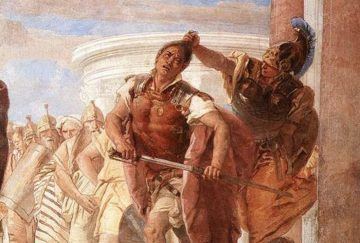
Suppose that you are angry on Tuesday because I stole from you on Monday. Suppose that on Wednesday I return what I stole; I compensate you for any disadvantage occasioned by your not having had it for two days; I offer additional gifts to show my good will; I apologize for my theft as a moment of weakness; and, finally, I promise never to do it again. Suppose, in addition, that you believe my apology is sincere and that I will keep my promise.
Could it be rational for you to be just as angry on Thursday as you were on Tuesday? Moreover, could it be rational for you to conceive of a plan to steal from me in turn? And what if you don’t stop at one theft: could it be rational for you to go on to steal from me again, and again, and again?
Though your initial anger at me might have been reasonable, we tend to view a policy of unending disproportionate revenge as paradigmatically irrational. Eventually we should move on, we are told, or let it go, or transmute our desire for revenge into a healthier or more respectable feeling. This idea has given rise to a debate among academic philosophers about the value of anger. Should we valorize it in terms of the righteous indignation of that initial response? Or should we vilify it in terms of the grudge-bearing vengeance of the unending one?
Consider two classic hypotheses about the development of language and cognition.
One main line of Western intellectual thought, often called nativism, goes back to Plato and Kant; in recent memory it has been developed by Noam Chomsky, Steven Pinker, Elizabeth Spelke, and others (including myself). On the nativist view, intelligence, in humans and animals, derives from firm starting points, such as a universal grammar (Chomsky) and from core cognitive mechanisms for representing domains such as physical objects (Spelke).
A contrasting view, often associated with the 17th century British philosopher John Locke, sometimes known as empiricism, takes the position that hardly any innateness is required, and that learning and experience are essentially all that is required in order to develop intelligence. On this “blank slate” view, all intelligence is derived from patterns of sensory experience and interactions with the world.
In the days of John Locke and Immanuel Kant, all of this was speculation.
Nowadays, with enough money and computer time, we can actually test this sort of theory, by building massive neural networks, and seeing what they learn.
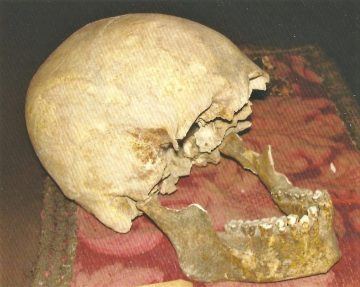
A team of Italian researchers have strengthened the case that at least the cranium found near Pompeii 100 years ago really does belong to Pliny the Elder, a Roman military leader and polymath who perished while leading a rescue mission following the eruption of Mt. Vesuvius in 79 C.E. However, a jawbone that had been found with the skull evidently belonged to somebody else.
Over the last couple of years the experts, including anthropologists and geneticists, conducted a host of scientific tests on the skull and lower mandible that had been found a century ago on the shore near Pompeii, which have since been at the center of a scholarly debate as to whether they should be attributed to Pliny.
The main finding of the researchers, who presented their conclusions at a conference in Rome on Thursday, is that the jawbone belonged to a different person, but that the skull is compatible with what we know about Pliny at his death.
In 2001, when I was the new Washington correspondent for The Arizona Republic, I attended the annual awards dinner of the National Immigration Forum. The forum is a left-right coalition that lobbies for unauthorized immigrants and expansive immigration policies. Its board has included officials of the National Council of La Raza, the American Civil Liberties Union and the American Immigration Lawyers Association, as well as the United States Chamber of Commerce, the National Restaurant Association and the American Nursery and Landscape Association.
After dinner, the group’s executive director, Frank Sharry, made a pitch to business allies who wanted Congress to allow them unfettered access to foreign workers. “You guys in business get all the workers you want, whenever you want them,” he proposed. “No bureaucracy.”
“Sold!” yelled John Gay, a lobbyist for the American Hotel and Lodging Association. Mr. Sharry quickly added that the deal must include advocacy for “three little, tiny pieces of paper: a green card, a union card and a voter registration card” for unauthorized immigrants.
For me, a reporter who had long covered immigration in the Southwest and Mexico, the exchange was a revelation about the politics of immigration in Washington.
Introducing her new Netflix series, The Goop Lab, Gwyneth Paltrow explains that Goop, the lifestyle brand she founded in 2008, is laddering up to one thing—namely, what she calls the “optimization of self.” She defines the phrase, saying, “We’re here one time, one life, like, how can we really like milk the shit out of this?” The structure of the show is such that Paltrow, the face of Goop, and Elise Loehnen, Goop’s chief content officer and cohost of the Goop podcast, discuss wellness, mental health, and all things Goop-y. The camera flits between Paltrow and Loehnen sitting in the office and having discussions about depression, anxiety, trauma, and vaginal health with various experts and members of the Goop team (called goopers), a team made up very thin, very stylish people of a wide range of genders and races. The message is that everyone at Goop is out in the world every day, experiencing wellness and attempting to both bond with one another and fix themselves.
The six-episode mini-series kicks off on a memorable note: In “The Healing Trip,” Paltrow’s team is offered the chance to travel to Jamaica to try mushrooms and heal together. They lie on patterned mats on the floor; a lot of white people hug and cry and deal with deep, traumatizing emotions. One jokes, “Someone put a heart monitor on me!” laughing in a way that seems as terrified as it is inspired. As the retreat wraps up, Loehnen tells the camera, “This is not a typical workspace experience, although I kind of wonder if it wouldn’t be incredibly therapeutic for workspace teams if you felt really safe and wanted to become even more intimate and connected with the people that you spend the majority of your day with.” Encouraging coworkers not only to do drugs together, but to explore trauma en masse seems like an HR disaster waiting to happen. But in the world (or, rather, the career) of Goop, it’s just another day at the office.
Likewise, watching the Goop team in the second episode, “Cold Comfort,” “learn to breathe” felt like watching a very quiet, very gentle hazing. (“It was basically all of the symptoms of a panic attack,” one female participant says.) The team does “snowga” together, a practice that basically involves a group of skinny, beautiful people standing in the snow in bathing suits and bare feet and doing yoga, their arms swaying from side to side before their bodies pivot into warrior pose. The fact that Goop’s leadership views these exercises as a fun bonding activity points to a position that’s increasingly expressed by business experts but ignored by company leaders: Give your workers benefits and good salaries, and let them do their jobs. An April 2019 article in Fast Company asserts that “Companies offer all sorts of benefits and extras to attract the most favored workers, from healthcare and stock options to free food. But all those perks come at a price: your freedom.”
Della DePaulo never fantasized about a dream wedding or being a bridesmaid. Instead, she saw herself as “single at heart,” pursuing intellectual refinement, friendship, and solitude as a young psychologist. Still, she had internalized the popular idea that married people were happier and healthier than the unmarried, and took her own pleasant experience to be exceptional. That is, until she looked into it, and found the claims about the “transformative power of marriage” to be, she says, either “grossly exaggerated or totally untrue.” From then on, she’s focused on how singles actually live.
Now at the University of California, Santa Barbara, DePaulo has written widely about how marriage and the nuclear family are making way for other social arrangements. (Read her Nautilus feature about these new kinds of families) She’s not fooled by shows such as The Bachelor or romantic comedies that end with a storybook wedding proposal. Those narratives exist, she says, “not because we as a society are so secure about the place of marriage in our lives, but because we’re so insecure.” At least one cause of that insecurity is the empowerment of single women, which she writes about in her book, Singled Out: How Singles Are Stereotyped, Stigmatized, and Ignored, and Still Live Happily Ever After. Nautilus caught up with DePaulo to discuss how single women are transforming social and political life, how they’re settling down, and what that says about living happily.
IN THE MID-1980s, Rony Brauman, who, at the time, was the president of the leading humanitarian organization Médecins sans Frontières, established a new human rights group called Liberté sans Frontières. For the inaugural colloquium, Brauman invited a number of speakers, among them Peter Bauer, a recently retired professor from the London School of Economics. Bauer was an odd choice given that he was a staunch defender of European colonialism; he had once responded to a student pamphlet that accused the British of taking “the rubber from Malaya, the tea from India, [and] raw materials from all over the world,” by arguing that actually “the British took the rubber to Malaya and the tea to India.” Far from the West causing Third World poverty, Bauer maintained that “contacts with the West” had been the primary agents of the colonies’ material progress.
Bauer hammered on this point at the colloquium, claiming that indigenous Amazonians were among the poorest people in the world precisely because they enjoyed the fewest “external contacts.” Taiwan, Hong Kong, Malaysia, and Singapore, he continued, showed proof of the economic benefits such contacts brought. “Whatever one thinks of colonialism it can’t be held responsible for Third World poverty,” he argued.
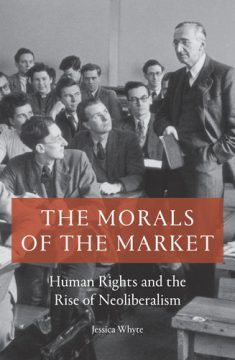
In her illuminating new book, The Morals of the Market: Human Rights and the Rise of Neoliberalism, Jessica Whyte recounts this story only to ask why Brauman, a leading humanitarian activist, invited Bauer — whom the Economist had described as being as hostile to foreign aid as Friedrich Hayek had been to socialism — to deliver a talk during the opening event for a new human rights organization.
Derek Walcott, the Nobel Prize-winning poet from the West Indies who died March 17 at age 87, was long inspired by Jewish culture, history and friendships. As the literary scholar Bénédicte Ledent has pointed out, Walcott’s poem “A Far Cry from Africa” draws a “parallel between blacks and Jews.” The poem, about the Mau Mau Uprising, a 1950s military conflict in British Kenya, Walcott ironically describes the rebels as “savages, expendable as Jews.”
Paula Burnett, another informed reader of Walcott’s poetry, notes that although the “paralleling of the New World black experience with that of Jews in the Holocaust had been a long-standing theme of Walcott’s, the theme of Nazi atrocities takes on a fresh prominence” in his collection, “The Fortunate Traveler” (1982) In it, swirling images express the inhuman treatment of people of color by colonizers, in a world overwhelmed by the Holocaust, so that the abbreviation A.D., instead of Anno Domini, appears to represent After Dachau. The Americanist Eric J. Sundquist points to a key essay by Walcott, “The Muse of History,” published in 1974, in which African slaves arriving in the West felt “identification with Hebraic suffering, the migration, the hope of deliverance from bondage… the passage over our Red Sea was not from bondage to freedom but its opposite, so that the tribes arrived at that New Canaan chained.”
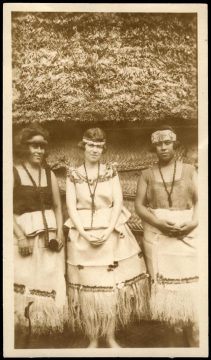
In 1978, after 50 years at the pinnacle of American opinion, the anthropologist Margaret Mead died with a secure reputation and a lustrous legacy. Her ascent seemed to mirror the societal ascent of American women. In some two dozen books and countless articles, she gave a forceful voice to a sturdy if cautious liberalism: resolutely antiracist, pro-choice; open to ‘new ways of thinking’ yet wary of premarital sex and hesitant about the Pill. The tensions in public opinion were hers, too. In her obituary, TheNew YorkTimes called her ‘a national oracle’.
But posthumous reputation is a brittle thing. It’s difficult to defend oneself after death, and the years wear away a name, eventually reducing it to dust or mere ‘influence’. Issues change, standards shift, new thinkers rise: few names last forever. Within anthropology, Mead is still revered, but mostly as a way to understand the discipline’s origins. In the popular mind, Mead’s name has all but vanished, her reputation whittled down to an apocryphal quote found on coffee mugs and dorm-room posters: ‘Never doubt that a small group of thoughtful, committed citizens can change the world; indeed, it’s the only thing that ever has.’
What’s more, Mead has become a target of vitriolic dislike for a particular kind of cultural conservatism.
American Radicals establishes the truly riotous nature of nineteenth-century activism, chronicling the central role that radical social movements played in shaping U.S. life, politics, and culture. Holly Jackson’s cast of characters includes everyone from millenarian militants and agrarian anarchists to abolitionist feminists espousing Free Love. Rather than rehearsing nineteenth-century reform as a history of bourgeois abolitionists having tea and organizing anti-slavery bazaars for their friends, Jackson offers electrifying accounts of Boston freedom fighters locking down courthouses and brawling with the police. We learn of preachers concealing guns in crates of Bibles and sending them off to abolitionists battling the expansion of slavery in the Midwest. We glimpse nominally free black communities forming secret mutual aid networks and arming themselves in preparation for a coming confrontation with the state. And we find that antebellum activists were also free lovers who experimented with unconventional and queer relationships while fighting against the institution of marriage and gendered subjugation. Traversing the nineteenth-century history of countless “strikes, raids, rallies, boycotts, secret councils, [and] hidden weapons,” American Radicals is a study of highly organized attempts to bring down a racist, heteropatriarchal settler state—and of winning, for a time.
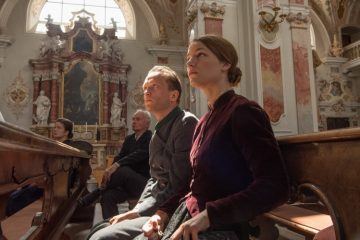
Is there a contemporary director who can match Terrence Malick for enigmatic genius? A summa cum laude philosophy major at Harvard, then a Rhodes Scholar, Malick was a philosophy professor at MIT before changing course and enrolling in film school. His long career—the filmmaker is seventy-six—has featured a sparse filmography, an abiding unconcern for critical or popular acclaim, and a mid-career hiatus, during which he disappeared from public life while reportedly laboring on a masterwork, to be called Q, exploring the origins of life on earth from the Big Bang onward. His first, short film, the twelve-minute Lanton Mills (1969), is essentially kept under lock-and-key at his behest by the AFI Conservatory, his alma mater, and only available for scholars to see. Malick is the Thomas Pynchon or J. D. Salinger of directors, and the dreamily elliptical quality of his movies has only added to the luster.
In his academic years Malick was a translator of Heidegger—and the links to German Romanticism, Nazism, and Heimat that have complicated the philosopher’s legacy could be said to form the deep background of A Hidden Life.
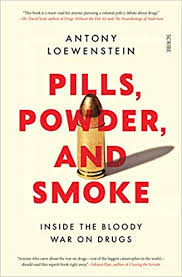
There are two key problems with books that attempt to be objective about illegal drugs. The first is that for the most part their authors won’t admit to having used such substances for fear their own objectivity may be compromised. The second follows fairly logically from the first: who, precisely, are such books aimed at? If they are targeted at readers who already have a consuming interest in drugs (pun intended), then they are very likely – by definition – to know rather more about the subject than the author; and if they are for people who only have a tangential interest in the subject, why should they want to read about it at all? True, there may be such a thing as a “gateway” book about drugs that leads people deeper and deeper into compulsive reading about the subject, but I suspect neither of these titles will fulfil that role, no matter how vulnerable the reader is to literary addiction.
This notion of survival — and of death, its necessary analogue — sits at the center of “Summer Snow,” which offers no illusions about the bittersweet consolations of looking back. “Christmas in August” goes on to remember an older man, “a refugee Professor from another generation” — Hass’s UC Berkeley colleague Czeslaw Milosz. For many years before Milosz’s death in 2004, the two collaborated on translations, and his fellow poet’s presence lingers in these verses like a specter or a soul.
In “An Argument About Poetics Imagined at Squaw Valley After a Night Walk Under the Mountain,” Hass refers to him directly. “My friend Czeslaw Milosz disapproved of surrealism,” he insists, reminding us of Milosz’s astonishing World War II poem “Campo dei Fiori,” with its shocking juxtaposition of a carousel in spring “[w]hile gunfire crackles on the other side of the ghetto wall.”
A number of readers of my recent Chronicle Review essay, “The Humanities’ Fear of Judgment,”doubted the existence of literature professors so enchanted by the pseudo-equality of consumer culture as to reject literary judgment. Therefore I’m grateful that G. Gabrielle Starr and Kevin Dettmar are so explicit on this point. When I suggest that teaching a great writer like Gwendolyn Brooks to resistant students is worthwhile, they retort: “When Silicon Valley types say they want to hire humanities majors, it’s not because they want coders who know Gwendolyn Brooks poems.”
Starr and Dettmar reject the “authority” by which a literature professor presumes to show students works worth reading. Who are we, they argue, to tell students that James Baldwin, Shakespeare, or Gwendolyn Brooks are good? As a first-generation college student, I learned to be wary of professors loudly forswearing their authority, approaching students as buddies, just wanting to have a friendly conversation. Such a stance typically concealed a far more thoroughgoing play at authority. And of course Starr and Dettmar immediately reveal their suspicion of authority to be hypocritical. These literature professors modestly disavow any expertise in literary judgment in order to claim expertise in empathy, morality, and “metacognitive skills.” Such expertise, they tell us, will “prepare our students to contend with some degree of success in the marketplace of ideas.”
But what exactly qualifies a literature Ph.D. as an empathy expert? Why should students attending Pomona College — one of the wealthiest institutions on the planet — go into debt to learn how to be moral from the authors of scholarly books on 18th-century literature and Bob Dylan?
If there’s a fire, my husband and I know the plan: Grab the children and the red accordion file in the hall closet before fleeing the building. The file contains mostly what you would expect: passports, birth records, Social Security cards and my husband’s certificate of United States citizenship. Also included — more unusual but equally valuable — are the four letters I’ve written to myself over the course of my life. Three have been opened and read; one remains sealed. I wrote the first letter when I was 14, and I stole the idea from a novel. I was alone in my bedroom reading “Emily of New Moon,” a series by L. M. Montgomery, who also wrote the more famous series “Anne of Green Gables.” There are three Emily books, and although I loved Anne, I related more to Emily. Anne is a spunky extrovert, whereas Emily is more withdrawn, more serious. I was a serious, bookish child. I could, in fact, trace my childhood via the female literary characters I loved: Trixie Belden to Betsy and Tacy, Emily of New Moon to Morgaine in “The Mists of Avalon,” all the women in Doris Lessing’s “The Golden Notebook.”
I was 14, and Emily’s bone-deep loneliness resonated with me. When I read the section in the second novel where Emily writes a letter to her future self, I put down the book and did the same thing. It was an impulse; the idea of the letter delighted me. It was a grand gesture, yet of the kind an introverted kid could make alone, with no one noticing. I described the current state of my life and listed my hopes and dreams for myself 10 years later. When I finished writing, I sealed the letter, and from that moment forward, fought the desire to break the seal. I can still remember how hard it was to keep from opening the envelope at the age of 16, and 18 and 20. Talk about delayed gratification! A decade — during that stage of life — was an eternity. I wonder, now, what I was hoping to find in those pages. A truth about myself that, if learned, would allow me to be happy? An answer to the question of who I was, and whether I mattered?
George Foy stayed in the anechoic chamber for 45 minutes and nearly went mad. He could hear the blood rushing in his veins and began to wonder if he was hallucinating. He had been to a monastery, an American Indian sweat lodge, and a nickel mine two kilometers underground. In the anechoic chamber, the floor’s design eliminates the sound of footsteps. NASA trains astronauts in anechoic chambers to cope with the silence of space. Without echo, in the quietest place on earth, what else can we hold onto? What replaces sound in concert with what you see? The human voice, the timber when a person says kamsahamnida or yes, please, or fuerte, is 25 to 35 decibels. Hearing damage can start around 115 decibels. Metallica, front row, possible damage albeit possible love. The Who, 126 decibels. A Boeing jet, 165 decibels. The whale, low rumble frequency and all, 188 decibels, can be heard for hundreds of miles underwater. I once walked around inside a whale heart, which is the size of a small car. The sound was like Brian Doyle’s heart that gave out at 60 after he wrote my favorite essay about the joyas voladoras and the humming bird heart, the whale heart, and the human heart. Glass can break at 163 decibels. Hearing is the last sense to leave us. Some say that upon death, our vision, our taste, our touch, and our smell might leave us, but some have been pronounced dead and by all indication are, but they can hear. In this moment, when the doctor pronounces the time or when the handgun pumps once more, what light arrives? What sounds, the angels? The Ultrasonic Weapon is used for crowd control or to combat riots—as too many humans gathered in one place for a unified purpose can threaten the state. The state permits gatherings if the flag waves. Sound can be weaponized or made into art. It can kill. It can heal a wound. It is a navigation device and can help determine if the woman has a second heart inside of her now, the beating heart of a baby on the ultrasound, a boy or a girl, making a new music in the body of another body, a chorus, a concert, a hush.
by Lee Herrick from Scar and Flower, Word Poetry, 2019.

 Suppose that you are angry on Tuesday because I stole from you on Monday. Suppose that on Wednesday I return what I stole; I compensate you for any disadvantage occasioned by your not having had it for two days; I offer additional gifts to show my good will; I apologize for my theft as a moment of weakness; and, finally, I promise never to do it again. Suppose, in addition, that you believe my apology is sincere and that I will keep my promise.
 Consider two classic hypotheses about the development of language and cognition.
 A team of Italian researchers have strengthened the case that at least the cranium found near Pompeii 100 years ago really does belong to Pliny the Elder, a Roman military leader and polymath who perished while leading a rescue mission following the eruption of Mt. Vesuvius in 79 C.E. However, a jawbone that had been found with the skull evidently belonged to somebody else.
 In 2001, when I was the new Washington correspondent for The Arizona Republic, I attended the annual awards dinner of the National Immigration Forum. The forum is a left-right coalition that lobbies for unauthorized immigrants and expansive immigration policies. Its board has included officials of the National Council of La Raza, the American Civil Liberties Union and the American Immigration Lawyers Association, as well as the United States Chamber of Commerce, the National Restaurant Association and the American Nursery and Landscape Association.
 Della DePaulo never fantasized about a dream wedding or being a bridesmaid. Instead, she saw herself as “single at heart,” pursuing intellectual refinement, friendship, and solitude as a young psychologist. Still, she had internalized the popular idea that married people were happier and healthier than the unmarried, and took her own pleasant experience to be exceptional. That is, until she looked into it, and found the claims about the “transformative power of marriage” to be, she says, either “grossly exaggerated or totally untrue.” From then on, she’s focused on how singles actually live.
 Neve Gordon in the LA Review of Books:
 Benjamin Ivry in Forward:
 Sam Dresser in Aeon:
 Britt Rusert in The Boston Review:
 Is there a contemporary director who can match Terrence Malick for enigmatic genius? A summa cum laude philosophy major at Harvard, then a Rhodes Scholar, Malick was a philosophy professor at MIT before changing course and enrolling in film school. His long career—the filmmaker is seventy-six—has featured a sparse filmography, an abiding unconcern for critical or popular acclaim, and a mid-career hiatus, during which he disappeared from public life while reportedly laboring on a masterwork, to be called Q, exploring the origins of life on earth from the Big Bang onward. His first, short film, the twelve-minute Lanton Mills (1969), is essentially kept under lock-and-key at his behest by the AFI Conservatory, his alma mater, and only available for scholars to see. Malick is the Thomas Pynchon or J. D. Salinger of directors, and the dreamily elliptical quality of his movies has only added to the luster.
 T
T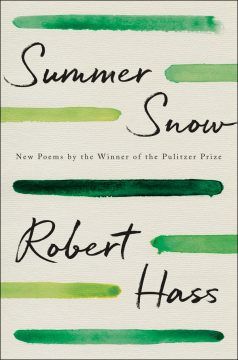 This notion of survival — and of death, its necessary analogue — sits at the center of “Summer Snow,” which offers no illusions about the bittersweet consolations of looking back. “Christmas in August” goes on to remember an older man, “a refugee Professor from another generation” — Hass’s UC Berkeley colleague Czeslaw Milosz. For many years before Milosz’s death in 2004, the two collaborated on translations, and his fellow poet’s presence lingers in these verses like a specter or a soul.
 A number of readers of my recent Chronicle Review essay,
  If there’s a fire, my husband and I know the plan: Grab the children and the red accordion file in the hall closet before fleeing the building. The file contains mostly what you would expect: passports, birth records, Social Security cards and my husband’s certificate of United States citizenship. Also included — more unusual but equally valuable — are the four letters I’ve written to myself over the course of my life. Three have been opened and read; one remains sealed. I wrote the first letter when I was 14, and I stole the idea from a novel. I was alone in my bedroom reading “Emily of New Moon,” a series by L. M. Montgomery, who also wrote the more famous series “Anne of Green Gables.” There are three Emily books, and although I loved Anne, I related more to Emily. Anne is a spunky extrovert, whereas Emily is more withdrawn, more serious. I was a serious, bookish child. I could, in fact, trace my childhood via the female literary characters I loved: Trixie Belden to Betsy and Tacy, Emily of New Moon to Morgaine in “The Mists of Avalon,” all the women in Doris Lessing’s “The Golden Notebook.”