
Francesca Wade at the Paris Review:
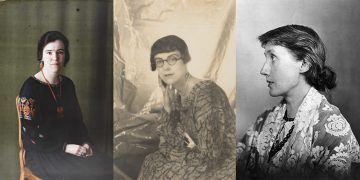 “I would venture to guess that Anon, who wrote so many poems without signing them, was often a woman,” wrote Virginia Woolf in A Room of One’s Own (1929). In that essay, commenting on the fact that women’s lives are “all but absent from history,” she argues that this is not only a consequence of the ways women have been deprived of the material conditions under which their talents can prosper but also reveals the sort of events and lives historians have traditionally considered worth remembering—primarily, the public activities of “great men.” Perusing the index of G. M. Trevelyan’s History of England, Woolf looks up “position of women” and is dismayed to find only a smattering of references, mostly to customs of arranged marriage, wife-beating, and the fictional heroines of Shakespeare. Flicking through chapters on wars and kings, she wonders why so little room is left for women’s activities in the events that “constitute this historian’s view of the past.” It was clear to Woolf that new histories were needed, which would examine the reality of women’s lives, their relationships and activities, and the forces that thwarted their ambitions.
more here.
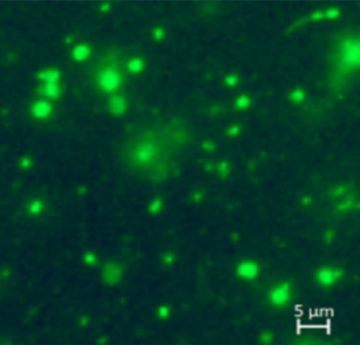 Sometime around 2 billion years ago, a bacterium slipped inside a larger cell, started producing energy there, and became the indispensable powerhouse we know today as the mitochondrion, so the working theory goes. But that old story now has a new twist. Scientists have detected the organelles outside of cells, apparently functioning perfectly well while drifting around the blood of healthy people, according to findings published recently (January 19) in
 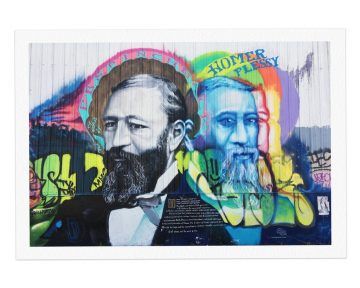 When Homer Plessy boarded the East Louisiana Railway’s No. 8 train in New Orleans on June 7, 1892, he knew his journey to Covington, La., would be brief. He also knew it could have historic implications. Plessy was a racially mixed shoemaker who had agreed to take part in an act of civil disobedience orchestrated by a New Orleans civil rights organization. On that hot, sticky afternoon he walked into the Press Street Depot, purchased a first-class ticket and took a seat in the whites-only car. The civil rights group had chosen Plessy because he could pass for a white man. It was asserted later in a legal brief that he was seven-eighths white. But a conductor, who was also part of the scheme, stopped him and asked if he was “colored.” Plessy responded that he was. “Then you will have to retire to the colored car,” the conductor ordered.
 I believe there is much to be learned philosophically from the study of languages that are spoken by only a small number of people, who lack a high degree of political self-determination and are relatively powerless to impose their conception of history, society, and nature on their neighbours; and who also lack much in the way of a textual literary tradition or formal and recognisably modern institutions of knowledge transmission: which for present purposes we may call “indigenous” languages.
 On the Puerto Rican
 The annual
  For
For  Most AI systems used today—whether for language translation, playing chess, driving cars, face recognition or medical diagnosis—deploy a technique called machine learning. So-called “convolutional neural -networks,” a silicon-chip version of the highly-interconnected web of neurons in our brains, are trained to spot patterns in data. During training, the strengths of the interconnections between the nodes in the neural network are adjusted until the system can reliably make the right classifications. It might learn, for example, to spot cats in a digital image, or to generate passable translations from Chinese to English. Although the ideas behind neural networks and machine learning go back decades, this type of AI really took off in the 2010s with the introduction of “deep learning”: in essence adding more layers of nodes between the input and output. That’s why DeepMind’s programme AlphaGo is able to defeat expert human players in the very complex board game Go, and Google Translate is now so much better than in its comically clumsy youth (although it’s still not perfect, for reasons I’ll come back to).
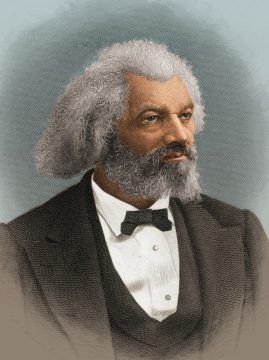 I have had but one idea for the last three years to present to the American people, and the phraseology in which I clothe it is the old abolition phraseology. I am for the “immediate, unconditional, and universal” enfranchisement of the black man, in every State in the Union. [Loud applause.] Without this, his liberty is a mockery; without this, you might as well almost retain the old name of slavery for his condition; for in fact, if he is not the slave of the individual master, he is the slave of society, and holds his liberty as a privilege, not as a right. He is at the mercy of the mob, and has no means of protecting himself.
 Michael D. Gordin in the LA Review of Books:
 Alexander Klein in Aeon:
 Alan Livsey in the FT:
 Bruce Robbins in The Nation:
 Offill’s writing is shrewd on the question of whether intense psychic suffering heightens your awareness of the pain of others, or makes you blind to it. The answer, of course, is that it can do both; that it inevitably does both. Sometimes Offill’s narrators seem vulnerable to the delusion that their dysfunction sets them apart — that they are breaking down against the backdrop of others’ composure, which can come across as self-deprecation but is actually its own form of egotism. But part of the brilliance of Offill’s fiction is how it pushes back against this self-deception: “Stay, just stay,” the wife in “Dept. of Speculation” tells her suicidal student, a girl overcome by pain of her own; while Lizzie’s meditation teacher, who believes in reincarnation, insists that “everyone here has done everything to everyone else.” Lizzie is often overwhelmed by her interior landscape, but she is also often aware that everyone around her inhabits an interior landscape that feels just as intense; and that they are all inhabiting an exterior landscape with intensities of its own.
 What makes industrial landscapes unique is that they fascinate regardless of whether they’re operating. The hellish Moloch of a petrochemical refinery is as captivating as one of the many abandoned factories one passes by train, and vice versa. That doesn’t mean, though, that all industrial landscapes are created equal. Urban manufacturing factories are considered beautiful—tastefully articulated on the outside, their large windows flooding their vast internal volumes with light; they are frequently rehabilitated into spaces for living and retail or otherwise colonized by local universities. The dilapidated factory, crumbling and overgrown by vegetation, now inhabits that strange space between natural and man-made, historical and contemporary, lovely and sad. The power plant, mine, or refinery invokes strong feelings of awe and fear. And then there are some, such as the Superfund site—remediated or not—whose parklike appearance and sinister ambience remains aesthetically elusive.