
Robert Zaretsky in LA Review of Books:
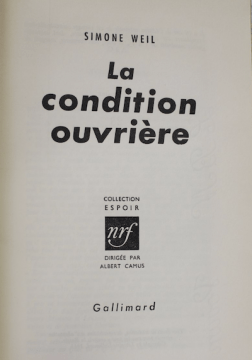 IN THE SUMMER or fall of 1943, La France libre, the London-based provisional government led by General Charles de Gaulle, received a letter from across the Channel. In three closely typed pages, the writer, identifying himself as “un résistant intellectuel,” described the “anguish” he felt as he surveyed the political and moral landscape of Nazi-occupied France. We are teetering, he declared, between renaissance and ruin. Moreover, those struggling on behalf of the former were driven by two often competing ideals: “The clear desire for justice and profound demand for liberty.” Yet, he warned, if we can one day create a doctrine based on these two imperatives, they would lead to the “complete overhaul” of the nation’s constitutional and financial institutions. One way or another, in short, France would never again be the same.
De Gaulle most probably never read this letter. He was, for the most part, too busy making life wretched for Franklin Roosevelt and Winston Churchill to find the time to read or reflect on the clandestine missives sent by the internal resistance movements. Besides, while de Gaulle cast himself as the embodiment of a free France, he had a cast of hundreds to attend to the details of achieving this freedom. This cast included analysts who read these letters from France, recapped the contents, and reported them to their immediate superiors.
This particular letter, I think, would have caught the attention of one of the analysts. Like the writer, the analyst was thinking hard how to balance the often-competing imperatives of liberty and justice. Equally important, she wanted to be sent to France in order to fight, like the writer, in the Resistance. As she told a friend, the suffering of those in France “obsesses and overwhelms me to the point of annihilating my faculties and the only way I can revive them and release myself from the obsession is by getting for myself a large share of danger and hardship.” Her efforts to persuade her superiors, however, were repeatedly rebuffed. Indeed, when de Gaulle himself read one of the analyst’s proposals — namely, to lead a group of nurses as poorly trained as herself to be parachuted onto a battlefield — he dismissed her as “crazy.”
More here.
 Once upon a time, there was a man who thought love was a maths problem.
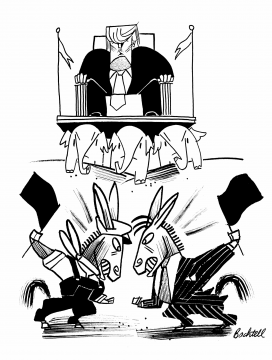 Michael Tomasky in the NYRB:
 Anthony Paletta in The Boston Review:
 Jeremy Rossman in The Conversation:
 Greg Valliere of AGF Investments over at the firms’ website:
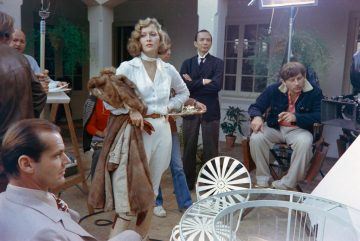 Fifty years ago, the screenwriter Robert Towne said to his girlfriend, “I want to write a movie for Jack.” He meant Nicholson — in those days, and possibly even now, there is only one Jack — who had just had his breakout role in “Easy Rider.” “A detective movie,” Towne explained. “Maybe Jane Fonda for the blonde.” He knew he wanted to set it in Los Angeles before the war, like a Raymond Chandler novel. But that was about the extent of it. When he told Nicholson, the actor naturally asked, “What’s it about?”
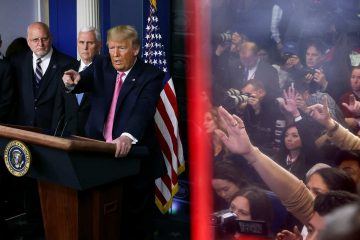 What we are seeing right now is the collapse of civic authority and public trust at what is only the beginning of a protracted crisis. In the face of an onrushing pandemic, the United States has exhibited a near-total evacuation of responsibility and political leadership — a sociopathic disinterest in performing the basic function of government, which is to protect its citizens.
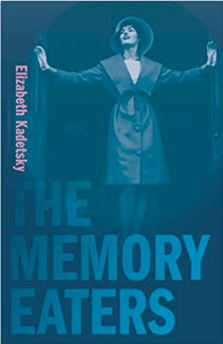 The Memory Eaters is told in the context of 1970s and 1980s New York City. The memoir moves from her parents’ divorce to her mother’s career as a Seventh Avenue fashion model and from her sister’s addiction and homelessness to her own experiences with therapy for post- traumatic stress disorder. The Memory Eaters is about consciousness fractured by addiction and dementia, and a compulsion for the past salved by nostalgia. More can be found at
 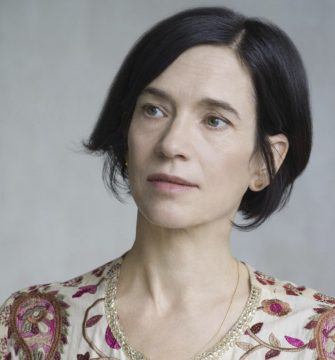 Elizabeth Kadetsky: Coming of age in the 1970s, I was exposed, through my mother, to a lot of what you might call groovy spirituality that enshrined this idea that you would find truth if you just relaxed your brain enough to let it come to you. This was the thinking behind the versions of so many of the trendy ideologies that we adopted: I Ching, astrology, Ouija Board, palm reading. I don’t think that we believed in the magic of any of these systems in the least. The idea was that these were all tools that helped you get more in tune with your subconscious. So, my mother’s ideas about “watching” definitely came out of that, that there was a sort of divine intelligence that you could tap into through paying close attention in both dream and waking life. It’s funny because when I think about it now I see the pitfalls of this mindset, especially for the writer.
 Japan is reporting its first case of a person becoming reinfected with the coronavirus after showing signs they had fully recovered,
  Across the globe, a