
Tamar Avishai at the NYRB:
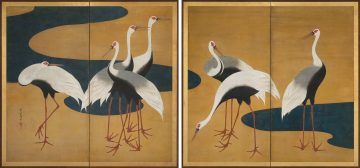 You will have seen art from the Edo Period—its most recognizable images are the ukiyo-e prints: mass-produced woodblock scenes of popular entertainment and Japanese landscapes, the most world-famous of which is Katushika Hokusai’s The Great Wave off Kanagawa from 1829. These prints were ubiquitous, disseminated through the city’s pleasure quarters, and sold, it’s colloquially said, as cheaply as a second helping of noodles. And before Edo Japan opened up to the world and these inexpensive prints were splashed all over Europe, they were bought almost exclusively as souvenirs by a growing Japanese middle class, a pictorial keepsake of insular pride. The Great Wave is itself an amalgam of some of Japan’s most distinctive characteristics, illustrating its relationship with the spiritual anchor of Mount Fuji, and with the sea itself, which is embodied in both the quotidian economics of the fishing industry, and in the Buddhist philosophy of a wave’s impermanence.
more here.
 THE FIRST PERSON YOU MEET
  Before
  For centuries western culture has been permeated by the idea that humans are selfish creatures. That cynical image of humanity has been proclaimed in films and novels, history books and scientific research. But in the last 20 years, something extraordinary has happened. Scientists from all over the world have switched to a more hopeful view of mankind. This development is still so young that researchers in different fields often don’t even know about each other.
 On a crisp afternoon, four cyclists pedaled mountain bikes along the serpentine two-lane byway on the southern shores of
  The past few centuries of scientific progress have displaced humanity from the center of it all: the Earth is not at the middle of the Solar System, the Sun is but one star in a large galaxy, there are trillions of galaxies, and so on. Now we know that we’re not even made of the same stuff as most of the universe; for every amount of ordinary atoms and other known particles, there is five times as much dark matter, some kind of stuff we haven’t identified in laboratory experiments. But we do know a great deal about the behavior of dark matter. I talk with Lina Necib about why we think there’s dark matter, what it might be, and how it’s distributed in the galaxy. The latter question has seen enormous recent progress, especially from high-precision measurements of the distribution of stars in the Milky Way.
 This is a good moment, then, for the Belgian architect Jean Dethier to release a 512-page survey chronicling earth construction from prehistory onwards across five continents. Proportioned and priced as a coffee table filler, the book is in fact ferociously polemical. Within pages, Dethier is raging against the climate-wrecking paradigm of contemporary construction: ‘The excessive use of industrialized building materials, often under the pretext of rationality, is one of the main causes of climate change.’ He argues that ‘prevailing building practices of today are often exploitative and dangerous, forced upon us by a lobby of multinational manufacturers of industrialized materials that have come to dominate our lives’.
 “I hope you are able to work hard on science & thus banish, as far as may be possible, painful remembrances,” Charles Darwin wrote in the spring of 1864 to a young and obscure German correspondent who had just sent him two folios of his
  A few years ago, one of my students came to me and spoke about her mother who was undergoing treatment for breast cancer. She said her mother was losing her memory and her bearings, and was very worried because nobody knew what to do about her symptoms. The oncologist sent her to the psychiatrist. The psychiatrist sent her back, saying that her symptoms were a result of the cancer treatment. This experience prompted my student and me to begin studying the problem of ‘chemobrain’ or ‘chemofog’ – the
 The story of Trump’s rise is often told as a hostile takeover. In truth, it is something closer to a joint venture, in which members of America’s élite accepted the terms of Trumpism as the price of power. Long before anyone imagined that Trump might become President, a generation of unwitting patrons paved the way for him. From Greenwich and places like it, they launched a set of financial, philanthropic, and political projects that have changed American ideas about government, taxes, and the legitimacy of the liberal state.
 For a few fleeting moments during New York Gov. Andrew Cuomo’s daily coronavirus briefing on Wednesday, the somber grimace that has filled our screens for weeks was briefly replaced by something resembling a smile.
 Two thoughts have long come unbidden to my mind whenever I hear people talking about doing their family trees, or, more recently, getting their DNA done. The first is of Bruce Willis’s character in Pulp Fiction, the boxer Butch Coolidge in the back of the taxi, who, when asked by his South American driver what his name means, replies, “I’m an American, baby, our names don’t mean shit.” The other is of Seneca, who wrote in his Moral Letters to Lucilius: “If there is any good in philosophy, it is this, — that it never looks into pedigrees. All men, if traced back to their original source, spring from the gods.”