
Christof Koch in Scientific American:
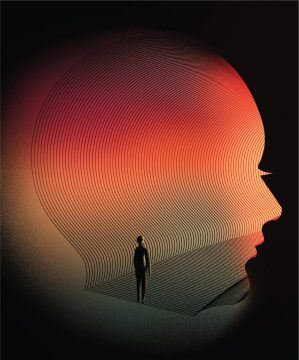 A young Ernest Hemingway, badly injured by an exploding shell on a World War I battlefield, wrote in a letter home that “dying is a very simple thing. I’ve looked at death, and really I know. If I should have died it would have been very easy for me. Quite the easiest thing I ever did.” Years later Hemingway adapted his own experience—that of the soul leaving the body, taking flight and then returning—for his famous short story “The Snows of Kilimanjaro,” about an African safari gone disastrously wrong. The protagonist, stricken by gangrene, knows he is dying. Suddenly, his pain vanishes, and Compie, a bush pilot, arrives to rescue him. The two take off and fly together through a storm with rain so thick “it seemed like flying through a waterfall” until the plane emerges into the light: before them, “unbelievably white in the sun, was the square top of Kilimanjaro. And then he knew that there was where he was going.” The description embraces elements of a classic near-death experience: the darkness, the cessation of pain, the emerging into the light and then a feeling of peacefulness.
Near-death experiences, or NDEs, are triggered during singular life-threatening episodes when the body is injured by blunt trauma, a heart attack, asphyxia, shock, and so on. About one in 10 patients with cardiac arrest in a hospital setting undergoes such an episode. Thousands of survivors of these harrowing touch-and-go situations tell of leaving their damaged bodies behind and encountering a realm beyond everyday existence, unconstrained by the usual boundaries of space and time. These powerful, mystical experiences can lead to permanent transformation of their lives.
…Why the mind should experience the struggle to sustain its operations in the face of loss of blood flow and oxygen as positive and blissful rather than as panic-inducing remains mysterious. It is intriguing, though, that the outer limit of the spectrum of human experience encompasses other occasions in which reduced oxygen causes pleasurable feelings of jauntiness, light-headedness and heightened arousal—deepwater diving, high-altitude climbing, flying, the choking or fainting game, and sexual asphyxiation. Perhaps such ecstatic experiences are common to many forms of death as long as the mind remains lucid and is not dulled by opiates or other drugs given to alleviate pain. The mind, chained to a dying body, visits its own private version of heaven or hell before entering Hamlet’s “undiscovered country from whose bourn no traveler returns.”
More here.
 A grimace revealing powerful yellow incisors clearly indicated we were too close. As our game drive vehicle gently reversed, the female leopard, Thandi, relaxed and settled back in the thicket with her seven-month-old cub, panting as she digested her latest kill. An impala carcass hung limply in the branches nearby. Leopards are famously elusive – but here in the private Sabi Sands Game Reserve, on the edge of Kruger National Park in South Africa, these cats are so habituated to human presence, they’re commonly seen strolling nonchalantly past vehicles of tourists, unconcerned by the frantic clicking of cameras. Though their presence in the Sabi Sands might suggest otherwise, South Africa’s leopard population faces an uncertain future. In a country where reserves and national parks are surrounded by farms, roads and developments, leopards have been forced into ever smaller areas. In some populations, as one recent paper shows,
 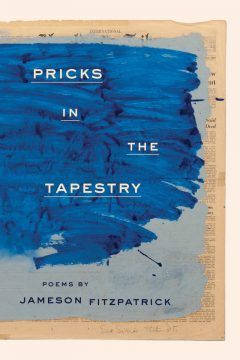 HIV infects the body through a protein on the surface of white blood cells. A tiny percentage of people have no functional receptors for this protein, meaning they can have sex with whomever they want and never risk contracting the virus. Other people, like the poet Jameson Fitzpatrick’s uncle, have fewer working receptors, so HIV is harder for them to contract, develops more slowly, and leads to less abundant viral loads. “Roughly,” about his uncle, is the longest poem in Fitzpatrick’s new collection Pricks in the Tapestry, a book that often views queer cultural inheritance in the 21st century from the vantage of past generations.
 The distribution of wealth follows a well-known pattern sometimes called an 80:20 rule: 80 percent of the wealth is owned by 20 percent of the people. Indeed, a report last year concluded that just eight men had a total wealth equivalent to that of the world’s poorest 3.8 billion people.
 The key consequence of seeing the humanities as a world alongside other broadly similar worlds is that the limits of their defensibility becomes apparent, and sermonizing over them becomes harder. If people stopped watching and playing sports, how much would it matter? The question is unanswerable since we can’t imagine a society continuous with ours but lacking sports, even though one such is, I suppose, possible. We do not have the means to adjudicate between that imaginary sportless society and our own actual sports-obsessed society. The same is true for the humanities. If the humanities were to disappear, new social and cultural configurations would then exist. Would this be a loss or gain? There is no way of telling, partly because we can’t picture what a society and culture that follow from ours but lack the humanities would be like at the requisite level of detail, and partly because, even if we could imagine such a society, our judgment between a society with the humanities and one without them couldn’t appeal to the standards like ours that are embedded in the humanities themselves. The humanities would be gone: that’s it.
 One of my favorite Earle performances is
  Here is another
  In January, Robert Williams, an African-American man, was wrongfully arrested due to an inaccurate facial recognition algorithm, a computerized approach that analyzes human faces and identifies them by comparison to database images of known people. He was handcuffed and arrested in front of his family by Detroit police without being told why, then jailed overnight after the police took mugshots, fingerprints, and a DNA sample. The next day, detectives showed Williams a surveillance video image of an African-American man standing in a store that sells watches. It immediately became clear that he was not Williams. Detailing his arrest in the
 Democracy imposes a substantial moral burden on citizens. They must regard one another as political equals, even when they disagree deeply about justice. Each side is likely to see the opposition as not only wrong about the issue, but on the side of injustice. How can citizens both stand up for justice and yet embrace a political arrangement that gives injustice an equal say? Political sympathy, a disposition to recognize in our opposition an attempt to live according to their conception of value, is proposed as a way to lighten democracy’s burden.
 Human civilization is only a few thousand years old (depending on how we count). So if civilization will ultimately last for millions of years, it could be considered surprising that we’ve found ourselves so early in history. Should we therefore predict that human civilization will probably disappear within a few thousand years? This “Doomsday Argument” shares a family resemblance to ideas used by many professional cosmologists to judge whether a model of the universe is natural or not. Philosopher Nick Bostrom is the world’s expert on these kinds of anthropic arguments. We talk through them, leading to the biggest doozy of them all: the idea that our perceived reality might be a computer simulation being run by enormously more powerful beings.
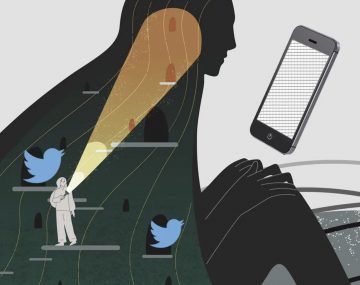 “One way the internet distorts our picture of ourselves is by feeding the human tendency to overestimate our knowledge of how the world works,”
  At it
At it
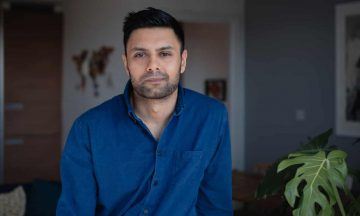 There’s a trope of the British Asian identity narrative, once captured with such originality and brilliance in Hanif Kureishi’s