
Claire Jarvis at The Hedgehog Review:
 The ideal mother, as countless novelists have known, is a dead one. It’s only when she is no longer living that the mother can function as a creature fully devoted to her child. Anything less than full, obliterating devotion is troubling: If she wasn’t willing to sacrifice everything—her relationship, her sleep, her career, her bodily integrity, her life—she should never have chosen to have a child. Spend a little time wallowing in the comments section of any online article about mothers, and you’ll see this formula. Motherhood is supposed to be all-encompassing and all-transforming. Except that now women are also required to maintain their sense of self—as manifested by their relationships, their bedtime routines, their jobs, their bodies—as a sign that they love their children enough to be good role models, exemplars of having it all. So, obviously: Mom is screwed from the start. She is never devoted enough to her child, never willing to transform herself entirely into her child’s helpmeet. She is also not separable enough—too worried about letting her child go, too occupied with her child’s life to live her own.
more here.
 During the 1920s, Frank Ramsey made massive contributions to no fewer than four disciplines: philosophy, economics, mathematics and subjective utility theory. In 1999, the philosopher Donald Davidson caught his brilliance by coining the term the “Ramsey Effect”: when you discover that your exciting and apparently original philosophical discovery has already been presented, and presented more elegantly, by Frank Ramsey.
 In the 1970s, the late mathematician Paul Cohen, the only person to ever win a Fields Medal for work in mathematical logic,
  The U.S. government has never been a consistent promoter of human rights — other interests were often prioritized — but when it did act, it could be powerful. Yet U.S. influence on human rights has plummeted under President Donald Trump. If Joe Biden assumes the presidency, he will need to oversee a major transformation if he wants the U.S. government to be a credible human rights voice.
 Asad Raza’s expansive cross-disciplinary practice defies categorization. Situated somewhere between performance, installation and curation, its elusiveness can be attributed to many factors. Primary to these is the fact that Raza’s work rejects the rigid prescriptiveness that these disciplines often demand. Rather, his open-ended, site-specific installations supply fertile ground for interaction, ideas and communities to develop. In his piece ‘Absorption’, currently on view at Gropius Bau as part of ‘
 All the facts are already known, and against each fact the supporters of Donald Trump have woven careful rationalizations. The truths are ugly, and so they have been festooned with kitschy trappings; some fall from the lips of a First Lady who speaks of bringing Americans together in a dress that costs about what the average female wage-earner in the United States makes in a month. I imagine the homes of Trump supporters as staging areas for transforming these ugly truths: the 186,000 Covid-19 death toll wrapped in duct tape and Trump’s yellow ties until it cannot be seen, and set down in a corner. Also in that dark corner we see factual information about Kamala Harris’s birthplace in Oakland, California, rejected—her birth certificate obscured with black lettering that shouts foreigner, “anchor baby,” alien, spy, and bitch. In this way, millions of factories of false facts are slapped-and-dashed together in the homes of Trump’s supporters to create a world that accords with the words of their leader. There is no arsenal of truth that can penetrate into their homes or their hearts.
 In 2019, a
  Over at Crooked Timber, first Chris Bertram:
 Philip Oltermann in The Guardian:
 Jesmyn Ward in Vanity Fair:
 Julianne Chung in Psyche:
 Sara Tafakori in openDemocracy:
 I
I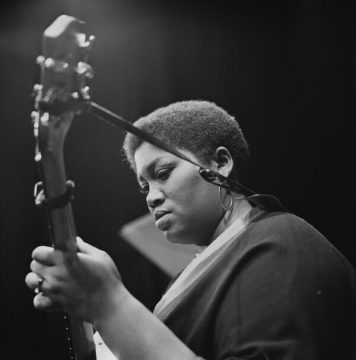 “Next a lone spotlight shone on Odetta wearing a dark loose-fitting dress, and she began singing ‘Water Boy,’ or, rather, she unleashed it. Accompanying herself with her large National acoustic guitar, eyes closed, brows knitted in concentration, she brought the full tragedy and anger of chain gang life to bear.”