
Alexis Petridis at The Guardian:
 Sweet Dreams tactfully sidesteps whether some of the New Romantics mirrored the celebrity-for-celebrity’s sake aspirations of many of today’s vloggers and influencers. But Jones makes a convincing case that their penchant for what used to be called “gender-bending” and their sartorial obsession with self-expression as “a platform for identity” foreshadows a lot of 2020’s hot-button topics. The book is excellent on the movement’s origins both in the aspirational teenage style cult that built around Bryan Ferry in the mid-70s and the more fashion-forward occupants of the same era’s gay clubs and soul nights, who saw the clothes Malcolm McLaren and Vivienne Westwood sold in their boutique Sex not as harbingers of spittle-flecked youth revolution but as a particularly outrageous brand of couture: it’s often written out of punk’s history that, at precisely the same time the Sex Pistols’ career was getting underway, there were people in Essex dancing to disco dressed exactly like Johnny Rotten.
more here.
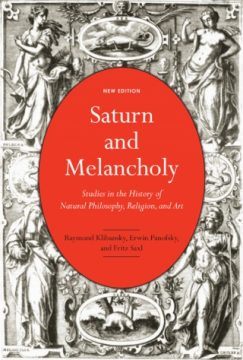 If melancholia may be “[s]ometimes painful and depressing, sometimes merely mildly pensive or nostalgic,” then this new edition is, in its own right, a melancholic exercise, a wistful homage to the once-world in which the book was produced. It is also melancholic from the perspective of the contemporary reader who is able to fathom the shear catholicity of mind necessary to produce a Meisterwerk of this sort. But it is in fact that very nostalgia that is in question in the book proper, for the study lays out just how persistently the posture of scholar, artist and anchorite alike has been one of despair at the path that separates them from the great transcendence lying on the horizon, whether that goes by the name of God, the eternal intellect or the Mallarmean “Book.” And in this respect, the history of melancholy itself joins up with the story of the long, arduous path by which the book came into being.
 Radhika Coomaraswamy in Daily FT (Sri Lanka):
 I
I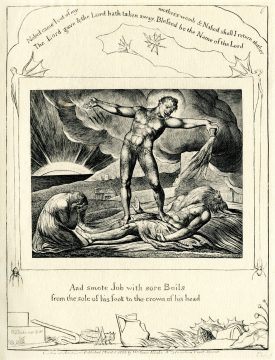 I thought of the biblical story of Job last month when I was asked to speak to the National Partnership for Hospice Innovation. How would I counsel others to cope with losses so terrifying and unfair? How could those grieving find a sense of hope or meaning on the other side of that loss? In my research I found myself drawn to the powerful rendition of the Book of Job by the 18th-century British poet, artist and mystic William Blake, in particular his collection

 Estimates of the proportion of people who die from Covid-19 have been controversial, with some even dismissing it as similar to a bad flu. There are three main problems accounting for this controversy.
 My love for your poetry is complicated further, because the memory of a Tamil woman called Thangamma keeps casting a dark shadow of fear and menace over your work. She darts and dives between the lines of your poems with an angry, restless spirit that will not cease.
 In her sharp and sympathetic foreword, Alice Kaplan observes that, for readers who know Camus only as the author of The Stranger, the “lush emotional intensity of these early essays and stories will come as a surprise.” Yet I confess that, even for someone who knew this side of Camus, I was again, as I reread the pieces, surprised by their Dionysian intensity.
 Throughout his career, Hawke has consistently challenged himself to grow. He has appeared in more than eighty movies, predominantly independent films interspersed with Hollywood money-makers. He has directed four films, written three novels, and co-founded a theatre company. In the process, Hawke has been nominated for four Academy Awards (including two for Best Adapted Screenplay) and a Tony, for his performance, in Tom Stoppard’s trilogy “The Coast of Utopia,” as Mikhail Bakunin, the revolutionary Russian anarchist, whose bowwow personality resurfaces in the fulminations of Hawke’s John Brown. The range of Hawke’s roles—a romantic charmer (in the “Before” trilogy), a drug-addled Chet Baker (in “Born to Be Blue”), a guilt-ridden suicidal priest (in “First Reformed”), to name just a few—is also a reflection of his expansive empathy. “Acting, at its best, is like music,” he said. “You have to get inside your character’s song.”
 With a presidential election less than five weeks away, and a new term at the U.S. Supreme Court just over a week away, President Donald Trump says he will, in a matter of days, announce his third nominee to the high court. The funeral for Justice Ruth Bader Ginsburg, whose seat he would be filling after she died last week, is not scheduled until next week, but President Trump and other Republican Party leaders have made clear their intent to return the court to its full complement of nine justices as soon as possible. The announcement is certain to provoke a fierce and partisan confirmation battle in the U.S. Senate. But if the nomination is successful, it could transform the high court in a way perhaps not seen in close to a century, securing a two-thirds majority of conservative jurists that could advance conservative causes like regulating abortion, expanding gun rights, and reining in federal regulations at a speed and scope of its choosing.
 If anyone knows about going fungal, it’s Paul Stamets. I have often wondered whether he has been infected with a fungus that fills him with mycological zeal—and an irrepressible urge to persuade humans that fungi are keen to partner with us in new and peculiar ways. I went to visit him at his home on the west coast of Canada. The house is balanced on a granite bluff, looking out to sea. The roof is suspended on beams that look like mushroom gills. A Star Trek fan since the age of 12, Stamets christened his new house Starship Agarikon—agarikon is another name for Laricifomes officinalis, a medicinal wood-rotting fungus that grows in the forests of the Pacific Northwest.