
Category: Recommended Reading
Albert Camus Faced The Human Condition With Clarity
Morten Høi Jensen at Commonweal:
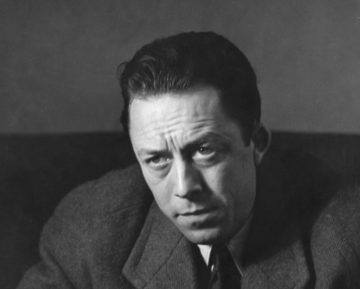 In what would tragically turn out to be the last years of his life, Camus returned imaginatively to the landscape of his youth—a landscape that, because of the Algerian War, was not accessible to him in the way it once had been. In 1958, he agreed to a French edition of The Wrong Side and the Right Side, republished by Gallimard. The timing was significant. “I still live with the idea that my work has not even begun,” Camus wrote in his preface to the new edition. It was an odd claim for a writer who had just been given the Nobel Prize for Literature, but Camus was more troubled by the award than he was honored by it. Pained by the war in his native Algeria, shunned by Parisian intellectuals for his critique of the revolutionary Left, he feared he was finished as a writer—a fear that the Nobel Prize, which usually honors work done over a long career, only served to heighten. Refusing an interview with the newspaper L’Express, Camus explained that he wanted the noise and publicity surrounding the award to die away quickly. “I want to disappear for a while,” he said. To his friend Roger Quinox, he seemed “like someone buried alive.”
more here.
The Rise and Fall of Rhodesia
Xan Smiley at Literary Review:
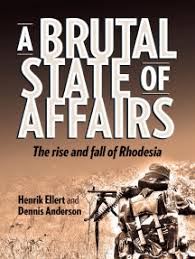 The authors of this book paint a detailed and dispassionate yet wrenching picture of the painful and bloody transformation of Rhodesia into Zimbabwe in the period following the white leader Ian Smith’s unilateral declaration of independence from Britain in 1965. Their main gift to historians is the wealth of information they provide, much of it hitherto unknown outside secret service circles, about how Rhodesia’s Special Branch, of which the authors themselves were two of the wiliest spooks, helped to keep the forces of African liberation at bay for so long.
As a correspondent in the country on and off during the decade before Robert Mugabe led the way to independence in 1980, I first met Dennis Anderson, one of the two authors, in the isolated little outpost of Chipinga (now Chipinge) in the remote southeastern highlands of Zimbabwe. It was the mid-1970s, when Mugabe’s guerrillas were infiltrating the area thick and fast, picking off white settlers, many of them diehard Afrikaners, one by one.
more here.
Tuesday Poem
Hair
I left Africa carrying my skin
and my father’s thick ringlets
braids were for children,
tussled locks for grown women
eleven and unaware
a black child in a white playground
learns new words
girls flock to touch a tamed head
weaved by loving hands
and chemical cravings set in
It’s your crown says my mother
whose gorgeous mane gets wrapped tight
rolled ready for feverish waves
that convert to straight
what a word
by Liyou Libsekal
from Poetry International Web
The other virus that worries Asia
Harriet Constable in BBC:
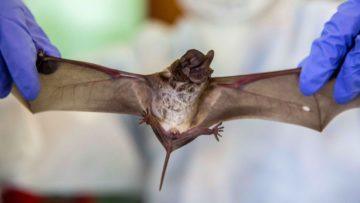 Asia has a high number of emerging infectious diseases. Tropical regions have a rich array of biodiversity, which means they are also home to a large pool of pathogens, increasing the chances that a novel virus could emerge. Growing human populations and increasing contact between people and wild animals in these regions also ups the risk factor. Over the course of a career sampling thousands of bats, Wacharapluesadee and her colleagues have discovered many novel viruses. They’ve mostly found coronaviruses, but also other deadly diseases that can spill over to humans.
These include the Nipah virus. Fruit bats are its natural host. “It’s a major concern because there’s no treatment… and a high mortality rate [is] caused by this virus,” says Wacharapluesadee. The death rate for Nipah ranges from 40% up to 75%, depending on where the outbreak occurs. She isn’t alone in her worry. Each year, the World Health Organization (WHO) reviews the large list of pathogens that could cause a public health emergency to decide how to prioritise their research and development funds. They focus on those that pose the greatest risk to human health, those that have epidemic potential, and those for which there are no vaccines. Nipah virus is in their top 10. And, with a number of outbreaks having happened in Asia already, it is likely we haven’t seen the last of it.
More here.
Making Sense of the ‘Mob’ Mentality
Benedict Carey in The New York Times:
 The reign of King Louis Philippe, the last king of France, came to an abrupt and ignominious end on Feb. 24, 1848, after days of increasingly violent demonstrations in Paris and months of mounting agitation with the government’s policies. The protesters surging through the city at first were fairly orderly: students chanting, well-dressed men and women strolling, troublemakers breaking windows and looting. But late in the evening of Feb. 23, the tide turned dark. Soldiers had fired on the crowd near the Hôtel des Capucines, leaving scores of men and women gravely wounded. Some blocks away, a journalist was “startled by the aspect of a gentleman who, without his hat, ran madly into the middle of the street, and began to harangue the passers-by. ‘To arms!’ he cried. ‘We are betrayed.’”
“The effect was electric,” the journalist wrote later. “Each man shook his neighbor by the hand, and far and wide the word was given that the whole system must fall.”
Several decades later, in 1895, those events became grist for one of the first concerted scholarly efforts to understand the mob mentality, Gustave Le Bon’s “The Crowd: A Study of the Popular Mind.” Ever since, social scientists have sought to describe the dynamics of humans en masse. What, independent of police provocation, causes a seemingly peaceful group of people to turn violent? How coherent in their purpose are crowds? Why and how does a crowd become a mob?
More here.
Sunday, January 10, 2021
We Must Find Ways to Detect Cancer Much Earlier
Azra Raza and other members of The Oncology Think Tank in Scientific American:
Every year, cancer kills approximately 10 million people worldwide. Of those who die, two thirds do so because they were diagnosed with advanced disease. A new paradigm in the approach to cancer is overdue. COVID-19 has already altered conversations and expectations within the medical community and is forcing a rethinking of many public health issues.
To contemplate a transformative approach for the postpandemic cancer landscape, The Oncology Think Tank (TOTT) was created in June 2020, bringing together a diverse group of thought leaders, researchers and oncologists from academia and industry. Meetings were held remotely, at least once a week and sometimes twice weekly for four months. The burden of TOTT was to formulate a fresh, compassionate, patient-centric, effective and radically different vision for health care’s approach to cancer. This opinion paper will focus on what TOTT believes is the best way forward with a goal of reducing the number of patients who are diagnosed with, or develop, advanced stage cancers and die.
There has been universal agreement that the best way to abolish cancer’s terrible impact on the world is through early detection. In October, Cancer Research UK (CRUK) published an article in the Lancet Oncology laying out an important cross-sectoral vision for a future where no cancer will be detected too late to treat. TOTT proposes not just early stage I and II cancer detection as understood today but to reach farther back in time to spot the earliest detectable precancerous perturbations.
More here.
Huygens, senior and junior: How a father’s mere curiosity about nature evolved during the Dutch Golden Age into the son’s focused scientific enquiry
Hugh Aldersey-Williams in Aeon:
 During the 1650s, the admired Dutch diplomat Constantijn Huygens often found himself with time on his hands. He was the loyal secretary to successive princes in the House of Orange, the ruling dynasty in the northern Netherlands during the Eighty Years’ War with Spain, and had been knighted by both James I of England and Louis XIII of France. Now that the Dutch were embarking upon an experimental period of republican government, his diplomatic services were no longer required. So he set down his untiring pen, and turned to books.
In September 1653, he happened to read Poems and Fancies, a newly published collection by the English exile Margaret Cavendish, Duchess of Newcastle, a staunch royalist who had sought to escape the persecutions of Oliver Cromwell’s Commonwealth by making her home in the city of Antwerp. Among its verses and dialogues, Cavendish’s book featured a range of her untested scientific ideas, including a 50-page verse exposition of her atomic theory. Her ‘extravagant atoms kept me from sleeping a great part of last night,’ Huygens wrote to a mutual friend.
A few years later, in March 1657, the 60-year-old Huygens initiated a correspondence with Cavendish, wondering if she might have an explanation for an odd phenomenon that had given rise to something of a craze in the salons of Europe. So-called Prince Rupert’s drops were comma-shaped beads formed by trickling molten glass into a bucket of cold water.
More here.
Jeffrey D. Sachs: The Truth About Trump’s Mob
Jeffrey D. Sachs at Project Syndicate:
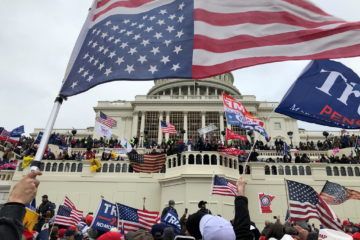
 The storming of the US Capitol on January 6 is easily misunderstood. Shaken by the ordeal, members of Congress have issued statements explaining that America is a nation of laws, not mobs. The implication is that the disruption incited by President Donald Trump is something new. It is not. The United States has a long history of mob violence stoked by white politicians in the service of rich white Americans. What was unusual this time is that the white mob turned on the white politicians, rather than the people of color who are usually the victims.
Of course, the circumstance of this rioting is crucial. The aim was to intimidate Congress into stopping the peaceful transition of power. This is sedition, and in stoking it, Trump has committed a capital offense.
In the past, such mob violence has been aimed at more traditional targets of white hate: African-Americans trying to vote or desegregate buses, housing, lunch counters, and schools; Native Americans trying to protect their hunting lands and natural resources; Mexican farmworkers demanding occupational safety; the Chinese immigrant laborers who previously built the railways and worked the mines. These groups were the targets of mob violence stoked by Americans from President Andrew Jackson and the frontiersman Kit Carson in the nineteenth century to Alabama Governor George Wallace in the twentieth.
More here.
Review of “Fermentation as Metaphor” by Sandor Ellix Katz
Leanne Ogasawara in the Dublin Review of Books:
 He calls himself a fermentation revivalist. With several award-winning books on the subject and a very large following on YouTube, Sandor Ellix Katz is part fermentation expert and part fermentation superstar. But I wondered: why revivalist? Did fermentation ever go out of fashion? Where I spent my adult life ‑ in Japan ‑ fermentation has always stood centre-stage. From soy sauce to miso and from sake to tsukemono, it is hard to imagine Japanese food without it.
I was inducted into the Way of Pickles early on in my Japan days. The first time I visited my ex-husband’s hometown in Shizuoka, the family egged me on to stick my hand into Grandma’s pickle jar. It was kept underneath the sink, and every day someone had to put their hand deep into the large ceramic jug and stir things up to keep the fermentation process going. This was called nukazuke, and Grandma Ogasawara was an expert. The nuka “bed” ‑ made from rice bran, salt, seaweed and some water ‑ required regular stirring for oxygenation. Why this had to be done with a human hand remained a mystery, one among many. Grandma would toss in cucumbers, radishes, eggplant, carrots, little onions or anything else she had on hand and then a few days or weeks later, eat accordingly. Because she never tossed out the nuka bed, the flavours became more complex over time. Or so the story goes. In the end, I did stick my hand in and give it a stir ‑ to everyone’s great delight. And his grandma rewarded me with the best pickles I had ever tasted.
More here.
Inside jokes
Laurie Taylor in New Humanist:
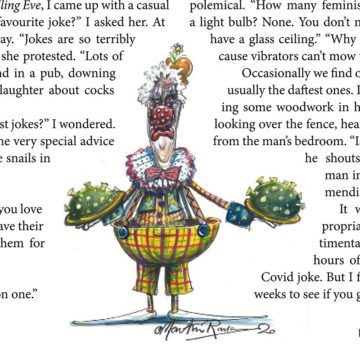 It was, in all respects, another typical Covid evening. We’d finished our regulation bottle of Chianti, yet again postponed our online Italian lesson, and decided that not one of the films on television merited a moment of our time. Three vacant hours lay between us and bedtime.
…And then, a few weeks ago, when we’d both decided that we’d lost the plot of Killing Eve, I came up with a casual suggestion. “What’s your favourite joke?” I asked her. At first she didn’t want to play. “Jokes are so terribly male, so horribly macho,” she protested. “Lots of hairy men standing around in a pub, downing pints and shrieking with laughter about cocks and tits.”
“Aren’t there any feminist jokes?” I wondered.
“Mmm. Well, there is the very special advice about how to get rid of the snails in your garden.”
“Go on.”
“You just tell them that you love them madly and want to have their baby and you won’t see them for dust.”
‘“Any more?”
“There’s the Dolly Parton one.”
“Go on.”
“Somebody asked her how long it took to do her hair and she said, ‘I don’t know. I’m never there.’ Your turn.”
I settled back on the sofa. My turn. Good. I’ve been collecting jokes since I was seven years old. My battered diary from that period even lists some of my childhood favourites. “Which nation uses the most cold cream?” Answer: The Japanese (the chappy knees). “What is brown, hairy and wears sunglasses?” Answer: A coconut on holiday. Boom boom.
Something a little more mature was called for. A riddle. “What does a dyslexic, agnostic, insomniac do at night?”
“I give up.”
“He stays up wondering if there is a dog.”
“That’s a typical man joke. Very clever. Very ‘look at me’. Not as funny as the story about the vicar’s wife who gazes lovingly at a dress in a shop window. Guiltily she goes in and tries it on. It’s gorgeous. ‘Get thee behind me, Satan,’ she murmurs to herself. A second later she’s alarmed to hear a whispered reply. ‘It looks all right from here,’ says the hidden voice.”
More here.
Sunday Poem
Waiting for a Greyhound Bus at the Los Angeles Station
A black woman stands with two toddlers hanging off her hips.
Her balance is perfect as she pushes her luggage with one leg,
the boys curl into her shoulders unaware of how
they all slide forward. I offer her my help. Her face is serious
when she says, Yes. On the bus, her boys nestle into their shared seat.
The driver, a white man, begins his headcount:
duck, duck, goose. He asks for her ticket. Says, Only one child is free,
tells her to pay for the other or get off. It is past 2 AM
and he threatens her with the mention of his superior.
What goes through his mind as he argues with a mother
juggling her children? Empty seats surround us like
silent witnesses; this time rules can’t be broken.
I stand up to say, One child is with me, but this young mother
doesn’t trust me or the difference between us.
Another woman stands and says the child is with her
and then another woman says the child is with her.
Something beautiful is happening here, and the driver
can no longer fight our unity or the energy within us.
by Cynthia Guardado
from: Endeavor
World Stage Press, 2017
Jean Valentine (1934 – 2020)
Eugene Wright (1923 – 2020)
Michael Apted (1941 – 2021)
For Donald Trump, what began as farce is ending as tragedy
Marilynne Robinson in The Guardian:
 A kinder fate might have cast Donald J Trump as a maitre d’ in the world of swank, careful to save the best tables for his best customers, warmly responsive to a good tip, the ultimate outsider as insider, being and also impersonating a man whose fondest memory of youth is the first time he heard “I Did It My Way.” But fate was not kind. It made him a billionaire of sorts with a trick of putting his name on vodka bottles and casinos, of growing richer through bankruptcies and bad debt, of enthralling the tabloids. And yet, despite all this, Manhattan seems to have remained unimpressed. A tower almost as tall as he said it was, remarkable hair, and yet he was the baffled outsider trying to figure out what he was getting wrong. What began as farce is ending as tragedy.
Fate truly outdid herself when she made him president of the United States. From this pinnacle of attainment he was able to look out over a vast world that was largely and unshakably certain he did not belong there. It would be easier to grant the pathos of his situation if his response to it had not been so largely bitterness and rage, and if his great office had not magnified his petulance into a force that could destabilize the republic.
The attack on the US Capitol, perhaps satisfying as revenge, was still a serious miscalculation. Trump told his mob once again that he had been cheated out of re-election, then sent them off to the Capitol where his defeat, an accomplished fact, was being formalized and finalized in deference to law and tradition, two sources of exasperation that had nagged him since he first set foot in the Oval Office. Which, by the way, is not all that spectacular.
More here.
Saturday, January 9, 2021
The Four-Year Assault
 Adam Shatz in the LRB:
So this is how it ends. Four years of rage and lies; four years of racism and xenophobia so coarse and inflammatory Richard Nixon might have blushed; four years of dismantling economic and environmental regulation, packaged as a populist revolution on behalf of the forgotten (white) American; four years of ‘law and order’ indistinguishable from moral and political disorder; four years of war against the media, ‘globalists’, ‘elites’ and other ‘enemies of the people’, which is to say his people, or rather his loyalists; four years of contempt for the vulnerable, whether Muslims, undocumented immigrants, Black victims of police brutality or those afflicted with Covid-19; four years of garish exhibitionism parading as leadership – four years of Donald Trump in power have led to the bizarre and grotesque spectacle of 6 January.
To call the explosion of the mob that took over the Capitol building an attempted coup, or an insurrection, is unfair to the plotters of coups and insurrections. Like the man who egged them on in a speech that morning – and who had spent the last two months refusing to concede the election, going so far as to order Georgia’s secretary of state to ‘find’ votes to overturn the outcome – the revellers in DC were practitioners of what political scientists call ‘expressive’ politics, capable only of defiant stonewalling and destructiveness. Some had arrived in full Civil War re-enactment regalia, carrying rifles and Confederate flags. Others looked as if they were auditioning for a sequel to The Big Lebowski, notably the ‘QAnon shaman’, Jake Angeli, a tattooed, shirtless man who strutted through the chambers of the Capitol with horns on his head and red, white and blue paint on his face. And then there were the neo-Nazis, white supremacists and militia members, the ‘fine people’ of Charlottesville. For all their shouts of ‘USA, USA,’ they represented a furious, desperate, lumpen minority unwilling, or unable, to accept defeat – or the ‘surrender’ of Trump’s Republican collaborators, who could no longer go on pretending that Joe Biden hadn’t won, especially when they realised the potential political costs of doing so.
More here.
It’s Time to Use Eminent Domain on the Coronavirus Vaccines

Arnab Acharya and Sanjay Reddy in Foreign Policy:
Jonas Salk, the scientist who developed the first effective polio vaccine, when asked “Who owns this patent?”, replied, “Well, the people, I would say. There is no patent. Could you patent the sun?” In a world where private companies reap the fruits of developing vaccines, many now view this attitude as quaint. But quite apart from the philosophical case, there are compelling practical reasons to adopt Salk’s attitude, and treat all vaccine formulas that have proved effective against COVID-19, like the sun, as a global public good.
The easiest way to make vaccines truly available to all is to freely license every effective vaccine formula so that generic producers can manufacture the vaccine anywhere. This approach would overcome the short-run limits on production, which come from intellectual-property restrictions that constrain production to specific firms. Doing away with this barrier would ensure that the vaccines are produced and sold by many actors in a competitive marketplace, and made available to the public at the least cost.
More here.
Criticism and Truth
 Jonathan Kramnick in Critical Inquiry:
Does literary criticism tell truths about the world? This is a question scholars of literature don’t often ask, or don’t often ask directly, but it gets to the heart of how work in the discipline is done and why the discipline exists in the first place. One way to answer the question is to examine whether criticism attempts to make true statements about literary texts and, if so, by what means its statements are judged as true or false. How do we encounter and interact with our objects of study? Where does our writing begin and the writing we’re writing about end? How are consensus judgments about the validity or perspicuity or elegance of a reading made? Another way to come at this question is to examine whether criticism is capable in some fashion of telling truths about the world itself, not just the small piece of it called literature. Does criticism about ecology or consciousness, to take examples from my own work (and feel free to insert your own), tell some truth about ecology or consciousness themselves? I think we’d all like to believe that it does, but how? Both lines of inquiry take aim at method and therefore at epistemology. They ask how critical practice—writing about writing—purports to convey knowledge, whether that is knowledge about literature or knowledge about the world in which literature is one part. This essay is a preliminary effort to consider these two sides of the relation between criticism and truth.
More here.
The Campus Underground Press
 Liza Featherstone in JSTOR Daily:
Famous for its social movements—against the Vietnam War, in defense of the planet, demanding Black civil rights, gay liberation, and women’s equality—the 1960s and 1970s were also a fertile time for the underground press in the United States. Reveal Digital’s Campus Underground collection on JSTOR includes more than seventy-five publications, many from college campuses or college towns (often produced by a loose cluster of students and other college-aged young people). The open access digital archive provides an exhilarating glimpse into this creative and politically incendiary period.
The explosion of small publications alongside the political upheaval—the latter of which is documented in a companion collection, Student Activism—is not a coincidence. Historically, an alternative press has thrived when social movements are most active. Political organizing gives the alternative press more material to write about. The movements also produce more readers for such outlets: in politically charged times, more people are open to new ideas and question established news sources.
More here.