Kevin Berger in Nautilus:
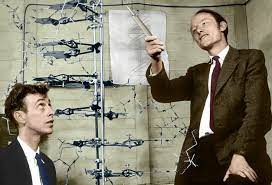 James Watson once said his road to the 1962 Nobel Prize began in Naples, Italy. At a conference in 1951, he met Maurice Wilkins, the biophysicist with whom he and Francis Crick shared the Nobel for discovering the double-helix structure of DNA. Meeting Wilkins was when he “first realized that DNA might be soluble,” Watson said. “So my life was changed.” That’s a nice anecdote for the science textbooks. But there’s “a tawdry first act to this operetta,” writes Howard Markel in his new book, The Secret of Life, about the drama behind the scenes of the famous discovery. At the time, Watson was an arrogant, gawky 22-year-old, working as a postdoctoral fellow at the University of Copenhagen. His biology lab director, Herman Kalckar, invited Watson and another fellow in the lab, Barbara Wright, to accompany him to the Naples conference. The confident and competitive Watson didn’t think much of Wright’s work. It was “rather inexact,” he sniped. But Watson was pleased to be invited on the trip. “It should be quite exciting,” he wrote his parents.
Watson was bored with most of the presentations at the conference. But he perked up when Wilkins projected images of DNA, captured with X-ray crystallography. The novel image showed the molecule arose from a crystalline structure. Watson later tried to buddy up to Wilkins at a cocktail party, but the socially awkward Wilkins did his best to avoid the bumptious American. Watson thought he had another opening when he spotted Wilkins chatting with his sister, who had joined Watson in Naples. But when Watson approached them, Wilkins slipped away.
Nonetheless, Watson’s encounter with Wilkins cemented his future. He was determined to discover the precise molecular structure of DNA. He knew he had little chance to join Wilkins at his lab at King’s College at the University of London, mainly because Wilkins didn’t like him. Watson set his sights on joining the other prominent biology lab probing molecular structures. At Cavendish Laboratory Biophysics Unit at Cambridge, Watson met the intellectually unstoppable Crick, and in two years, the duo built the first sound model of DNA’s structure. Their model showed the world how DNA did its thing and shaped the course of biological life.
In The Secret of Life, Markel, a distinguished professor in the history of medicine at the University of Michigan, and author of nonfiction books that roll along like novels, relishes explaining the backstory to Watson’s and Wilkins’ first encounter. Turns out Kalckar was having an affair with Wright and wanted to keep their trysts secret. Watson was invited to Naples “to act as a beard for his boss, to provide cover for his affair with Wright,” Markel told me in a recent interview. In The Secret of Life, Markel writes, “one cannot help but smile at the paradox that the unraveling of the double helix of DNA began with the coupling of Kalckar and Wright.”
More here.

 The word ‘economy’ evolved from the Greek root οἶκος. ‘Oikos’ had three interrelated senses in ancient Greece: the family, the family’s land, and the family’s home. These three, taken interchangeably, constituted the first or fundamental political unit in the ancient Greek world, especially in the minds of Greece’s hereditary aristocrats, for whom family mattered more than all other affiliations. The family, then and after, was viewed as the state in miniature, with its rules of order and its exemplars (of moral strength or moral incontinence).
 T
T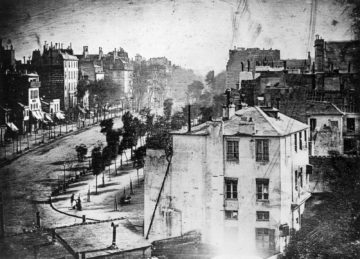 City streets seemed eerily empty in the early years of photography. During minutes-long exposures, carriage traffic and even ambling pedestrians blurred into nonexistence. The only subjects that remained were those that stood still: buildings, trees, the road itself. In one famous image, a bootblack and his customer appear to be the lone survivors on a Parisian boulevard. When shorter exposure times were finally possible in the late 1850s, a British photographer marveled: “Views in distant and picturesque cities will not seem plague-stricken, by the deserted aspect of their streets and squares, but will appear alive with the busy throng of their motley populations.”
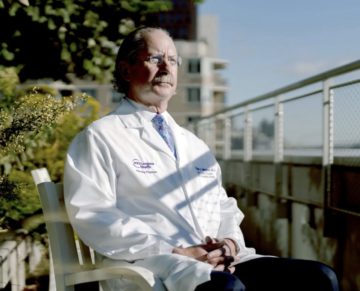 Surgeons in New York have successfully attached a kidney grown in a genetically altered pig to a human patient and found that the organ worked normally, a scientific breakthrough that one day may yield a vast new supply of organs for severely ill patients.
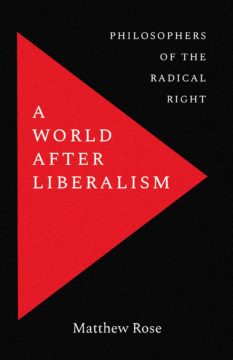 Perhaps the most invigorated intellectual movements to gain steam during the Trump era occupied not the progressive left but the reactionary right. The conservative visions of Reagan, Goldwater, or Buckley have now receded into the pages of history, voicing only a whimper of protest. What stands in the wake of these older modes of conservatism is not yet fully determined, but various modes of populism, authoritarianism, nationalism, cable news antagonisms, and conspiracy-driven paranoia now contend for whatever will come next.
 The Quick and the Dead, which is not set in Florida but in the West, is one of the weirdest, funniest, darkest novels you’ll ever read. It lost the 2001 Pulitzer Prize to The Amazing Adventures of Kavalier & Clay, thus fulfilling the promise of Luke 4:24. Williams’s new novel, Harrow, is Quick’s spiritual successor, perhaps even sequel, taking up that novel’s concerns and amplifying them by the full twenty years it took her to write it. Harrow reminds me very much of Denis Johnson’s Fiskadoro and Cormac McCarthy’s The Road, but, with apologies to the boys, it’s better than both of their novels put together. Harrow belongs at the front of the pack of recent climate fiction, even as it refuses the basic premise (human survival is important) and the sentimental rays of hope (another world is possible!) that are the hallmarks of the genre. This novel doesn’t care who you vote for or if you recycle. It’s not bullish on green tech jobs or sustainable meat. It would leave Steven “Things Are Getting Better” Pinker and Matthew “One Billion Americans” Yglesias writhing in shame if guys like them were capable of reading novels or feeling shame. Harrow is a crabby, craggy, comfortless, arid, erudite, obtuse, perfect novel, a singular entry in a singular body of work by an artist of uncompromised originality and vision. For all of its fragmentation and deliberate strategies of estrangement, Harrow feels coherent and complete, like a single long-form thought or a religious epiphany. It’s also funny as hell.
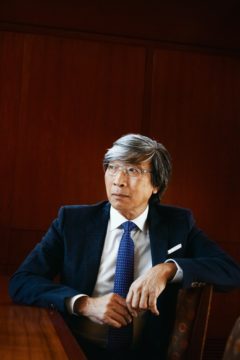 In the mid-nineteen-eighties, Lee Iacocca, the celebrated executive who had run both Chrysler and Ford, visited the Los Angeles laboratory of Patrick Soon-Shiong, a surgeon at U.C.L.A. Iacocca’s first wife had died of Type 1 diabetes a few years earlier; he was searching for a cure. Soon-Shiong, who was in his thirties, specialized in pancreas transplant, a risky treatment reserved for severe diabetics. Soon-Shiong was a skilled surgeon who had trained under organ-transplant pioneers, but he’d grown unhappy with the procedure: pancreas transplants carried a high risk of organ rejection, and he didn’t feel that the outcomes were worth the danger. He wanted to shut down U.C.L.A.’s pancreas-transplant program and embark on a new line of research. Instead of replacing the entire pancreas, Soon-Shiong would replace only the insulin-producing islet cells inside it.
 Fatalism creeps across our movements like rust. In conversations with scientists and activists, I hear the same words, over and again: “We’re screwed.” Government plans are too little, too late. They are unlikely to prevent the Earth’s systems from flipping into new states hostile to
 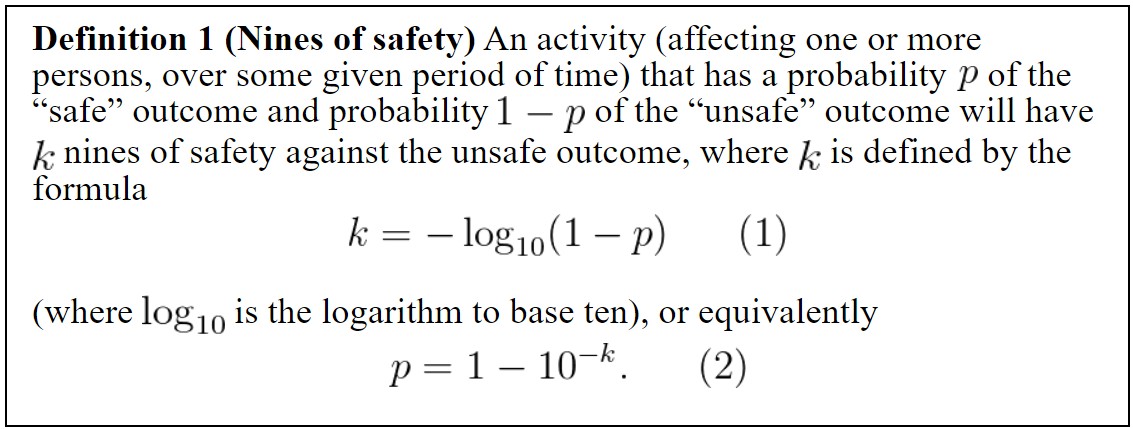 Because of all the very different ways in which percentages could be used, I think it may make sense to propose an alternate system of units to measure one class of probabilities, namely the probabilities of avoiding some highly undesirable outcome, such as death, accident or illness. The units I propose are that of “
 are in the probability of successfully avoiding the negative outcome, thus
 success = one nine of safety
 success = two nines of safety
 success = three nines of safety
 Psychology, as a scientific discipline in its own right, appears towards the end of the nineteenth century at roughly the moment when it is no longer possible in respectable institutions to speak of the soul. To put this another way, the science of the soul, which is all the word “psychology” means, begins only when those concerned with it declare the soul off-limits within the scope of their science. This might seem paradoxical, but in fact it is a common pattern: “biology” comes into its own, too, only when it ceases for the most part to look for that special je-ne-sais-quoi we call “life” that would somehow place living beings at a different ontological rank on some imagined “scale of being” from helium or silica, and just gets down to the business of accounting for how a certain class of carbon-based compounds do their thing. Philosophy for its part would still be able to talk about the soul in some limited contexts, but typically only as an occasion for investigating other conceptual problems or as shorthand for the gedankenexperimental fiction of a fully disembodied conscious being. Still, “Does the soul exist?” remains even today a legitimate topic of inquiry in a typical Intro to Philosophy course, though I suspect many instructors rush at the beginning of this segment to reassure their students that they personally know full well that it does not.
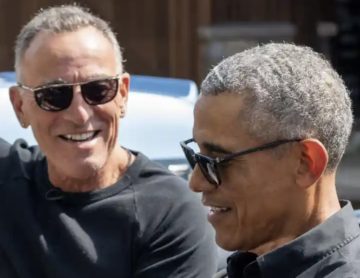 Springsteen From when I was a young man, I lived with a man who suffered a loss of status and I saw it every single day. It was all tied to lack of work, and I just watched the low self-esteem. That was a part of my daily life living with my father. It taught me one thing: work is essential. That’s why if we can’t get people working in this country, we’re going to have an awful hard time.
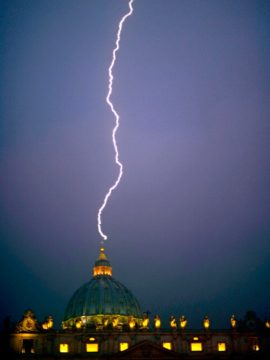 In 2019, over the course of a chilly February weekend, the Catholic Church seemed as though it was on the verge of a reckoning. For four days, Pope Francis convened a gathering of bishops in Vatican City for the Church’s first ever sexual abuse summit. Since becoming Pope in 2013, Francis has developed a reputation as a moderniser whose dedication to social justice could overcome the Church’s unwillingness to deal with a scandal that has lost it many followers in recent decades. The Pope said he wanted to address the generations-long delay in dealing with the sexual abuse of children by priests and other clergymen over decades across the world. In front of an audience of 180 bishops and cardinals, Pope Francis spoke of monstrous acts of evil and, ultimately, of justice. It was hailed as a defining moment in his leadership. At last, it seemed, the Catholic Church was ready to reform itself.