
Olúfémi O. Táíwò in The Nation:
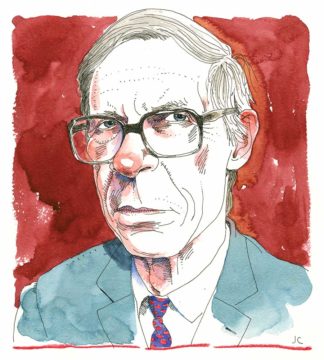 With its doctrine of fairness, A Theory of Justice transformed political philosophy. The English historian Peter Laslett had described the field as “dead” in 1956; with Rawls’s book that changed almost overnight. Now philosophers were arguing about the nature of Rawlsian principles and their implications—and for that matter were once again interested in matters of political and economic justice. Rawls’s terms became lingua franca: Many considered how his arguments, focused mostly on domestic or national issues of justice, might be applied to questions of international justice as well. Others sought to extend his theory’s set of political principles, while still others probed the limits of Rawls’s epistemology and the narrowness of his focus on individuals. A decade after A Theory of Justice appeared, Forrester notes, 2,512 books and articles had been published engaging with its central claims.
Rawls’s liberal theory of justice as fairness has continued to define the shape and trajectory of political philosophy and liberalism writ large to this day.
More here.
 Last week, the
  Nancy Kathryn Walecki: So first of all, most people probably think of psychedelics in the context of the 1960s countercultural movements, when they were being used recreationally. So is using psychedelic drugs in psychiatric treatment a new idea?
 E
E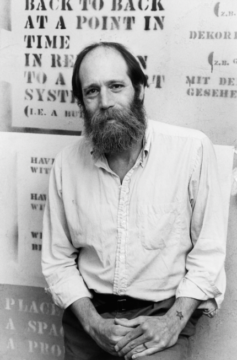 Lawrence Weiner, a towering figure in the Conceptual art movement arising in the 1960s and who profoundly altered the landscape of American art, died December 2 at the age of seventy-nine. Known for his text-based installations incorporating evocative or descriptive phrases and sentence fragments, typically presented in bold capital letters accompanied by graphic accents and occupying unusual sites and surfaces, Weiner rose to prominence among a cohort that included Robert Barry, Douglas Huebler, Joseph Kosuth, and Sol LeWitt. A firm believer that an idea alone could constitute an artwork, he established a practice that stood out for its consistent embodiment of his famous 1968 “Declaration of Intent”:
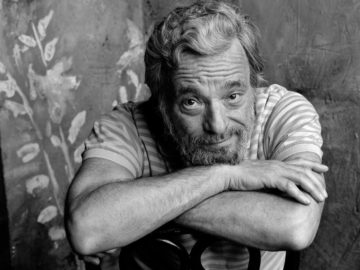 “Stephen’s story is well documented, the pain of it. Now here he was writing a beautiful song for the mother and wanting to write the son’s part. I had a relationship with my mother that I don’t think was as difficult, it had a little more grace, but it was challenging nonetheless. Stephen and I came to the conclusion that we never made the connection in the way we were searching for it. We kept passing by each other like ships in the night. A few days later, he hands me my part of the mother’s song. He’d taken our conversation and poeticised it. I got to be a teeny tiny part of what he was trying to say for this character. He wrote the most beautiful love song of two human beings trying to reach each other. That was the highlight of my entire professional life.”
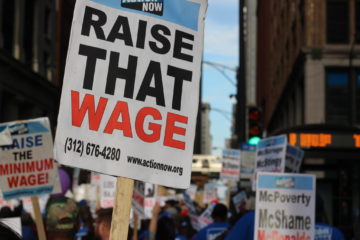 Brian Callaci in The Boston Review:
 Yulia Gromova interviews Quinn Slobodian in Strelka:
 The self-help industry is booming, fuelled by research on
 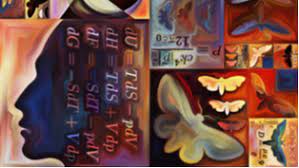 On a May evening in 1959, C.P. Snow, a popular novelist and former research scientist, gave a lecture before a gathering of dons and students at the University of Cambridge, his alma mater. He called his talk “The Two Cultures and the Scientific Revolution.” Snow declared that a gulf of mutual incomprehension divided literary intellectuals and scientists.
 Several years ago, I met Francis Bacon’s cleaning lady. Bacon’s amanuensis, the art critic David Sylvester, referred me to her, as he had her to Bacon. Jean Ward, who had her grey hair swept back into a thin ponytail like a pirate’s, welcomed me to her flat on a housing estate in Tooting Beck, South London. In a raspy voice she told me about her decade working for the painter whose legendarily messy studio—layer upon layer of dust, paint, discarded imagery, champagne bottles, and other detritus—would not have provided her much of a recommendation for future jobs.
 He poses on the cover of my old Grove Press edition in the aspect of a warrior, stripped to the waist, forehead bound in a hachimaki, looking out from under heavy brows. His shadowed gaze is intent, unnerving. His left cheekbone and the strong bridge of his nose catch the light. (A humanizing touch: his ears stick out slightly too far.) In a suit he might seem ordinary, at best of average build, but shirtless he is a panther ready to spring. His forearms are unusually furry for a Japanese man, his concave stomach bifurcated by a line of black hair. His triceps resemble warm marble. Superimposed on this fierce portrait are the concentric rings of a red target, as though Mishima were about to be feathered with arrows like St. Sebastian—a picture of whose “white and matchless nudity” moves the frail narrator of Mishima’s novel Confessions of a Mask to his first ejaculation. In the center of this target, his grim mouth forms the bull’s-eye; the outer rings drape his shoulders and pectoral muscles like a mantle of blood. His right hand is drawing out of its sheath, upward into the frame, the naked blade of a samurai sword.