
From City Journal:
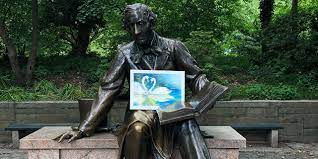 Matthew Mehan is the director of academic programs for Hillsdale College in Washington, D.C., and assistant professor of government for the Van Andel Graduate School of Government. He is also the author of two children’s books (both illustrated by John Folley): Mr. Mehan’s Mildly Amusing Mythical Mammals and the recently published The Handsome Little Cygnet. He spoke with City Journal associate editor Daniel Kennelly about his books and the state of children’s literature.
Tell us about The Handsome Little Cygnet. Is it a retelling of Hans Christian Andersen’s The Ugly Duckling?
Yes, but with a contemporary twist. Set in Manhattan’s Central Park, the story follows a father and mother swan and their baby cygnet as he tries to understand what he is and who he is meant to be. Unlike the original Ugly Duckling, this little swan starts knowing exactly what he is and who his parents are. But due to some confusing and ugly spray-paint—essentially vandalism of Central Park’s Gapstow Bridge—our plucky little cygnet gets confused. How he comes back to what he is meant to be—that is the core of this touching story.
Why did you decide to set the story in Central Park, in the heart of the nation’s densest urban area?
While there is the Ugly Duckling echo, I can’t say it was only for that reason. I also wanted to give New York City a little pick-me-up. The book has that feel of the city, with landmarks and vistas of Central Park and the surrounding skyline. Between Covid-19, riots, crime, and Bill de Blasio, it just seemed like New York needed a little love. I even hide a few N95 masks in the refuse of the ugliest place our little cygnet wanders into!
I also wanted Manhattan and Central Park for a deeper thematic reason. The book’s theme of identity—trying to figure out what we are so we can become who we are meant to be—involves two things: first, our nature; second, some artful work to make that nature truly thrive. Think of a rose bush (nature) and some lattice work to prop it up (art). That’s what it means for a happy girl to become a thriving woman, for a boy to become not just an adult male, but a real man—nature and art. Well, in the press and din of a city full of manmade buildings, bridges, and roads, there’s Central Park, a beautiful mixture of nature and art. That’s why we feature both wildlife found in the park (nature) and monuments, bridges, and sculptures found in the park (art).
More here.
 Cities are bastions of opportunity. They are filled with vast numbers of people meeting friends and family, visiting restaurants, museums, concert halls and sporting events, and travelling to and from jobs. Yet many of us who live in cities have occasionally been overwhelmed by the activity. At other times, we might feel ‘alone in the crowd’. For decades, the conflicting experiences of city living have led urbanites and scholars to ask: are cities bad for mental health?
 NASA just got a $10 billion space telescope for Christmas.
 If there’s one thing we’ve learned
  Joe Bucciero in The Nation:
 Lisa Herzog in The Raven:
 Massimo Pigliucci in Aeon:
 In 2019, the year Keegan Fong opened
  At the turn of the millennium, Reid Byers, a computer systems architect, set out to build a private library at his home in Princeton, N.J. Finding few books on library architecture that were not centuries old and in a dead or mildewed language, he took the advice of a neighbor across the street, the novelist Toni Morrison. Ms. Morrison “once famously said if there is a book you want to read and it doesn’t exist, then you must write it,” recalled Mr. Byers, 74, in a video chat from his current home, in Portland, Maine. The project stretched over a generation and culminated this year in a profusely illustrated, detail-crammed, Latin-strewn and yet remarkably unstuffy book called “
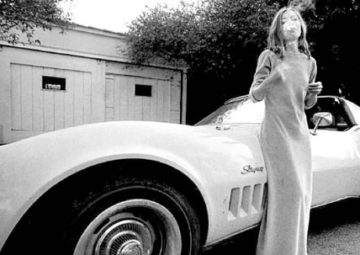
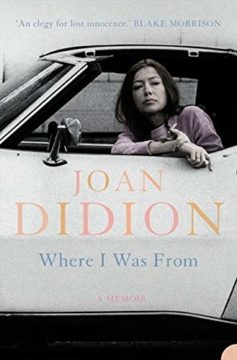 Joan Didion is not a nice person. I would almost put her in the category of Michel Houellebecq and Witold Gombrowicz. But not quite. I’m not sure what quality it is that holds her just at the cusp of “evil writer” without her falling in. Perhaps it is that she believes, though she would never put it this way, in the redemptive capacity of the act of writing.
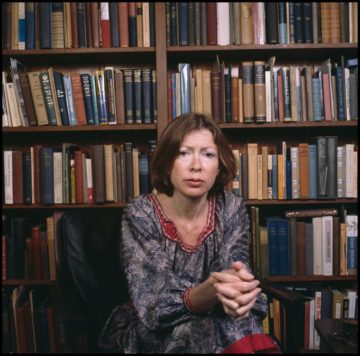 Joan Didion was 5 years old when she wrote her first story, upon the instruction of her mother, who had told her to stop whining and to write down her thoughts. She amused herself by describing a woman who imagines she is about to freeze to death, only to die burning instead.
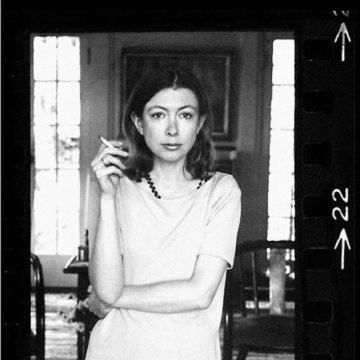 INTERVIEWER
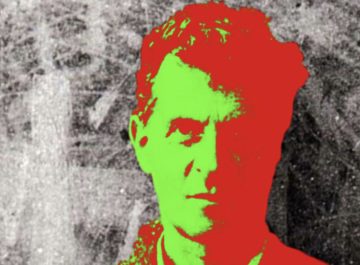 A work of philosophical genius according to some, a work of art according to others. Ludwig Wittgenstein’s Tractatus Logico Philosophicus was published 100 years ago, in 1921. It’s a book that according to its own philosophy of language, is mostly nonsense. Language, according to the strict logic of the Tractatus, is meaningful only when it functions as a picture of the world, a crystal-clear reflection of the structure of reality. It follows that most philosophical questions are meaningless and have to be condemned to silence. The Tractatus went on to influence philosophical movements like the logical positivists, but its lasting significance remains a matter for debate. Leading Wittgenstein scholars offer their views on the question of its legacy today.
 Known for her pioneering blend of the personal and the political in her journalism and essays,