
Category: Recommended Reading
Thursday Poem
A Supermarket in California
What thoughts I have of you tonight, Walt Whitman,
for I walked down the sidestreets under the trees
with a headache self-conscious looking at the full moon.
… In my hungry fatigue, and shopping for images,
I went into the neon fruit supermarket, dreaming
of your enumerations!
… What peaches and what penumbras! Whole families
shopping at night! Aisles full of husbands! Wives in the avocados,
babies in the tomatoes!—and you, Garcia Lorca,
what were you doing down by the watermelons?
… I saw you, Walt Whitman, childless, lonely old grubber,
poking among the meats in the refrigerator and eyeing the grocery boys.
… I heard you asking questions of each: Who killed the pork chops?
What price bananas? Are you my Angel?
… I wandered in and out of the brilliant stacks of cans following you,
and followed in my imagination by the store detective.
… We strode down the open corridors together in our solitary fancy
tasting artichokes, possessing every frozen delicacy, and never
passing the cashier.
… Where are we going, Walt Whitman? The doors close in an hour.
Which way does your beard point tonight?
… (I touch your book and dream of our odyssey in the supermarket
and feel absurd.)
… Will we walk all night through solitary streets? The trees add shade to shade,
lights out in the houses, we’ll both be lonely.
… Will we stroll dreaming of the lost America of love past blue automobiles
in driveways, home to our silent cottage?
… Ah, dear father, graybeard, lonely old courage-teacher, what America
did you have when Charon quit poling his ferry and you got out on a smoking bank
and stood watching the boat disappear on the black waters of Lethe?
by Allen Ginsberg,
from Collected Poems 1947-1980.
HarperCollins Publishers, Inc.
Reading here
An interview with Jesus
Krish Kandiah in The Spectator:
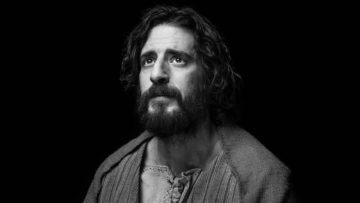 It’s Christmas in Paris and Les Champs-Elysees is appropriately adorned. We are, after all, in the so-called Elysian Fields, paradise, heaven on earth. Red illuminated trees line both side of France’s most famous avenue, stars fill the sky and the red carpet is laid out in front of the prestigious Gaumont cinema. The welcome is fit for royalty. And, on cue, Jesus turns up.
Paris may be a far cry from Bethlehem two thousand years ago, but tonight sees a different long-awaited arrival: the French language national television release of the hit series The Chosen and a premiere with the man who plays Jesus –Jonathan Roumie. This is probably the most successful television show you have never heard of. Over 150 million people have streamed this dramatisation of the life of Jesus, told through the eyes of the disciples. It is the biggest crowd-funded television series in history with fans raising $40 million to cover the production costs of the first two seasons, and a third season is already in credit. Jonathan Roumie has already started to collect awards, as has the director Dallas Jenkins.
Tonight in Paris it’s a game changer. ‘The Chosen’ will air on Canal Plus’s national free to air channel C8 at prime-time over the festive period. As I interview those on the red carpet at the premier screening, everyone I speak to is astounded that Europe’s most secularised nation (40 per cent say that they don’t follow any religion) has agreed to dedicate these highly sought-after television slots to a detailed retelling of the biblical story of Jesus. How has this religious coup-de-grace been made possible? It seems that the controversial billionaire owner of Canal Plus, Vincent Bollore, may have something to do with it. Rumour has it that he has been personally impacted by the story behind the film.
He’s not the only one. Around the world some 2.5 billion people claim to follow Jesus. That’s some pressure on any actor that dares to play him, let alone on the man who stars in the most-watched depiction of his life in the world right now. How does Jonathan Roumie deal with that pressure? He tells me in his humble and self effacing way: ‘I pray a lot.’ Roumie explains that he is ‘excited’ about the national release because it is going to allow French people ‘to have it available in their own language. I almost prefer the voice of Jesus in French to my own voice.’
More here.
In Our Time: The Hittites
https://www.youtube.com/watch?v=Ygahpk-Zh9M
Burdened By Books
Robert Zaretsky at The Baffler:
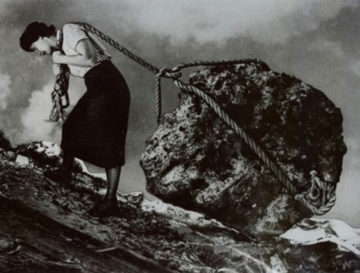 I’ve begun to fear that requiring my existentialism students to bring real books to class is . . . well, absurd. Absurd not just in the everyday sense of ridiculous, but absurd in the Camusian sense as well. Is it just as unreasonable to demand that students use an ancient technology as it is to demand that an indifferent universe offers us meaning? It might be the case that my traditional expectations of students are unreasonable. More than a few students, rather than bringing paperbacks of the assigned works, bring printouts. At best, this means they haven’t the means to buy the book; at worst, it means they find unmeaningful the very possession of the book. They have no more intention to keep a printout—to reread or reflect upon it—than I have the intention to keep yesterday’s newspaper.
But the real problem, if that is the right word, is not whether they own the book. It is whether they know what to do with it.
more here.
Fish Do the Wave to Ward Off Predatory Birds
Jack Tamisiea in Scientific American:
 Although the jungles of southern Mexico seem like an ideal spot for fieldwork, the region’s sulfur springs are far from a tropical getaway. In addition to the area’s stifling heat, the pools reek of rotten eggs. Their milky, turquoise water is even more inhospitable: it is laced with toxic levels of hydrogen sulfide and contains very little oxygen.
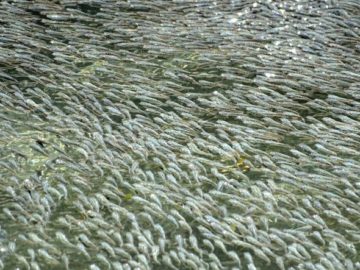
These hellish backwaters, however, serve as the stage for a remarkable display—tens of thousands of fish moving in unison like sports fans doing the wave across a stadium. “It’s mesmerizing—you can stand there literally for hours and just let your mind flow while they do their waves,” says Juliane Lukas, a researcher at Berlin’s Leibniz Institute of Freshwater Ecology and Inland Fisheries (IGB). But these pulsating waves are not just captivating. In a study published on December 22 in Current Biology, Lukas and her team identified the pulsating waves as one of the first examples of a collective behavior meant to directly stymie a predator.
More here.
Alfred Döblin’s Surreal Foray Into Climate Fiction
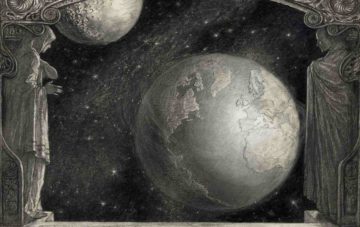 Berlin Alexanderplatz came to define Döblin’s legacy, both in his lifetime and over the ensuing decades. Unlike its predecessors, it focuses on a single character (Franz Biberkopf) and covers a short timespan and limited geography (Berlin in the 1920s). Chaotic in plot and form, Alexanderplatz found an enthusiastic reception in Germany and a quick translation into English (by Eugene Jolas in 1931), helping to secure its status as a modernist totem. Yet one finds the seeds of its immersive and clamorous style buried in Mountains Oceans Giants, a book better known for its lukewarm if bemused reception. Both of the works could aptly be defined as an “epic,” not just in a general sense but also as Döblin himself interpreted the term in 1929 (in an essay Godwin has translated). Distinguishing the epicist from the novelist, Döblin argues that the former employs “the report mode”; the epicist “must approach very close to reality, its solidity, its blood, its smells, and then must pierce through it.” But reportage doesn’t preclude creation, even fabulation. In the epic, Döblin understands “reality, phantasy and wish-fulfillment” as co-constitutive. Mountains Oceans Giants itself relies on contemporaneous facts—whether culled from news reports on industrial monopolies or from scientific libraries—to imagine the facts of the future. Like the human mind, an adequate picture of reality holds both types of fact in suspension.
more here.
Wednesday, December 22, 2021
George Steiner And The Art Of Hopeful Failure
Richard Hughes Gibson at The Hedgehog Review:
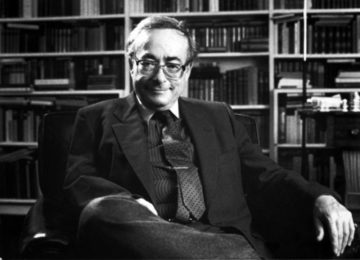 George Steiner was called many things across his lengthy writing career—sage, pedant, philosopher, snob, the last great European intellectual, a “mimic” staging a decades-long “impression of the world’s most learned man”—but the title he always claimed for himself was simply critic. As we reflect on the meaning of Steiner’s work in the wake of his death in February 2020, that self-characterization cannot be forgotten. Steiner was in many ways a formidable scholar, and his commentaries on core texts (Antigone, The Brothers Karamazov, the poetry of Paul Celan) and enduring themes (tragedy, translation, the inhuman) will surely be cited for many years to come. Yet from the beginning of his career in the late fifties to his last notable works at the turn of the century, he was explicitly engaged in the practice of criticism—the goal of which was to reach the wider republic of readers (not just academicians) with his urgent dispatches on the state of the arts and culture. It was as a critic that he asked to be judged.
more here.
Reopening Vermeer’s Love Letter To Contradiction
Kristian Vistrup Madsen at Artforum:
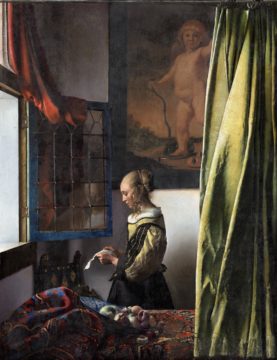 IN DRESDEN, a city renowned for the picture-perfect restoration by which it looks the same and yet entirely strange, an old tale of love and deception is playing out.
Since Vermeer’s Girl Reading a Letter at an Open Window, c. 1657–59, arrived in the Saxon capital from Paris in 1742, a girl in a green dress has been intently studying a letter by pale daylight against a white wall. As other of the Dutch master’s pictures, and indeed many of those made by his contemporaries, tend to do, the unadorned interior offers no clue as to what she might be thinking. Instead, what long impressed viewers about this particular girl was her apparent modernity. She was free, it seemed, of mythology and religion, exemplifying a unity of form and substance, a kind of pure presence. But alas. Now on view at Dresden’s Gemäldegalerie Alte Meister is the remarkable outcome of the painting’s most recent conservation effort. Behind the girl in the green dress is no white wall but the domineering feature of a large painting of Cupid leaning on his bow and stepping on two masks fallen to the ground.
more here.
Orhan Pamuk on a Lost Pool, and the World Beneath Its Surface
Orhan Pamuk in Literary Hub:
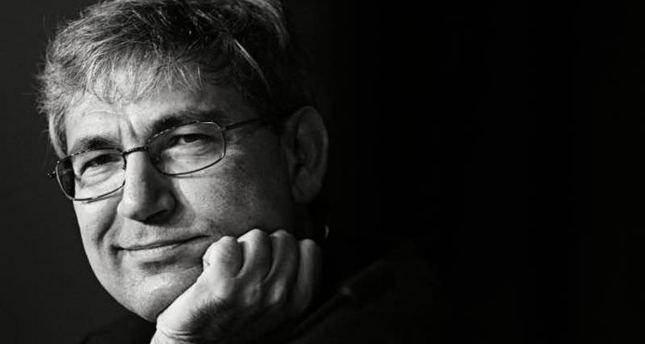
In 1964, when I was about 12 or 13, I spent the summer at a house by the seaside 35 miles from Istanbul. I would leap over the low garden wall and walk towards the beach through the rocks and empty fields that lined the shore, inspecting all the marvelous little surprises that nature would lay upon my path. One day I came across a small pool of water among the rocks. It wasn’t exactly a pool. The sea kept pouring in through the gaps among the rocks and stones. But like a real pool, it was about one foot deep and six or seven meters wide, and shielded from the assault of the sea’s unruly waves. I quickly discovered that below the unruffled and perfectly transparent surface of my “pool” was another world, a whole civilization, and I began to spend more and more time there, alone in the summer heat, fascinated by the bustling realm submerged in the tepid seawater.
More here.
These are the viruses that mRNA vaccines may take on next
Laura Sanders in Science News:
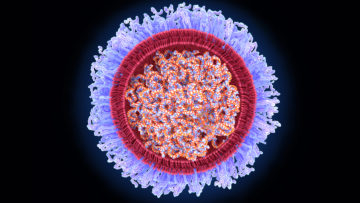 Tiny molecules came up big in 2021. By year’s end, COVID-19 vaccines based on snippets of mRNA, or messenger RNA, proved to be safe and incredibly effective at preventing the worst outcomes of the disease.
mRNA vaccines tell our cells how to make a mimic of a viral protein, in this case the spike protein that the coronavirus uses to break into cells (SN Online: 12/16/21). The vaccine-generated protein then teaches the immune system what the real threat looks like should it later encounter that threat.
For decades, efforts to develop mRNA-based vaccines to fight infectious diseases like rabies have been on a slow and meandering road (SN Online: 6/29/21). But the urgency of the pandemic breathed new life into these attempts. The promise of mRNA technology now takes us well past this pandemic’s horizon. “We’re right at the beginning of a really exciting time,” says Anna Blakney, a bioengineer who studies RNA technology at the University of British Columbia in Vancouver.
The dreams are big: Fighting all sorts of infections. Attacking cancer cells. Restoring specific proteins to treat genetic diseases, such as cystic fibrosis.
More here.
The “Thucydides Trap” Does Not Explain Geopolitics
Richard Hanania in his Substack newsletter:
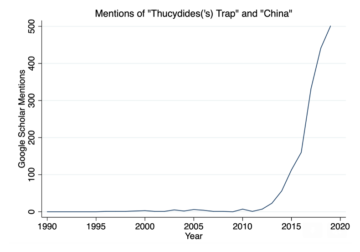 When I discuss the US-China relationship with people, I’ve found that they often turn to the concept of the “Thucydides Trap.” It seems as if few international relations books in the last decade have had as much influence as Destined for War: Can America and China Escape Thucydides’s Trap? by Graham Allison, a former Assistant Secretary of Defense under Clinton and a professor at the Harvard Kennedy School. Here is the number of Google Scholar mentions I find for “Thucydides(‘s) Trap” and “China” in the same work from 1990 to 2019.
It’s a deeply unimpressive book though. Take a look at the blurbs on Amazon, and then actually read it if you want to understand the hollowness of the kinds of arguments that are used as justification for the American global empire. Allison receives praise from Kissinger, Biden, Petraeus, Michael Hayden, Ban-Ki Moon, Samantha Power, and even Klaus Schwab, who I once thought was a Twitter meme but is apparently also a real person (in their defense, I’m sure almost none of them read it).
More here.
Intelligence, Credulity, and Charity in the Age of AI
Alan Jacobs in The Hedgehog Review:
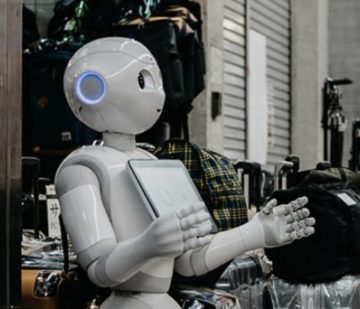 William Hasselberger, writing in The New Atlantis, offers a thoughtful assessment of computer scientist and tech entrepeneur Erik J. Larson’s recent book The Myth of Artificial Intelligence: Why Computers Can’t Think the Way We Do. Hasselberger’s reflection is more than a review; it is a useful contribution to the debate over whether artificial general intelligence is likely to be achieved. And it raises vital questions.
Hasselberger, philosopher and politics professor at Catholic University of Portugal, admires Larson’s book but insists that “while the critique of AI hype points us in the right direction, it is not radical enough. For Larson is fixated on intelligence’s logical aspects”—but “in defending the human in this way he misses the broader picture.” Hasselberger approaches that “broader picture” by reflecting on what it means for human beings to converse. Extending Larson’s argument, he points out that the definition of intelligence generally operative in the world of AI research “ignores the reflective aspect of human intelligence—how we discover, imagine, question, and commit to our objectives in the first place, the judgments we make about which objectives really matter in life, and which are trivialities, distractions, irrational cravings. The constricted definition of intelligence also ignores activities with no objective, forms of human mental life that we do for their own sake, like free-ranging conversation.”
More here.
An Oscar-Winning Animation of Charles Dickens’s “A Christmas Carol”
Wednesday Poem
Dawn
A man and a woman are driving across the Great Plains of North
America.
Kansas. Sashatchewan, South Dakota.
They are hundreds of miles into their journey, cocooned by speed
and metal and dusk, a chrysalis of solitude and cobalt distance.
They are bodiless and encapsulated as astronauts approaching the
moons of Jupiter,
their radio emits a voice-storm of signals and significant noise,
by the dashboard light they can just make out the markings on the
map, a grave-rubbing or ghostly palimpsest,
scrim as fine as angel’s hair or the latticed veins of tangerines,
images and symbols which admit of no single probable answer but
function as a kind of orchestral score for the landscape sweeping
invisibly past,
a notational logic of the possible.
Hiss of tires, rush oof wind, cardinal hush and ordinal thrum.
Toward dawn the radio begins another cycle.
Everything is exactly as it was. They have outdistanced the stars
and the plains are just as silent, gravid ineluctable. Tthey have
received the hieratic mysteries, they posses the blueprints of a
thousand civilizations.
They stop the car and get out.
In the first, ashen light shapes and templates begin to appear.
A horse, a flock of doves, windrows of trees between the freshly
plowed fields, distant cathedrals of grain elevators rising from the
mist.
They have everything they need to create the world.
They have only to join hands. They have only to choose.
by Campbell McGrath
from Nouns and Verbs
Harper Collins, 2019
Ill Liberal Arts
Rafia Zakaria in The Baffler:
 IN SEPTEMBER, THE ADMINISTRATION of Marian University, a small liberal arts school in Indianapolis, Indiana, put a proposal before its Academic Policies Committee. The administration stated that it wanted to eliminate the political science department and terminate the college’s only tenured faculty member in that department. “I had no idea this was coming, I was completely blindsided,” Dr. Johnny Goldfinger, the professor in question, told Inside Higher Ed. Earlier in the year, the department’s other tenured professor, Dr. Pierre Atlas, had resigned from the department when his request for a sabbatical was denied. Atlas’s subsequent requests for unpaid research leave were also denied. In Goldfinger’s case, the Faculty Assembly voted overwhelmingly against the proposal in November. The administration, however, was not interested in heeding faculty opinion. Nor were they swayed by the letter that the American Political Science Association wrote to them. Goldfinger, who has decades of teaching experience and a PhD from Duke University, saw his job eliminated last week by the college’s board of trustees. All departments other than political science were left intact.
This is not the story of one department at one college. An hour’s drive to the northwest of Marian, at Purdue University, it is the English department that faced threats. Citing budgetary concerns, the board of trustees halted the acceptance of any new students and proposed cuts to non-tenured faculty. This includes the Master of Fine Arts program in creative writing, which until recently included the trailblazing Haitian American author Roxane Gay. Other departments at other universities and colleges around the country are facing similar cuts.
…There are innumerable ways in which universities and colleges can create programs that combine liberal arts instruction with other degrees so that students can get the best of both worlds. Chopping off liberal arts education is shortsighted and dangerous and not unlike trying to cure a sprain with a total amputation. It only makes sense if the actual purpose of slicing off departments and professors is part of a larger political project that has nothing at all to do with providing the best education.
More here.
Fads are more than a cultural phenomenon — they’re part of our brain chemistry
Efi Chalikopoulou in Vox:
 The smooth, plastic egg fits in your palm. Brightly colored shell. Gray screen the size of a postage stamp. Below that, three buttons. Pull a thin plastic tab on the side, and the screen lights up. An 8-bit egg appears onscreen. It quivers and rolls and shakes until, finally, your Tamagotchi is born. Inside your head, the squishy, enigmatic organ known as the brain begins firing — not only to process the visual and sensory stimuli, but to generate curiosity in this new object. In fact, the spark of this fixation likely began before you even held this toy, when you heard friends feverishly speak about it and saw it in the clutches of popular kids at school.
Obsession is more than a cultural phenomenon — it’s part of our brain chemistry, and part of what it means to be human. For hundreds of thousands of years, we evolved in environments of scarcity, where social structures were required for survival, and seeking and curiosity were imperative. In the modern era, the same brain chemistry that lured us to the sweetness of fruit and alerted us to the presence of danger now draws us to fads like the Tamagotchi.
“People are born stupid,” says Paul Silvia, a psychologist at the University of North Carolina Greensboro and author of Exploring the Psychology of Interest. Many newborn animals already have instincts about their environment and quickly gain mobility. Sea turtles, for example, emerge from eggs ready to seek the sea. Human babies, meanwhile, are notably helpless. “We can’t really move, we can’t feed ourselves, we don’t have a lot of innate behaviors,” Silvia says. “But there’s an epic learning period that happens. You can be born knowing how to take care of yourself, or you could be born knowing how to learn.” That’s where interest comes in.
More here.
Tuesday, December 21, 2021
Daniel C. Dennett on the Richard Rorty Factor
Daniel C. Dennett in Philosophy Now:
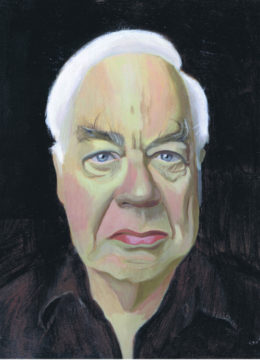 In a paper published in Synthese (#53) in 1982, ‘Contemporary Philosophy of Mind’, Richard Rorty wrote an enthusiastic account of the revolutionary ‘Ryle-Dennett tradition’. Was I really as radical a revolutionary as he said I was? I responded mischievously, perhaps rudely:
“Since I, as an irremediably narrow-minded and unhistorical analytic philosopher, am always looking for a good excuse not to have to read Hegel or Heidegger or Derrida or those other chaps who don’t have the decency to think in English, I am tempted by Rorty’s performance on this occasion to enunciate a useful hermeneutical principle, the Rorty Factor:
Take whatever Rorty says about anyone’s views and multiply it by .742.
After all, if Rorty can find so much more in my own writing than I put there, he’s probably done the same or better for Heidegger – which means I can save myself the trouble of reading Heidegger; I can just read [Rorty’s book] Philosophy and the Mirror of Nature (Princeton University Press, 1979) and come out about 40% ahead while enjoying my reading at the same time.”
Rorty took this in good spirits and continued his amiable practice of highlighting the connections he saw between analytic philosophers’ arguments and the grand march of isms that constitute Western philosophy. Part of his optimistic genius was seeing how other people’s hard work in the trenches might be seen as major steps of genuine philosophical progress. This collection of previously unpublished works, most of them lectures delivered on multiple occasions, shows his power, his insight, his constructive spirit throughout. It is indeed enjoyable and enlightening philosophical reading, although I now believe that philosophers really shouldn’t rely on Rorty and other like-minded scholars of the field to frame our projects.
More here.
Here’s what to do if you get Omicron
Yasmin Tayag in The Atlantic:
 My breakthrough infection started with a scratchy throat just a few days before Thanksgiving. Because I’m vaccinated, and had just tested negative for COVID-19 two days earlier, I initially brushed off the symptoms as merely a cold. Just to be sure, I got checked again a few days later. Positive. The result felt like a betrayal after 18 months of reporting on the pandemic. And as I walked home from the testing center, I realized that I had no clue what to do next.
I had so many questions: How would I isolate myself in a shared apartment? And why for 10 days, like the doctor at the testing site had advised? Should I get tested again?
More here.
Hindu Nationalism: A Movement, Not A Mandate
Alf Gunvald Nilsen in Public Books:
 We know by now that authoritarian populists have handled the Covid-19 pandemic badly. Both Donald Trump and Jair Bolsonaro presided over spiraling death rates, fueled by a disregard for medical science and neglect of public health imperatives.
But India’s Narendra Modi appeared to buck this trend. After the first wave of the pandemic dissipated in September 2020, both national and international media echoed the government narrative that India, with Modi at its helm, had vanquished the coronavirus.
This public image, however, was revealed to be a mirage when a deadly second wave ripped through the country from late March to early June 2021. Millions of lives were lost. And it was a direct consequence of the failure of Modi and his party—the right-wing Hindu nationalist Bharatiya Janata Party (BJP)—to expand medical infrastructure and roll out vaccinations effectively.
The BJP government, in short, chose to privilege Modi’s appearance as a strongman and heroic protector of the nation.
More here.