
Justin E. H. Smith in his Substack newsletter, The Hinternet:
 I have been doing a great deal of publicity these past weeks for my new book, The Internet Is Not What You Think It Is. I have been compelled to train my speaking voice, to craft short-and-sweet sound-bites, and even to worry about such externalities as my physical appearance when I am asked to make promotional videos or to appear on podcasts that transmit not only a trace of my voice, but an animate likeness of my very person, across the world wide web.
I have been saying “yes”, to virtually every podcast and radio invitation I’ve received. Sometimes I find myself doing some rather quick mental work, after clicking the Zoom link, to recall who exactly it is I’m talking to, and what is expected of me. Sometimes there’s a tell-tale hint —an Australian accent, say— that brings me back to the e-mail I received a week or so prior and that reminds me of the host’s general orientation and expectations. Sometimes I fly blind through the whole thing, still uncertain at the end whose show I’ve just graced with my presence.
More here.
 The
The 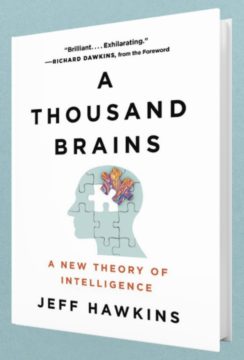 Over the years, I’ve read quite a few books about the brain, most of them written by academic neuroscientists who view it through the lens of sophisticated lab experiments. Recently, I picked up a brain book that’s much more theoretical. It’s called A Thousand Brains: A New Theory of Intelligence, by a tech entrepreneur named Jeff Hawkins.
 R
R In 2017, Karen Kostroff, a renowned oncology surgeon at Northwell Health in the New York Metropolitan area added a new talking point to her standard conversation with breast cancer patients facing tumor removal surgery. These conversations are never easy, because a cancer diagnosis is devastating news. But the new topic seemed to give her patients a sense of purpose, a feeling that their medical misfortune had the potential to do something good for other people.
  Alex Kane in Jewish Currents:
 Daniel J Herman in Aeon:
 Over at Phenomenal World, Lily Hu interviews Olúfẹ́mi Táíwò on climate crisis, reparations, and the use of history:
 A
A “Private Notebooks: 1914-1916” is a strange and intriguing record — illuminating when it comes to Wittgenstein’s preoccupations, his sexual anguish, his continuous struggles with his “work” in philosophy, along with his intermittent comments about his “job” in the military. (Like other writings by Wittgenstein that have been published posthumously, “Private Notebooks” is a bilingual edition, with German and English printed on facing pages.) Perloff also points out that unlike so many other war diaries, Wittgenstein’s includes very little about the larger stakes of the war itself. One exception is an entry that reads like a startlingly cheerful declaration that his own side was doomed: “The English — the best race in the world — cannot lose! We, however, can lose & will lose, if not this year, then the next!”
 A work of art has the power to transport its viewer to another time and place. Now, the