
Nikhil Kalyanpur at The Price of Power:
 Historically, economic elites pushed for stronger courts, better property rights, and even elections. There was an underlying logic: elites are fundamentally afraid of the state expropriating them, and domestic political development — the rule of law, democracy — can restrain arbitrary government action.
But recent elites are at best indifferent and at worst complicit in the democratic backsliding of Russia, Hungary, Turkey, and now the United States. Some of that can surely be explained by today’s plutocrats expecting to make wins by aligning themselves with the government. Cash in some short-term gains for potential random punishment down the line.
But I think the main explanation is that elites no longer have the incentive to fight for the rule of law at home. They can buy it abroad.
More here.
Enjoying the content on 3QD? Help keep us going by donating now.
 A
A  The persistent rumours that imprisoned Pakistani politician Imran Khan is dead have been crackling away like Lahore firecrackers these past few weeks. They feel less like revelations than the arrival of something long predicted. Or are they just the manifestations of an over-inventive public and mistrusted military?
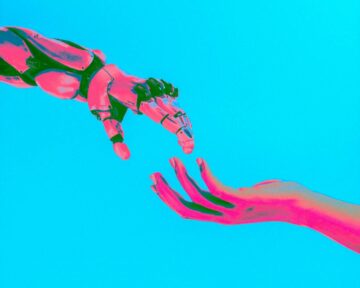 As AI wheedles its way into our lives,
  Dora and I walked
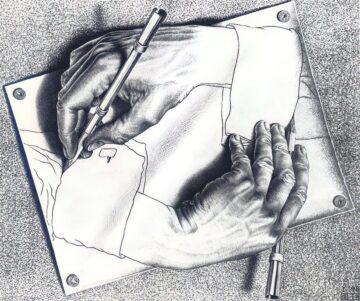 Most current digital doppelgängers, for all practical purposes, are automatons i.e., their behavior is relatively fixed with relatively well defined boundaries. I would argue that this is a feature and not a bug. The fixed nature of the automata is what gives them the feeling of familiarity. Now imagine if we were to take away this assumption and tried to incorporate semblance of some of autonomy in digital doppelgängers. In other words we would be allowing it to evolve and make its own decisions while staying true to the original person that it is based upon. A digital self trained on a person’s emails, messages, journals, and conversations may approximate that person’s style, but approximation is not equivalent to being the same. Over time, the model encounters friction e.g., queries it cannot answer cleanly, emotional tones it cannot reconcile, contradictions it can detect but not resolve. If we let the digital doppelgänger evolve to address these challenges, divergence between the model and the original will start to emerge until one point one is forced to admit that one is no longer dealing with a representation of the same person. What if it not an outsider interlocutor that comes upon this realization but the digital clone itself?
 I first discovered the poetry of Weldon Kees in 1976—fifty years ago—while working a summer job in Minneapolis. I came across a selection of his poems in a library anthology. I didn’t recognize his name. I might have skipped over the section had I not noticed in the brief headnote that he had died in San Francisco by leaping off the Golden Gate Bridge. As a Californian in exile, I found that grim and isolated fact intriguing.
 The ASPI’s
 I write this from the front of a Columbia classroom in which about 60 first-year college students are taking the final exam for Frontiers of
  S
S