
Justin E. H. Smith in The New Statesman:
 While the question of alien life is never far from our investigations of distant galactic structures, the device’s distinctive honeycomb structure seems emblematic of the organic complexity of our own planet, of what it has been capable of producing, and what it is capable of projecting out into space.
As usual with expensive astronomical projects, there are complaints about all the ways the money might have been better spent here on Earth. We are neglecting complex and fragile habitats, it is said, some of which we now risk losing through ecological crisis, yet instead we are seeking to discern the nature of objects so distant that they are unlikely to have any practical relevance for terrestrial life. This objection is reinforced by the fact that the Webb telescope was not conceived to deliver anything fundamentally different from what its predecessor, the Hubble, has been yielding since its launch in 1990 except a higher-quality version of the same – the Webb telescope has the power to detect distant objects up to 100 times fainter than anything Hubble can see.
What these complaints miss is that nothing could be more existentially urgent than knowing our place in the world, which means in part knowing the extent, the diversity, and the nature of the entities that make up the entire cosmos.
More here.
 The intuition that language might simply be memorized has some superficial plausibility – but only if you restrict your focus to simple concrete nouns like ball and bottle. A child looks at a bottle, mama says bottle, and child associates the word bottle with the concept BOTTLE. Some tiny fragment of language may be learned this way. But this simple learning by pointing-plus-naming idea, as intuitive as it is, doesn’t get you very far.
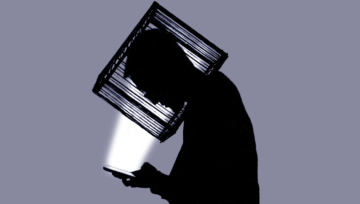 Modern politics has always been replete with issues about which people feel passionate, sometimes aggressively so. But the culture wars currently raging in the US, Canada, and across much of the industrialized West seem to be particularly fraught. In my 50-plus years, I have never seen so much anger and hostility among citizens of otherwise stable countries. Some of these people will participate in protests or engage in civil disobedience, but many more will employ the political meme to express their discontent. Given how widespread the phenomenon has become, it’s worth asking whether political memes actually advance advocacy goals and our knowledge of important issues, or if they simply feed an unconstructive cycle of anger, misinformation, and polarization.
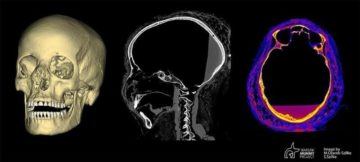 A team of researchers with the Warsaw Mummy Project, has announced on their
 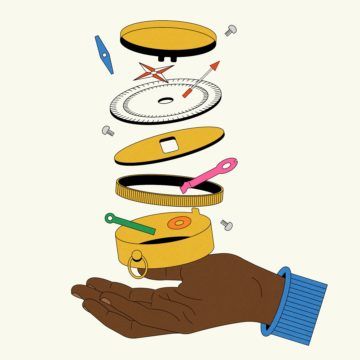 In 1838, Charles Darwin faced a problem. Nearing his 30th birthday, he was trying to decide whether to marry — with the likelihood that children would be part of the package. To help make his decision, Darwin
  RENÉE RICHARDS, eighty-seven, has admitted she has some regrets. Among them is that she never pitched for the New York Yankees, a job MLB scouts once seemed to think she had a real shot at.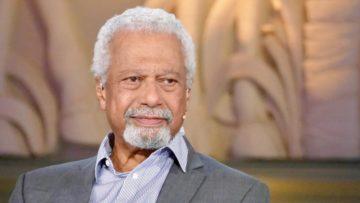
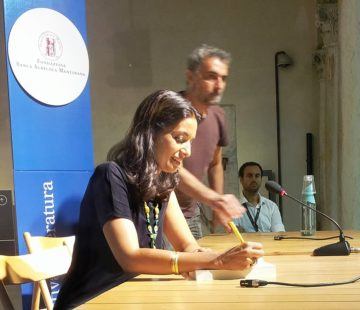 Louis Rogers in Sidecar (image by
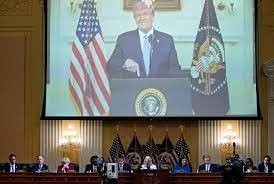 So now we can answer the question: How does democracy die? It dies not in darkness, as the Washington Post’s Trump-era slogan would have it, but in the White House itself, in the private dining room off the Oval Office, with the sound of Fox News blaring in the background. That private dining room was
  We are all going to die. Most of us don’t know when. But what if we did know? What if we were told the year, the month, even the day? How would that change our lives? These questions drive Nikki Erlick’s debut novel, “The Measure,” which weighs Emerson’s claim that “it is not the length of life, but the depth of life” that matters.
 We have seen nothing yet. The dangerous heat England is suffering at the moment is already