
Antonio Muñoz Molina at Hudson Review:
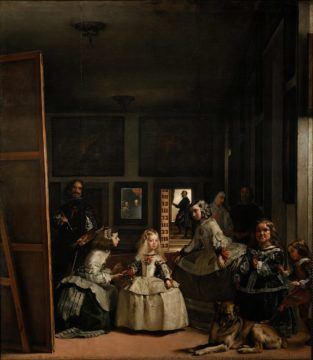 The foreground of the most looked-at painting in the museum is partly taken up by a painting seen from the back. Everything in Las Meninas seems overt and at the same time is deceptive. The mystery of what may or may not be painted on the canvas is counterpoised by the concrete evidence of its reverse, and along with it, by the irreducible material nature of the art of painting, emphasized by the scale of that enormous object made of stiff, rough cloth and wooden bars locked together firmly enough for the contraption to stand upright. Velázquez devotes as much attention to those carefully cut pieces of wood—their knots, their volume, the way the light shows them in relief, the rough texture of the cloth—as to the blond, dazzled hair of the infanta or to the butterfly, perhaps of silver filigree, that the maid María Agustina Sarmiento wears in her hair, as distinct as a piece of jewelry when seen from a distance, though it dissolves into small abstract patches of color when seen up close. Velázquez had “brushes . . . furnished with long handles,” says Palomino, “which he employed sometimes to paint from a greater distance and more boldly, so it all seemed meaningless from up close, and proved a miracle from afar.”
more here.
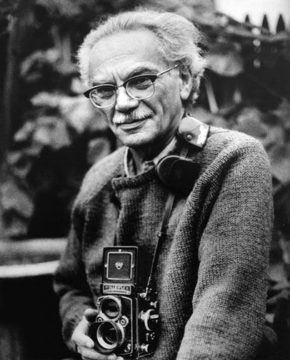 In the early nineties, I worked briefly as an assistant editor at Aperture, a job that involved considering unsolicited submissions of photographs. It was my good fortune that one such set of submissions was delivered to the office by the photographer himself, Milton Rogovin, and his wife, Anne, a writer and teacher. They lived in Buffalo, Anne’s home town, where Milton, a Jewish New York City native, born in 1909, was once a practicing optometrist and had long been photographing residents of his adoptive city’s relatively poor neighborhoods. The Rogovins brought a batch of his recent photos, from Buffalo’s Lower West Side, near where he had an optometry practice; some of his earlier work had been published by Aperture, and I hoped the same would happen with these newer images. It didn’t happen, but a spate of books from other publishers nonetheless followed, starting in 1994, showcasing an extraordinary body of work and with it an extraordinary couple—Milton wielded the camera, but the life project that his images embodied was a joint venture of his and Anne’s.
 It’s safe to say that effective altruism is no longer the small, eclectic club of philosophers, charity researchers, and do-gooders it was just a decade ago. It’s an idea, and group of people, with
  In the last week of December 1999, a group of researchers emailed their friends, colleagues, and various listservs to ask about their plans for New Year’s Eve. They recorded how big a party a person planned to attend, how much fun they expected to have, and how much time and money they would dedicate to their festivities. This survey was not, as it may seem, an endeavor to find the most raucous and decadent New Year’s Eve party—but an attempt to capture the fleeting nature of pleasure and happiness. Of the 475 people who responded in their field study,
 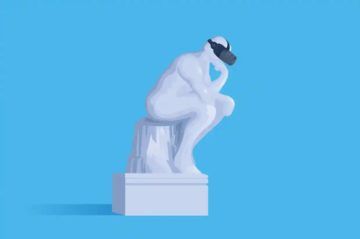 Elon Musk
 While there are references to Kierkegaard scattered through Gilles Louis René Deleuze’s work, these references have largely been overshadowed by the more pronounced (and less overtly ambivalent) influence of Nietzsche on Deleuze’s thought. For both, opposition to Hegel is a central theme in their thought, which for both leads to an attempt as Deleuze writes, ‘to escape the element of reflection’ (Deleuze 1994: 8). Similarly, both emphasise the importance of philosophical style, and move to indirect communication as a way of avoiding what they see as a tendency to conflate the representation of movement or becoming with becoming itself in traditional philosophical discourse. Nonetheless, there is an obvious difference between Deleuze and Kierkegaard, with Deleuze being a thoroughgoing atheist, and Kierkegaard a major theological thinker. In this book, Andrew Jampol-Petzinger focuses on the normative dimensions of both philosophers’ work, arguing that such a reading can diffuse some of the tensions between the theological positions of the two philosophers, as well as providing a corrective to some of the readings of Deleuze’s thought that emphasise the self-destructive aspect of the Deleuzian ethical project. Jampol-Petzinger addresses this through a focus on the account of the self that both philosophers develop, one that rejects a unified model of the self in favour of an account that draws out the consequences of Kant’s fracturing of the self in his paralogisms.
 The seventies and eighties were a high point in American dance, and consequently, dance on television. As video technologies advanced, one-off performances inaccessible to most could be seamlessly captured and broadcast to the masses. Like all art forms, dance at this time was also influenced aesthetically by this new medium, as cinematic techniques permeated the choreographic (and vice versa). Today, many of these dance films are archived on YouTube. My favorite is a recording of avant-garde choreographer
 Farewell,
 The alternative to war constrained by the laws of armed conflict, or
  Three weeks before Salman Toor’s “No Ordinary Love” opened at the Baltimore Museum of Art, on May 22nd, the twenty-six paintings in the exhibition were still in his Brooklyn studio, and the largest work, “Fag Puddle with Candle, Shoe and Flag,” rested against a pillar near the center of the room. Ninety-three inches high by ninety inches wide, it is the same size, Toor told me, as Anthony van Dyck’s “Rinaldo and Armida,” a Baroque painting that is in the museum’s permanent collection. Toor had been obsessed with this picture when he was an art student. He had painted “Fag Puddle” with the idea that it would be “in conversation” with “Rinaldo and Armida,” and, while his show is on view elsewhere at the museum, the two paintings will be facing each other on opposite walls of the same Old Master gallery.
 Female white-faced capuchin monkeys living in the tropical dry forests of northwestern Costa Rica may have figured out the secret to a longer life—having fellow females as friends. “As humans, we assume there is some benefit to social interactions, but it is really hard to measure the success of our behavioral strategies,” said UCLA anthropology professor and field primatologist Susan Perry. “Why do we invest so much in our relationships with others? Does it lead to a longer lifespan? Does it lead to more reproductive success? It requires a colossal effort to measure this in humans and other animals.”
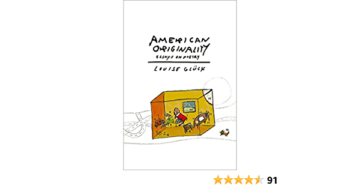 The role of poet-critics is a special one in any literature. Practitioners of the art, they also reveal its underpinnings, an activity that involves more than a mere thumbs-up-or-down review. Instead, by shaping whom and how we read, their influence can be considerable. Randall Jarrell famously dissected poets in regards to their best, or most often, worst tendencies. T.S. Eliot, on the other hand, took the high road, gazing calmly over the centuries while situating poets amid a cultural landscape over which he sought to reign. Usually, however, the stakes are not that high, for most often the role of the poet-critic is neither to delineate nor disseminate, but rather to illuminate. In such manner the main subject of the poet-critic, versus that of the literary critic or reviewer, is poetry itself. Reviewers tell us what a book of poems is “about”; the poet-critic reminds us of what poetry is and can be.