
Steven Petrow in The New York Times:
 Shortly after my parents died in 2017, I nearly lost custody of my dog, Zoe, in my divorce. When we were reunited, I remember telling her firmly, “You cannot die now,” even though she had just turned 15. Not long after, the vet told me that new lab work indicated kidney failure. I was quite glad then that Zoe couldn’t talk, at least not in the traditional sense. We had no painful discussions about quality-of-life issues or end-of-life concerns.
I approached her final chapter with intention and indulgence, which is to say I followed her lead. I fed her whatever and whenever she wanted. I let her decide whether we’d go for short walks or longer ones. Before I went to bed, I made sure Zoe had settled into hers. Even as I prepared to lose her, I found myself exulting in our days together. When she died, I consoled myself with the thought that she was never mine to begin with; I was lucky to have known her; we only have anyone we love for a short time.
As it turns out, it’s much easier to practice spiritual detachment from a Jack Russell terrier who is gone than from my younger sister, Julie, who is here, and called later that same year to tell me she had ovarian cancer. It was Stage 4, she said, as bad as it gets. Julie was 55, a lawyer and executive, a wife, and the mother of two daughters, 17 and 21.
More here.
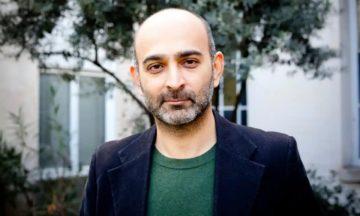 In 2017, I published my fourth novel,
  The omicron variant did indeed become
 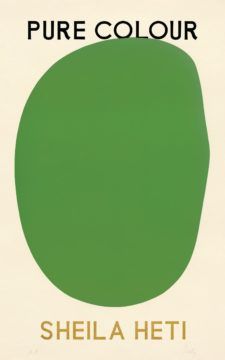 On the fourth page of Pure Colour, the fourth and most recent novel by the Canadian writer Sheila Heti, it is proposed that there are three kinds of beings on the face of the earth. They are each a different kind of “critic,” tasked with helping God to improve upon His “first draft” of the universe. There are birds who “consider the world as if from a distance” and are interested in beauty above all. There are fish who “critique from the middle” and are consumed by the “condition of the many.” And there are bears who “do not have a pragmatic way of thinking” and are “deeply consumed with their own.” The three main characters in the novel track with the three types: Mira, the art critic and main character, is a bird; Mira’s father, whose death takes up the middle part of the novel, is a bear; and Mira’s romantic interest and colleague at a school for art critics, Annie, is a fish.
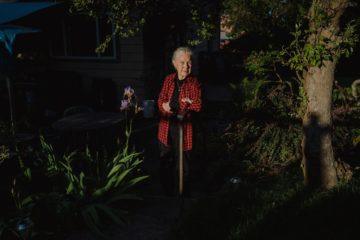 Americans aged sixty-two and older are the fastest-growing demographic of student borrowers. Of the forty-five million Americans who hold student debt, one in five are over fifty years old. Between 2004 and 2018, student-loan balances for borrowers over fifty increased by five hundred and twelve per cent. Perhaps because policymakers have considered student debt as the burden of upwardly mobile young people, inaction has seemed a reasonable response, as if time itself will solve the problem. But, in an era of declining wages and rising debt, Americans are not aging out of their student loans—they are aging into them.
 Last May, after the Isla Vista shooter’s manifesto revealed a deep misogyny, women went online to talk about the violent retaliation of men they had rejected, to describe the feeling of being intimidated or harassed. These personal experiences soon took on a sense of universality. And so #yesallwomen was born—yes all women have been victims of male violence in one form or another. I was bothered by the hashtag campaign. Not by the male response, which ranged from outraged and cynical to condescending, nor the way the media dove in because the campaign was useful fodder. I recoiled from the gendering of pain, the installation of victimhood into the definition of femininity—and from the way pain became a polemic.
 W
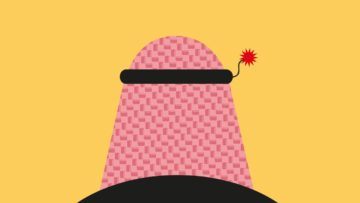
W Gregory Afinogenov in The Nation (illustration by Lily Qian):
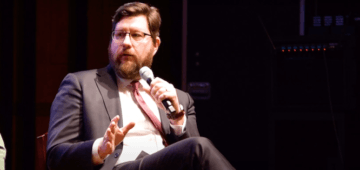 Patrick Iber interviews Matt Duss in Dissent:
 N
N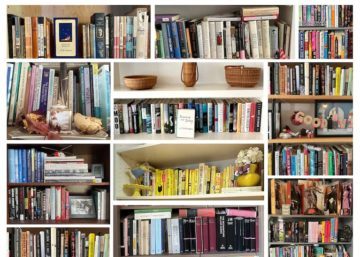 My bookshelves are a mess. It’s not just that I have too many books and too little space. I’m also simply disorganized. It wasn’t always so. Shelves I put together years ago, pre-children, remain generally intact: a full bookcase of poetry, alphabetized by author, and several jam-packed bookcases of fiction, also by authors’ last names. These shelves now serve primarily as decoration or reference or as a lending library for guests. But there’s more, much more: the tumbling pile on my desk — propping up the computer I am typing on — and the volumes stuffed frantically in the bookcase in my bedroom and stacked in towers on and around my nightstand. These are the books that are part of my daily life — for work, for pleasure, sometimes both. There is no rhyme or reason to how I arrange them, but as I read in
 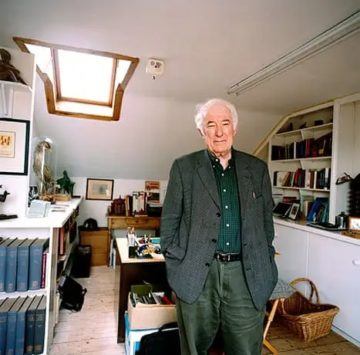 In the summer of 2012 Seamus Heaney wrote to me on some questions I had sent him about dictionaries and words and etymologies. Bits of what he had to say made it into a couple of talks I did around that time, but I recently rediscovered the original text, and thought it should see the light of day. So here’s a very lightly edited rendition of our exchange:
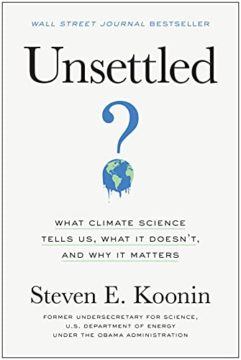 In a recent